

Competing with larger firms in Southern California often feels like an uphill battle when resources are limited. Staying competitive now demands more than relying on referrals or reputation alone. A well-defined marketing strategy empowers your firm to attract the right clients and build predictable growth, even against bigger budgets. This guide shares proven components and practical approaches that help small and mid-size firms create strategic marketing plans tailored for long-term success.
Table of Contents
- Defining A Marketing Strategy For Law Firms
- Types Of Law Firm Marketing Strategies
- How Digital Marketing Drives Law Firm Growth
- Risks Of Underinvesting In Marketing Efforts
- Calculating ROI And Long-Term Value
- Common Mistakes To Avoid In Legal Marketing
Key Takeaways
| Point | Details |
|---|---|
| Develop a Comprehensive Marketing Strategy | Law firms should create a dynamic marketing strategy that targets their ideal clients and emphasizes their unique value propositions. |
| Embrace Digital Marketing Channels | Utilizing digital platforms such as SEO, social media, and content marketing is essential for modern client acquisition and retention. |
| Measure Marketing ROI Effectively | Firms need to track comprehensive indicators of marketing performance to evaluate long-term value and adjust strategies accordingly. |
| Avoid Compliance Issues | Ensure all marketing efforts adhere to ethical standards to maintain trust and credibility with clients. |
Defining a Marketing Strategy for Law Firms
A marketing strategy represents a comprehensive roadmap for law firms seeking intentional client acquisition and sustainable growth. Traditionally, attorneys relied on referrals and word-of-mouth, but increased market competition now demands strategic, deliberate approaches to client development. Strategic planning for law firms has transformed from an optional consideration to a critical business imperative.
Defining a marketing strategy involves several essential components that go beyond simple advertising. The core elements include:
- Identifying your ideal client demographic
- Understanding your firm’s unique value proposition
- Analyzing competitive market positioning
- Establishing clear, measurable business development goals
- Creating targeted communication channels
Law firms must recognize that a marketing strategy is not a one-time document, but a dynamic framework requiring continuous refinement. Marketing strategy fundamentals emphasize the importance of adaptability and data-driven decision-making. This means regularly evaluating your approach, tracking client acquisition metrics, and adjusting tactics based on real-world performance.
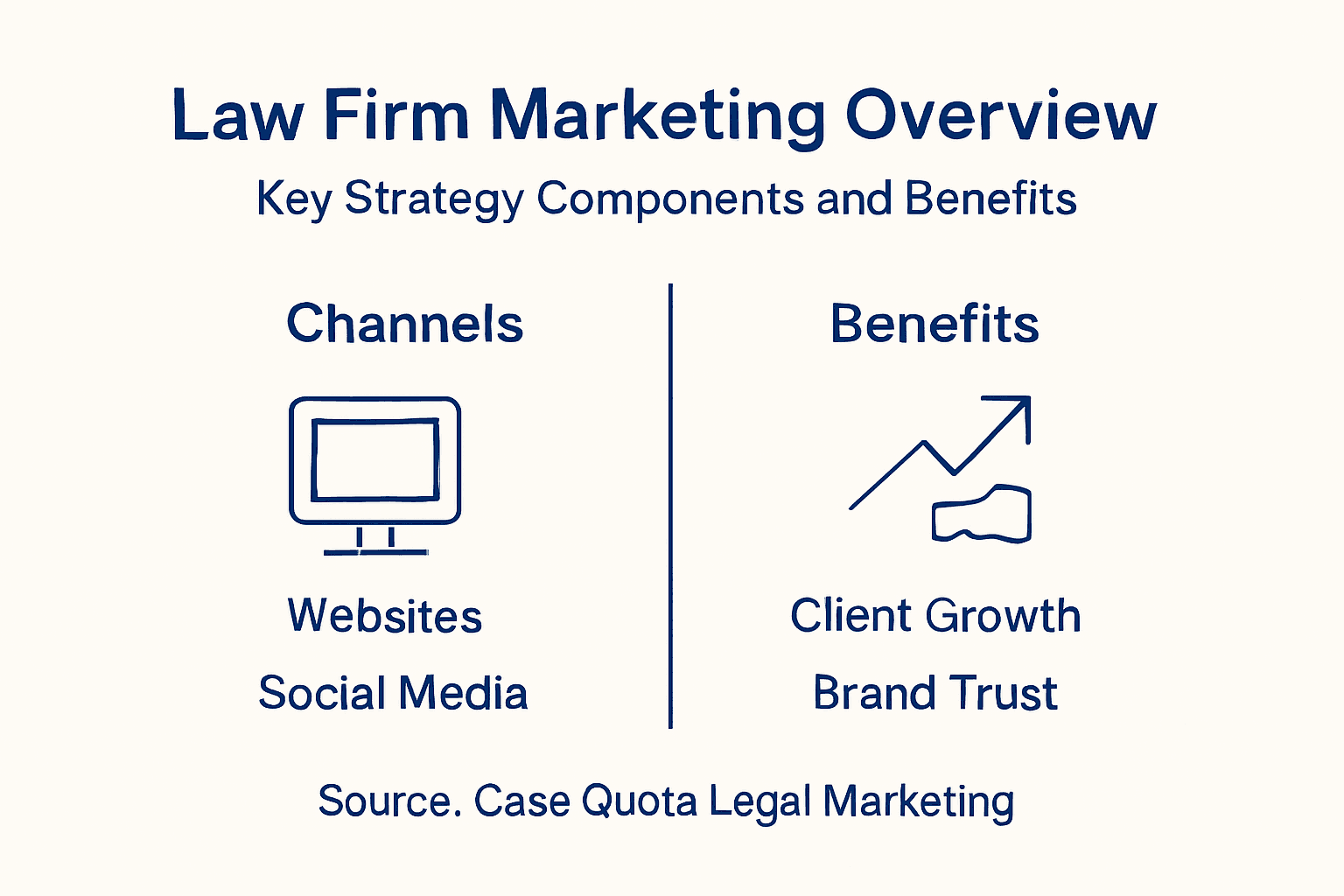
Successful law firm marketing strategies typically encompass multiple interconnected channels. Digital platforms like websites, targeted social media campaigns, content marketing, and strategic networking events can work synergistically to attract and retain clients. The goal is creating a cohesive narrative that communicates your firm’s expertise, reliability, and unique approach to solving legal challenges.
Pro tip: Develop a marketing strategy that reflects your firm’s authentic personality and specialization, rather than mimicking generic templates or competitors’ approaches.
Types of Law Firm Marketing Strategies
Law firms today must leverage diverse marketing strategies to effectively attract and retain clients in an increasingly competitive legal landscape. Strategic marketing approaches have evolved beyond traditional referral networks to include sophisticated digital and targeted outreach techniques.
The primary types of law firm marketing strategies include:
- Digital Marketing
- Search engine optimization (SEO)
- Content marketing
- Social media engagement
- Pay-per-click advertising
- Traditional Marketing
- Networking events
- Speaking engagements
- Print advertising
- Direct mail campaigns
- Reputation Management
- Client testimonial collection
- Online review management
- Thought leadership publication
Legal marketing strategies typically emphasize creating a comprehensive online presence that demonstrates expertise and builds trust. This involves developing informative websites, producing high-quality content that addresses potential clients’ legal questions, and maintaining active professional profiles across multiple digital platforms.
Successful law firms recognize that marketing is not a one-size-fits-all approach. Each strategy must be carefully tailored to the firm’s specific practice areas, target demographics, and unique value proposition. Firms must continuously analyze their marketing performance, tracking metrics like client acquisition cost, conversion rates, and return on investment to refine their approach.

Here’s a summary of how primary marketing strategy types differ in impact and approach:
| Strategy Type | Main Focus | Typical Benefit | Key Challenge |
|---|---|---|---|
| Digital Marketing | Online presence & outreach | Scalable client acquisition | Requires tech investment |
| Traditional Marketing | Offline engagement | Builds local trust | Limited reach and tracking |
| Reputation Management | Trust & authority building | Strong client loyalty | Highly dependent on reviews |
Pro tip: Create a flexible marketing strategy that can adapt quickly to changing market conditions and emerging digital trends.
How Digital Marketing Drives Law Firm Growth
Digital marketing has revolutionized how law firms attract, engage, and convert potential clients in an increasingly competitive legal marketplace. Digital transformation strategies now directly link online visibility to measurable revenue growth, enabling firms to target precisely the right clients with unprecedented accuracy.
Key components of digital marketing that drive law firm growth include:
- Search Engine Optimization (SEO)
- Improved website rankings
- Local search visibility
- Targeted keyword optimization
- Content Marketing
- Thought leadership articles
- Practice area specific blogs
- Educational video content
- Data-Driven Advertising
- Precision targeting
- Performance tracking
- Cost-effective client acquisition
Legal marketing technologies enable firms to implement sophisticated tracking mechanisms that transform digital interactions into actionable business intelligence. Modern digital strategies go beyond simple advertising, creating comprehensive ecosystems that nurture potential clients from initial awareness through final conversion.
Successful digital marketing requires a holistic approach that integrates multiple channels and technologies. Law firms must develop adaptive strategies that leverage data analytics, understand client behaviors, and create personalized engagement experiences that differentiate them from competitors. This means continuously refining digital approaches based on real-time performance metrics and emerging technological capabilities.
Pro tip: Invest in comprehensive digital marketing analytics to understand exactly how each online touchpoint contributes to client acquisition and firm growth.
Risks of Underinvesting in Marketing Efforts
Marketing underinvestment poses significant strategic risks for law firms competing in today’s complex legal marketplace. Marketing effectiveness measurement reveals that firms without robust marketing strategies often struggle to identify and capitalize on critical growth opportunities.
The primary risks of underinvesting in marketing include:
- Client Acquisition Challenges
- Reduced visibility in competitive markets
- Lower client conversion rates
- Limited brand recognition
- Revenue Impact
- Decreased potential client engagement
- Slower business growth
- Reduced market share
- Competitive Disadvantages
- Falling behind technologically advanced firms
- Missed digital marketing opportunities
- Weakened market positioning
Marketing industry challenges demonstrate that law firms frequently underestimate the long-term consequences of inadequate marketing investment. Short-term budget constraints can lead to missed opportunities for building sustainable client relationships and establishing thought leadership in specific practice areas.
Law firms must recognize that marketing is not an expense, but a critical investment in future growth. By allocating resources strategically, firms can develop comprehensive marketing approaches that generate measurable returns, build brand credibility, and create consistent client acquisition pipelines that drive sustainable business development.
Pro tip: Allocate at least 5-7% of your firm’s annual revenue to integrated marketing strategies that combine digital and traditional outreach methods.
Calculating ROI and Long-Term Value
Marketing ROI represents a critical metric for law firms seeking to understand the true impact of their strategic investments. Marketing effectiveness measurement requires a sophisticated approach that goes beyond simple revenue tracking, demanding comprehensive analysis of multiple performance indicators.
Key metrics for calculating marketing ROI include:
- Financial Performance Indicators
- Cost per lead acquisition
- Client lifetime value
- Revenue generated from marketing campaigns
- Engagement Metrics
- Website traffic conversion rates
- Social media interaction levels
- Content engagement statistics
- Long-Term Value Assessment
- Client retention rates
- Referral network expansion
- Brand reputation development
Law firm marketing performance demonstrates that successful ROI calculation involves tracking not just immediate financial returns, but understanding the complex ecosystem of client relationships and brand positioning. This means looking beyond short-term revenue to evaluate sustained growth potential and strategic market positioning.
Measuring long-term value requires law firms to develop sophisticated tracking mechanisms that capture nuanced performance indicators. By implementing comprehensive analytics frameworks, firms can transform marketing from a cost center to a strategic growth engine, providing leadership with actionable insights that drive intelligent business decisions.
Pro tip: Develop a multi-dimensional ROI tracking system that measures financial returns, client satisfaction, and strategic market positioning.
Compare important ROI metrics for law firm marketing effectiveness:
| Metric | What It Measures | Strategic Insight |
|---|---|---|
| Cost per Lead | Average spend per prospect | Reveals efficiency of campaigns |
| Client Lifetime Value | Revenue per client | Indicates quality and retention |
| Conversion Rate | Website to client ratio | Shows success of engagement efforts |
| Social Media Engagement | Interaction with content | Identifies brand visibility challenges |
Common Mistakes to Avoid in Legal Marketing
Legal marketing requires a strategic and nuanced approach that many law firms overlook. Legal marketing challenges reveal that firms frequently make critical errors that can undermine their entire marketing strategy and potentially damage their professional reputation.
Common mistakes in legal marketing include:
- Compliance and Ethical Violations
- Making unverifiable claims
- Violating advertising regulations
- Misleading potential clients
- Strategic Positioning Errors
- Inconsistent brand messaging
- Generic marketing approaches
- Failing to differentiate from competitors
- Data and Technology Mistakes
- Ignoring client data insights
- Poor digital privacy practices
- Inadequate performance tracking
Digital marketing ethical considerations demonstrate the critical importance of maintaining transparency and adhering to strict professional standards. Law firms must balance aggressive marketing techniques with strict ethical guidelines, ensuring that every communication maintains the highest levels of professional integrity.
Successful legal marketing requires a holistic approach that combines strategic planning, technological sophistication, and unwavering ethical standards. Firms must continuously evaluate their marketing strategies, remain adaptable to changing regulations, and prioritize client trust over short-term gains.
Pro tip: Develop a comprehensive marketing compliance checklist that reviews all marketing materials for ethical standards before publication.
Elevate Your Law Firm’s Growth with a Winning Marketing Strategy
Understanding the critical risks of underinvesting in marketing and the challenge of crafting a dynamic, measurable marketing strategy is the first step for small to mid-size law firms aiming to compete against larger rivals. Law firms often struggle with limited visibility, ineffective client acquisition, and a lack of tailored digital approaches that truly reflect their unique value proposition. The article highlights the need for adaptable, data-driven strategies that integrate SEO, targeted digital advertising, and reputation management to build trust and drive sustainable growth.
At Case Quota, we specialize in delivering customized digital marketing solutions designed exclusively for law firms in Southern California. With over 15 years of digital results experience and six years focused on legal marketing, we offer proven expertise in SEO-optimized web design, AI-powered pay-per-click campaigns, and strategic social media and video marketing. Our fractional CMO services provide high-level marketing leadership tailored to your firm’s goals, helping you convert online engagement into a steady stream of clients. Explore how our focused legal marketing strategies can transform your firm’s outreach on the Case Quota homepage and see real success stories in our client testimonials and case studies.
Ready to break free from generic marketing plans and achieve measurable growth? Start with a strategy grounded in legal marketing expertise and precision targeting. Visit Case Quota today to learn how we help law firms like yours gain a competitive edge in Southern California’s crowded marketplace.
Discover your firm’s full potential with tailored marketing solutions from Case Quota.
Ready to act now? Partner with us to build a marketing strategy that works for your unique legal practice.

Frequently Asked Questions
What are the main reasons law firms should invest in a marketing strategy?
Investing in a marketing strategy helps law firms improve client acquisition, enhance brand visibility, and maintain competitive advantage in a crowded marketplace.
How does digital marketing specifically benefit law firms?
Digital marketing allows law firms to target potential clients more precisely, optimize their online presence, and utilize data-driven methods for client engagement and conversion.
What metrics should law firms track to evaluate the effectiveness of their marketing strategy?
Law firms should track metrics such as client acquisition cost, conversion rates, social media engagement, and client lifetime value to measure the success of their marketing efforts.
What are the risks of not investing in a marketing strategy for law firms?
Not investing in marketing can lead to reduced visibility, lower client conversion rates, and ultimately, a negative impact on revenue and market share.
Recommended
- Law Firm Marketing Plan Template | Build Your Winning Strategy
- Digital Marketing Agency for Attorneys: Complete Guide to Growing Your Law Practice Online – Case Quota
- Complete Guide to Digital Marketing for Legal Firms: Strategies That Drive Results – Case Quota
- A Modern Law Firm Marketing Strategy That Wins Clients