

Most lawyers hear "digital ads" and immediately think of Google. And for good reason—capturing someone the moment they search for a "personal injury lawyer" is incredibly powerful. But that's only half the story.
What about the huge pool of potential clients who will need your services but aren't actively looking just yet? This is where Facebook Ads become a hidden gem for law firms.
Why Facebook Ads Are a Hidden Gem for Law Firms
Instead of fighting for clicks in the hyper-competitive arena of Google Search, Facebook lets you move "upstream" in the client's journey. You're not waiting for them to find you; you're proactively putting your firm in front of the right people at the right time.
Think of it this way: with Facebook, you can connect with individuals based on life events, behaviors, and interests that are strong indicators of a future legal need. You're building awareness and establishing trust, so when that need finally crystallizes, your firm is the first one that comes to mind.
Beyond Demographics: A Deeper Connection
The real magic of Facebook advertising is its ability to connect on a human level. You're not just another ad result on a search page. You're a helpful resource appearing in their social feed, a space they already associate with community and personal connection.
This approach is a game-changer for practice areas closely tied to major life events, things people often share, research, or signal on the platform.
- Family Law: Imagine targeting users who recently changed their relationship status to "Separated" or started following pages about co-parenting.
- Estate Planning: You can reach people in specific age brackets who are more likely to be thinking about wills, or those who have shown interest in retirement planning content.
- Personal Injury: It's possible to connect with users whose interests include motorcycles, construction work, or other activities that, unfortunately, carry a higher risk of injury.
By meeting potential clients where they already spend hours of their day, you can educate them, showcase your authority, and position your firm as the go-to resource long before they ever type a single query into Google. This proactive approach is a critical piece of any serious digital marketing plan for lawyers.
Ultimately, Google Ads capture existing demand, while Facebook Ads help you create it. Using both in tandem isn't just a good idea—it's a formidable growth strategy that allows modern law firms to build a predictable pipeline of cases and get a real edge on the competition.
Setting Up Your Ad Account for Success and Compliance
Before you even think about launching your first Facebook ad, you have to lay the groundwork. Skipping this part is like building a case on shaky evidence; it’s bound to fall apart, wasting your time, money, and putting your firm at risk.
Getting the technical foundation right from the very beginning is the most critical step. It ensures your campaigns run smoothly, you can actually track what's working, and you don’t get hit with a preventable account shutdown.
First things first: your firm needs a professional Facebook Business Page. This is your official presence, the identity tied to every ad you run. Make sure it’s completely filled out with your firm's name, address, phone number, and a link to your website. A professional headshot or a sharp firm logo and a high-quality cover photo are non-negotiable—they’re your first chance to build credibility.
Your Command Center: The Meta Business Manager
Once your page is live, the next move is creating a Meta Business Manager account. Think of it as the secure, centralized hub for all your firm’s advertising. It cleanly separates your personal Facebook profile from your professional work.
More importantly, it’s where you’ll manage ad accounts, pages, and permissions for anyone on your team or an outside marketing agency.
Setting it up is pretty straightforward, but it's an essential piece of the puzzle. Inside Business Manager, you'll create your ad account—this is where billing lives, where campaigns are built, and where you'll analyze performance. This structure gives you a professional framework that protects your digital assets and sets you up to scale.
The old ways of finding clients are being replaced by more direct, modern approaches, and platforms like Facebook are at the center of that shift.
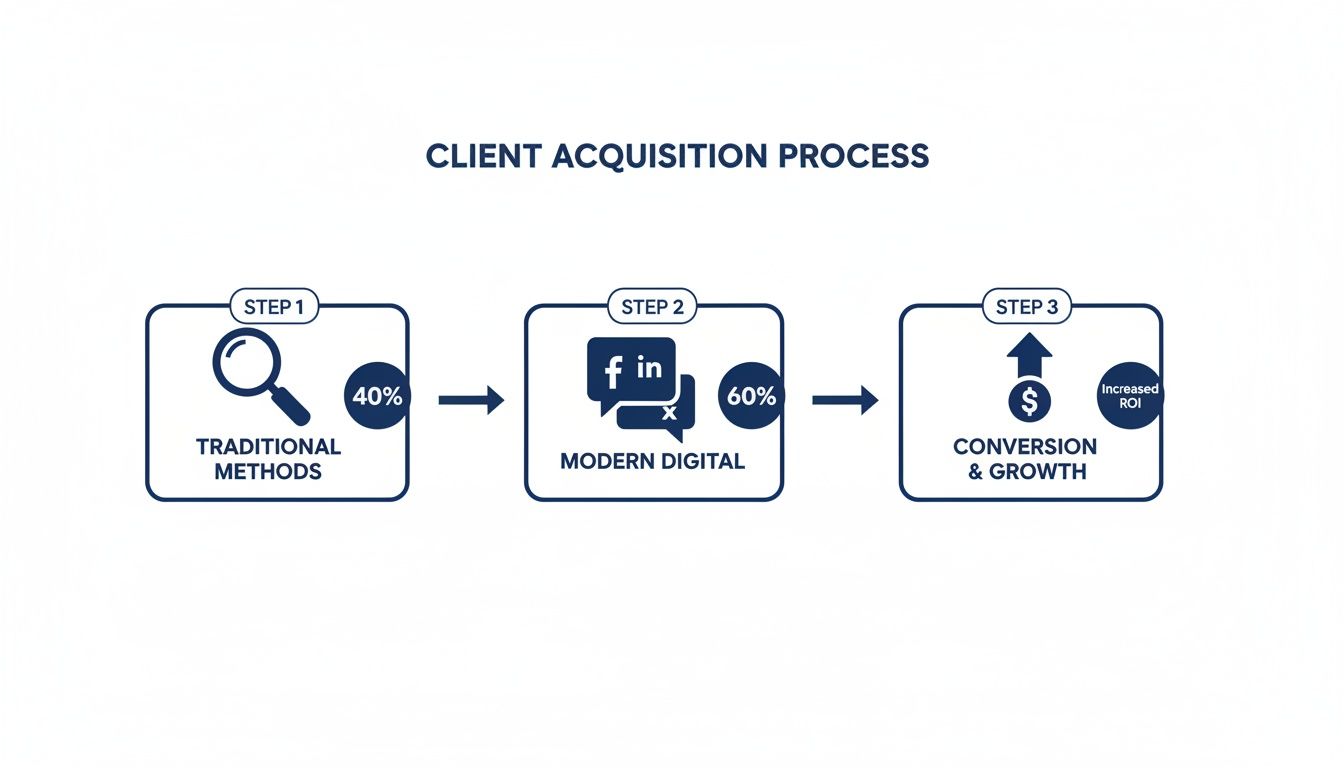
This visual just hammers home how digital platforms create a more streamlined path to connect with the exact people who need your help, moving you from waiting for the phone to ring to proactively engaging potential clients.
Navigating the Special Ad Category
Here’s a crucial detail that trips up a lot of law firms. Certain legal ads fall under Meta's Special Ad Category, which is designed to prevent discrimination in ads related to credit, employment, or housing.
If your firm handles practice areas like real estate law, employment law, or services touching on credit (like bankruptcy), you must declare this category when you create your campaign. No exceptions.
Choosing the Special Ad Category will limit some of your targeting options to comply with anti-discrimination policies. It might feel restrictive, but it’s mandatory. Failing to do this is a fast-track to rejected ads and a flagged account.
For many other practice areas—personal injury, family law, criminal defense—this category might not apply. But you still need to know the rules exist. Always review Meta's ad policies closely. Understanding ethical attorney advertising rules is just as important online as it is offline.
Installing Your Data Powerhouses: The Pixel and CAPI
To actually measure the success of your ads, you need to know what happens after someone clicks. This is where two key tools come into play: the Meta Pixel and the Conversions API (CAPI).
- The Meta Pixel: This is a small snippet of code you install on your law firm’s website. It’s a workhorse, tracking visitor activity like page views, contact form submissions, or clicks-to-call.
- The Conversions API (CAPI): CAPI works hand-in-hand with the Pixel. It sends data directly from your website's server to Facebook’s, creating a more reliable data connection that can’t be easily blocked by browser settings or ad blockers.
Using both is the modern standard for accurate tracking. It's what allows you to see which ads are driving real leads, calculate your true cost per lead, and build powerful retargeting audiences of people who’ve already shown interest by visiting your site.
Without this data infrastructure, you're just advertising in the dark. You have no way to prove your return on investment. The scale of Facebook is massive—with over 3 billion global users, the audience is unmatched. As more people search for legal help online, it’s no surprise that 28% of law firms now say Facebook Ads is their top paid social platform.
Pinpointing Your Ideal Client with Precision Targeting

Here's the single biggest difference between a law firm wasting thousands on Facebook and one generating a steady stream of quality cases: targeting.
Simply telling Facebook to show your ads to "men over 40 in Los Angeles" is a recipe for burning through your budget with little to show for it. The platform’s real power is its ability to find people based on their behaviors, interests, and life events—often before they even realize they need a lawyer.
This is where a client persona becomes your most valuable asset. It's a detailed profile of your ideal client that goes far beyond basic demographics. It forces you to get specific about who you want to attract, which then steers every targeting decision you make. Building this out is a cornerstone of any solid law firm marketing plan template and is what makes your message actually connect.
Building Audiences with Detailed Targeting
Meta’s Detailed Targeting is your primary tool for building these audiences from the ground up. It lets you include or exclude people based on a massive database of interests, behaviors, and demographics. This is where you get to be strategic.
Let's walk through a couple of real-world scenarios for different practice areas:
Estate Planning Attorney: You could start with an age demographic of 50-65+. Then, you layer on interests like "financial planning," "inheritance," or "retirement." To sharpen it even more, you could add behaviors like "frequent international travelers" or "small business owners"—both strong signals of someone with assets to protect.
Family Law Firm: Targeting for divorce cases requires a bit of finesse. You can't just target based on relationship status. Instead, think about the digital breadcrumbs people leave. You could target users who have shown interest in pages related to "co-parenting," "divorce support groups," or even "moving and relocation services," combined with a relevant age range.
The key is to think in terms of "proxy" interests—signals that correlate strongly with a need for your services. You're not just finding people; you're finding people exhibiting the behaviors of someone who will soon need a lawyer.
The Power of Lookalike Audiences
While Detailed Targeting is great for prospecting, one of the most powerful features for law firms is Lookalike Audiences. This tool takes a "source audience" you provide—like a client list—and finds new people on Facebook who share similar characteristics.
It’s essentially a way to clone your best clients.
Your source audience could be:
- A list of your past or current clients.
- People who have submitted a lead form on your website (tracked via your Meta Pixel).
- Users who have engaged with your Facebook Page or watched your videos.
For example, you could upload a list of your top 100 personal injury clients from the last five years. Facebook will then analyze their common traits and build a massive audience of new users who "look like" them. This is often the fastest path to high-quality leads because it’s based on your firm’s actual success data, not just educated guesses.
As a best practice, start with a 1% Lookalike. This creates the audience that most closely matches your source, giving you the highest probability of immediate success.
Creating Ads That Convert While Staying Ethically Sound

Crafting a compelling Facebook ad for a law firm is a delicate balancing act. You need copy and visuals that stop someone mid-scroll, but you also have to navigate a minefield of State Bar advertising rules. The real goal is to connect with a potential client's urgent problem without ever making a promise or guarantee you can't legally keep.
The good news? The most effective ads are almost always the ones that are fully compliant. They build trust by being direct, empathetic, and helpful—not by using sensationalism. You have to shift your mindset from "selling" legal services to "offering a solution" to a specific, painful problem your ideal client is facing right now.
This means your ad copy should focus on the client's situation and your firm's ability to guide them, not on promising a specific outcome. You can absolutely use emotional triggers, but it has to be done responsibly.
Crafting Compliant and Persuasive Ad Copy
Your ad copy is where the rubber meets the road. It has to be crystal clear, speak directly to a user's pain point, and steer clear of any ethical tripwires.
Words like "guarantee," "win," or "best" are immediate red flags. Instead, lean into phrases that convey experience and support, like "experienced guidance," "fighting for your rights," or "helping you navigate the process."
The following table provides some real-world examples of how to reframe your copy to be both compliant and much more effective.
Compliant vs. Non-Compliant Ad Copy Examples
| Practice Area | Non-Compliant Example (Avoid) | Compliant & Effective Example (Use) |
|---|---|---|
| Personal Injury | "Guaranteed win on your car accident case! Get the biggest settlement possible!" | "Injured in a car accident? Medical bills and lost wages can be overwhelming. We help accident victims understand their rights and pursue fair compensation. Schedule a free, no-obligation consultation." |
| Family Law | "We're the most aggressive divorce lawyers in town. We'll make sure you win custody." | "Facing a divorce can feel isolating. Our firm provides compassionate, experienced guidance to help you protect your family's future. Let's discuss your options in a confidential consultation." |
| Criminal Defense | "Avoid jail time! Our top-rated attorneys get charges dropped." | "Charged with a DUI? You have rights that need protection. Our team will build a strong defense strategy for your case. Contact us for a free case evaluation." |
| Bankruptcy | "Wipe out all your debt, guaranteed! The best bankruptcy firm to get you a fresh start." | "Overwhelmed by debt? You're not alone. We help individuals and families explore their options, including Chapter 7 and 13 bankruptcy, to regain financial control. Learn more with a free consultation." |
Notice how the effective examples work because they identify a problem, show empathy, and offer a clear, risk-free next step. It's helpful, not hype. This same principle applies across all practice areas. For more ideas on framing your message, our guide on https://casequota.com/social-media-marketing-for-lawyers/ offers a broader look.
Visuals That Build Trust, Not Hype
The images and videos you choose are just as critical as your words. They need to reflect the professionalism and trustworthiness of your firm.
Forget the generic stock photos of gavels or scales of justice. They're played out and completely ineffective.
Instead, focus on visuals that create a genuine human connection:
- Professional Headshots: Use high-quality, professional photos of you and your team. An approachable, friendly expression makes a potential client feel much more comfortable reaching out.
- Short Informative Videos: A simple 30-60 second video of an attorney explaining a common legal issue (like "3 Things to Do After a Minor Car Accident") can be incredibly powerful. It establishes your authority and builds a personal connection before they even click.
The whole point of your ad creative is to stop the scroll and build immediate credibility. A potential client is often in distress; your ad should be a beacon of calm, professional competence.
The All-Important Call to Action
Every single ad needs a clear and compelling Call to Action (CTA). This is the specific instruction telling the user exactly what to do next. Vague CTAs like "Learn More" have their place, but for lead generation, you need something more direct.
Try these action-oriented CTAs:
- "Get a Free Case Evaluation"
- "Download Our Free Divorce Guide"
- "Schedule a Confidential Consultation"
Your CTA must align perfectly with your ad's promise and send the user to a dedicated landing page built for one purpose: conversion. Sending traffic to your general homepage is a rookie mistake that tanks conversion rates. A focused landing page continues the conversation your ad started and makes it easy for the user to take that crucial next step.
Managing Campaigns to Maximize Your Return on Investment
Hitting "publish" on your ad is just the starting gun, not the finish line. The real, sustainable growth for your firm—the kind that builds a predictable pipeline of qualified cases—comes from what you do next. It’s all about diligent, intelligent campaign management.
Too many firms make the mistake of setting their ads on autopilot. That's a surefire way to burn through your marketing budget with very little to show for it.
Active management is where you turn raw data into smart decisions. This means setting a realistic budget, understanding how bidding works, and, most importantly, constantly testing to find out what truly connects with your ideal clients. We’re talking about making small, informed tweaks that compound over time to dramatically improve your results.
Budgets, Bidding, and Getting Started
Before you can optimize anything, you need a solid financial framework. Start with a budget you're comfortable experimenting with. Think of the first few weeks as an investment in learning, not necessarily immediate profit.
You’ll have two main options: a daily budget or a lifetime budget. A daily budget gives Meta a consistent spending cap each day, which is great for predictability. A lifetime budget gives the algorithm more freedom to spend on days it identifies better opportunities. For most law firms just starting out, I recommend a daily budget. It just gives you more control.
When it comes to bidding, you're telling Facebook how to spend your money to get you the results you want. For law firms, it usually boils down to two strategies:
- Lowest Cost (Highest Volume): This tells the algorithm to get you the most leads possible for your budget. It’s the perfect place to start because it gathers data quickly and establishes a baseline.
- Cost Per Result Goal: This is for when you have more control. You set a specific average cost you’re willing to pay for a lead. This helps manage your Cost Per Lead (CPL), but be careful—set the goal too low, and you might choke your campaign's reach.
My advice? Let the algorithm do the heavy lifting at first. Start with the "Lowest Cost" strategy to see what your natural CPL is. Once you have that data, you can switch to a "Cost Per Result Goal" to bring more precision to your spending.
The A/B Testing Framework for Lawyers
Guesswork has no place in a successful ad campaign. The only way to know for sure what works is to test everything systematically. We do this through A/B testing (or split testing), where you run two versions of an ad against each other to see which one performs better.
The golden rule is to change only one variable at a time. If you change the image and the headline in the same test, you'll never know which element was responsible for the change in performance.
Here’s a simple, methodical framework to follow:
- Test Your Audiences First: Start by pitting your two best audiences against each other. For example, you could run the exact same ad to a Lookalike Audience built from your client list and compare it against an interest-based audience you created from scratch. The winner becomes your new control group.
- Test Your Ad Creative: Now, using your winning audience, test two different images or videos. Keep the copy exactly the same. Does a professional headshot of you outperform a picture of your office building? Let the numbers decide.
- Test Your Ad Copy and Headline: With the winning audience and creative locked in, it's time to test the words. Try two different headlines. One might focus on the client's pain point ("Overwhelmed by Debt?") while the other focuses on the solution you provide ("Regain Financial Control").
By following this methodical process, you systematically eliminate the weak links and double down on what works. This is how you drive down your costs and improve lead quality over time. It's not magic; it's just good science.
Decoding Your Ads Manager Dashboard
Opening your Meta Ads Manager dashboard for the first time can be overwhelming. It's flooded with metrics, but only a handful truly matter for measuring the success of Facebook ads for lawyers. Don't get distracted by vanity metrics. Focus on the data that directly impacts your firm's bottom line.
These are the essential metrics you need to watch:
- Cost Per Lead (CPL): This is your north star. It tells you exactly how much you're paying for each person who fills out your consultation form.
- Conversion Rate (CVR): This is the percentage of people who clicked your ad and then actually became a lead. A high CVR is a great sign that your landing page is doing its job.
- Click-Through Rate (CTR): This shows the percentage of people who saw your ad and were compelled enough to click on it. A low CTR often means your ad creative or copy isn't strong enough to stop the scroll.
- Cost Per Click (CPC): This is simply how much you pay for each click. It's important, but it's secondary to CPL. After all, a click doesn't pay the bills—a new client does.
When managed well, these campaigns can be incredibly effective. Recent data shows the Attorneys and Legal Services sector has an average conversion rate of a stellar 10.53%, with the average cost-per-lead dropping to just $18.17. This proves that with smart targeting and testing, high-quality leads are well within reach.
Of course, tracking these numbers is just one piece of the puzzle. To truly understand the impact on your firm, it's crucial to learn how to measure social media ROI. This helps you connect your ad spend to actual signed cases and revenue. For a deeper dive, our guide on measuring advertising effectiveness provides a broader framework for evaluating all your marketing efforts.
Your Top Facebook Ads Questions, Answered
Jumping into Facebook ads can feel like navigating a minefield, especially when you're trying to generate leads while staying on the right side of your state bar's ethical rules. I get it. Let's clear up some of the most common questions we hear from law firms so you can build your campaigns with confidence.
Think of this as the practical advice you need to sidestep the usual mistakes and start making smarter, more profitable decisions for your firm.
How Much Should a Law Firm Actually Budget for Facebook Ads?
There's no magic number here, but if you're in a competitive market, a realistic starting budget is somewhere between $1,500 to $3,000 per month. This isn't an arbitrary figure; it's the level of investment needed to get enough data flowing so you can properly test your audiences, ad creative, and messaging.
Here’s a crucial mindset shift: treat the first 90 days as an R&D investment, not a profit center. The goal is to learn what works. Once you find a campaign that’s actually delivering a positive ROI, then you can scale the budget with confidence. Your final number will always circle back to your practice area, how fierce the competition is in your city, and how fast you want to grow.
A piece of advice I give every firm: It’s far better to dominate a small, specific geographic area with a solid budget than it is to spread a meager budget thin across an entire state. Focus your firepower for maximum impact.
Can I Target People Who Were Just in an Accident?
This is a big one, and the answer is a hard no. You absolutely cannot. Directly targeting someone based on a recent accident is a massive violation of Meta's advertising policies on sensitive personal data. Trying this is the fastest way I've ever seen to get an ad account shut down for good.
Instead, smart personal injury firms use what we call "proxy" targeting. This simply means you target users based on interests and behaviors that correlate with a higher chance of needing a PI lawyer, without ever crossing an ethical line.
Here’s how it’s done right:
- Interest-Based Audiences: Think about related interests. We've seen success targeting users who are interested in motorcycles, specific car brands, or even pages for chiropractors and physical therapy clinics.
- Geographic Layering: This is a clever one. You can target ads to small radiuses around major high-traffic intersections or hospital districts in your city.
- Strategic Retargeting: A completely compliant and powerful method is retargeting people who have already visited your website—specifically pages like your "Car Accident Information" blog post or your "What to Do After a Collision" guide.
This strategy gets you in front of a highly relevant audience without stomping all over user privacy or platform rules.
What's the Single Most Important Metric to Track?
While you'll see people talk about Click-Through Rate (CTR) and Cost Per Click (CPC), those are just diagnostic numbers. The single most important metric for any law firm is your Cost Per Qualified Lead (CPQL). Notice I didn't just say Cost Per Lead (CPL)—there's a huge difference.
A lead is just a name and an email from a form submission. A qualified lead is someone who actually meets your firm's intake criteria for a potential case. You absolutely must have a system to track which leads from your Facebook campaigns turn into actual consultations and, eventually, signed clients.
Focusing on your CPQL—and then your final Cost Per Acquisition (CPA) for a new case—is what proves your ad spend is actually making the firm money. It’s the difference between collecting contact info and actually growing your caseload.
Should I Send Ad Traffic to My Homepage or a Landing Page?
Always, always, always send ad traffic to a dedicated landing page. This isn't even a debate. It’s one of the most common and expensive mistakes firms make. Your homepage is built for a general audience. It has navigation, links to a dozen different pages, and multiple calls-to-action that just distract from the one thing you want the user to do.
A dedicated landing page, however, is a conversion machine. It's built for one purpose and one purpose only: to get that visitor from that specific ad to take action.
An effective landing page has to have:
- Message Match: The headline and copy on the page must perfectly mirror the promise you made in the ad they just clicked.
- A Singular Focus: There should be one clear call-to-action. Fill out the form. Call the number. That's it.
- Zero Distractions: Strip out the main website navigation menu and any other links that could tempt the visitor to wander off.
This focused experience will dramatically increase your conversion rates, which lowers your cost per lead and makes the whole campaign more profitable.
At Case Quota, we specialize in creating these types of targeted, high-performance marketing campaigns that drive real growth for law firms. If you're ready to move beyond guesswork and build a predictable client acquisition system, we can help. Learn more about our approach.