

Local SEO for law firms isn't just another marketing buzzword. It's a specific set of strategies laser-focused on making your practice impossible to miss when potential clients in your neighborhood are searching for legal help.
The goal is brutally simple: when someone in your city has a legal problem and turns to Google, your firm needs to be right there at the top of the results, especially on Google Maps. It's all about optimizing your firm's entire online footprint to pull in local clients who are ready to take action.
Why Local SEO Is A Non-Negotiable For Modern Law Firms
Imagine you opened a beautiful new office right in the heart of downtown, spent a fortune on the best furniture, and hired top-tier attorneys. Then, you forgot to put a sign on the door. No name, no logo, nothing. That’s exactly what running a law firm without a solid local SEO strategy is like in today's world.
Your potential clients aren't thumbing through the Yellow Pages anymore. They’re grabbing their phones and searching for an immediate solution to a very urgent problem.
When someone gets into a car wreck in Santa Monica, their first move is to search for a "personal injury lawyer near me." A family in Irvine looking to draft a will is going to search for an "estate planning attorney in Orange County." These aren't people just browsing; they have high intent and an immediate need for legal help.
Connecting with Clients at Their Moment of Need
Local SEO is the bridge that connects your firm to these people at the precise moment they need you most. This isn't just a "nice-to-have" marketing tactic—it's a core channel for acquiring new cases. If you're ignoring it, you are effectively invisible to the overwhelming majority of people in your community who are actively looking to hire a lawyer. This is doubly true for any practice that depends on a consistent stream of local clients to keep the lights on.
A strong local search presence ensures that when a potential client is in crisis—whether from an accident, an arrest, or a family dispute—your firm is the first one they find. It positions you as the accessible, authoritative choice in your community.
For a deeper dive into how search engine optimization can truly reshape your practice and bring in more cases, it's worth exploring a dedicated guide on SEO for lawyers.
The Local Advantage in a Competitive Field
Let's be honest, the legal field is incredibly competitive. But local SEO is the great equalizer. It allows smaller, highly specialized firms to punch way above their weight and outrank larger, less-focused competitors within a specific city or county.
By optimizing for local search, you stop trying to compete with every law firm in the state or country. Instead, you focus on one thing: completely dominating your own backyard. This targeted approach naturally delivers a much higher quality of leads because every person who finds you is already qualified by their location.
For law firms serious about sustainable growth, figuring out how to get more clients as a lawyer starts and ends with winning the local search battle.
The Three Pillars Of A Winning Local SEO Strategy
Getting local SEO right for your law firm isn't about one magic trick. It's a coordinated strategy, really, built on three core pillars. Think of it like putting together a compelling case for trial: you need a solid foundation, undeniable evidence, and credible witnesses to win. In the online world, these pillars work together to convince search engines like Google that your firm is the most relevant, trustworthy authority for potential clients searching for legal help right now.
Mastering these pillars is what separates the firms pulling in a steady stream of local cases from those that are practically invisible online. Each one sends a powerful signal to Google about who you are, where you practice, and exactly why a client should pick up the phone and call you.
This diagram shows how everything connects—your firm, Google, your clients, and even your competition.
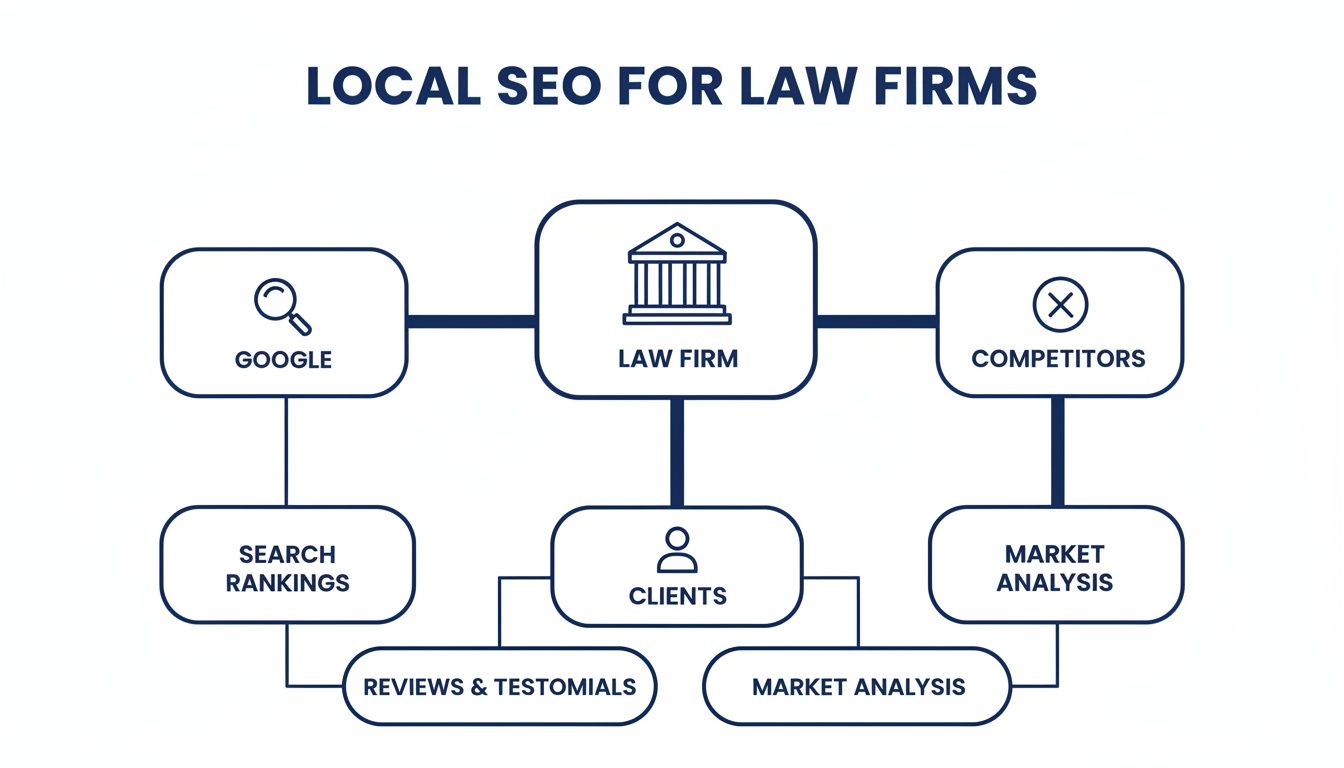
It’s a clear picture of a dynamic system. When you optimize your presence for Google, you directly impact your ability to attract the right clients and stay ahead of competing firms in your area.
Pillar 1: Your Google Business Profile
Your Google Business Profile (GBP) is, for all intents and purposes, the digital front door to your law firm. It's often the very first thing a potential client sees, showing up front and center in Google Maps and the local "map pack" results. An ignored or incomplete profile is like having a blank sign on your office door—it gives people zero reason to stop, and every reason to just walk on by.
A fully optimized profile, on the other hand, is a case-generating powerhouse. It has to be meticulously maintained with the correct name, address, and phone number (NAP), a clear list of services, and high-quality photos. For any firm in Southern California, this isn't optional; it's essential.
Here’s why it’s so critical:
- Drives Immediate Action: A well-managed profile makes it incredibly easy for prospects to take action. They can click to call or get directions straight from the search results.
- Builds Instant Trust: Positive client reviews are one of the most powerful trust signals in local search. They don't just influence potential clients; they directly influence your rankings.
- Owns Prime Visibility: Your GBP is the single biggest factor for ranking in the coveted Google Local Pack, which is where the vast majority of high-intent clients find their attorney.
To get this right, check out our guide on 10 proven Google Business Profile for attorneys tweaks and start owning your local search results.
Pillar 2: On-Page Website Optimization
If your GBP is the digital storefront, your website is the virtual office. This is where on-page SEO comes in. It’s all about optimizing your website's content and structure to clearly signal your specific practice areas and service locations to search engines. You have to speak Google's language.
This means strategically weaving location-specific keywords throughout your site. A personal injury firm shouldn't just target a broad term like "car accident lawyer." They need to get specific: "car accident lawyer in Santa Monica" or "Irvine brain injury attorney."
Effective on-page SEO ensures that when Google’s bots crawl your website, there is zero ambiguity about the legal services you offer and the specific communities you serve. This clarity is absolutely essential for ranking in local search.
Pillar 3: Local Link Building And Citations
The final pillar is all about building your firm's reputation across the web, much like you build a reputation in your local community through referrals, networking, and bar association events. Online, this is done through local citations and backlinks.
Citations are simply mentions of your firm's name, address, and phone number (NAP) on other relevant websites. Think of legal directories like Avvo, FindLaw, or local business listings. The key here is 100% consistency. Every single mention must be identical to avoid confusing Google.
Backlinks are links from other websites pointing back to yours. A link from the local Chamber of Commerce website or a feature in a Los Angeles legal journal acts as a powerful vote of confidence. It signals to Google that your firm is a respected local authority, and that’s a crucial piece of any successful strategy for local SEO services for law firms.
Key Local SEO Activities and Their Impact
To bring it all together, here’s a breakdown of some of the most important local SEO tasks and how they directly translate into more visibility and, ultimately, more clients for your firm.
| SEO Activity | Primary Goal | Direct Impact for Your Firm |
|---|---|---|
| GBP Optimization | Maximize visibility in Google Maps & Local Pack | More direct calls, direction requests, and website clicks from high-intent local searchers. |
| Local Keyword Research | Identify what potential clients in your city are actually searching for | Attracts highly qualified traffic by matching your content to real-world client needs. |
| On-Page SEO (City Pages) | Establish authority for specific services in specific geographic areas | Ranks your firm for searches like "divorce lawyer in Pasadena," capturing geographically-focused leads. |
| Review Management | Build social proof and trust signals | Increases client trust and conversion rates, while positively influencing Google rankings. |
| Citation Building | Ensure consistent NAP information across the web | Strengthens local search signals and makes it easier for Google and clients to verify your business. |
| Local Link Building | Earn "votes of confidence" from other reputable local websites | Boosts your website's authority and credibility, leading to higher rankings for competitive terms. |
| Technical SEO Audit | Ensure your website is fast, secure, and easily crawlable by search engines | Improves user experience, prevents ranking penalties, and ensures your content gets seen by Google. |
Each of these activities builds on the others. A strong GBP points to a well-optimized website, and both are lifted higher by a solid foundation of local citations and authoritative backlinks. It's a comprehensive approach that leaves no stone unturned in the pursuit of local market dominance.
Customizing SEO For Your Legal Practice Area
In the legal world, a one-size-fits-all approach to SEO is a surefire way to burn through your marketing budget. Trying to use the same strategy for a personal injury firm that you would for an estate planning practice is like using the same courtroom argument for a DUI case and a complex business merger—it’s just not going to work.
The client’s mindset, how urgently they need help, and what they type into Google are radically different from one legal discipline to another. That's why any effective local SEO service for law firms has to be meticulously customized. We have to get inside the head of a potential client, understand what they’re searching for, and know when they need you most. A generic strategy gets you generic traffic; a specialized strategy gets you qualified cases.

High-Urgency vs. High-Consideration Searches
The first step in building a winning strategy is figuring out the nature of your client's search. Are they in the middle of a crisis, or are they carefully doing their homework for a future decision?
- High-Urgency Practices (Personal Injury, Criminal Defense): These clients are often in distress. They need help, and they need it now. Their Google searches are direct, punchy, and almost always tied to a specific location.
- High-Consideration Practices (Estate Planning, Business Law): These clients are in a planning or research phase. They’re asking questions, comparing options, and taking their time. Their searches are more informational and involve a much longer decision-making process.
This one difference dictates everything—from the keywords we target to the kind of content we create for your website.
Personal Injury SEO: A Focus on Immediacy
For a personal injury firm, local SEO is all about capturing clients at their moment of need. After a car wreck, someone isn't casually browsing long-winded legal articles. They're on their phone, probably in pain, looking for immediate, local help.
The entire strategy has to mirror that urgency. We prioritize keywords like "car accident lawyer Santa Monica" or "slip and fall attorney near me." Your Google Business Profile becomes your most powerful tool, optimized for immediate calls and driving directions. The content on your site needs to be direct and reassuring, focusing on specific case types with a clear, can't-miss call-to-action for a free consultation. To learn more, check out our guide on marketing for personal injury law firms.
For urgent legal needs, the goal of local SEO is to be the fastest, most visible, and most reassuring answer to a frantic search. Speed and accessibility are everything.
Estate Planning SEO: An Educational Approach
Now, contrast that with an estate planning attorney in Los Angeles. Their potential client isn't panicking. They're thoughtfully weighing the future and have complex questions that need clear answers.
Here, the SEO strategy shifts completely from urgency to education. Instead of "lawyer near me," the focus is on answering long-form questions like "how to set up a living trust in California" or "what is the probate process in Orange County?" The goal is to build trust over time by publishing genuinely valuable blog posts, guides, and FAQs. While local signals still matter, the primary objective is to establish your firm as the go-to authority on the subject.
Tailoring Strategies for Other Practice Areas
This same core principle—aligning your SEO strategy with your client's intent—applies across every legal field.
- Family Law: This is often a hybrid. An emergency custody hearing is an urgent need, but a prenuptial agreement is a high-consideration decision. A smart SEO strategy has to serve both masters, targeting immediate-need keywords alongside research-based queries.
- Criminal Defense: Much like personal injury, this is a high-urgency field. SEO efforts need to be laser-focused on specific charges and locations, like "DUI lawyer Long Beach" or "felony defense attorney downtown LA," to connect with clients at the critical moment they need representation.
- Business Law: This is almost entirely a high-consideration practice. Clients aren't in a panic; they're searching for solutions to specific business problems like "forming an LLC in California" or "contract review attorney for small business." The strategy here revolves around creating content that positions your firm as an indispensable partner for their growth and protection.
Choosing The Right Local SEO Agency For Your Firm
Picking a partner to run your law firm's local SEO is one of the biggest marketing decisions you'll ever make. This isn't just about hiring a vendor; you're handing over the keys to a critical part of your client acquisition engine. The right agency can drive incredible growth, but the wrong one will burn through your budget and leave you playing catch-up with your competitors.
Here's the most important thing to remember: avoid generic, one-size-fits-all marketing agencies. Legal marketing has its own unique rulebook, from ethical guidelines to the specific mindset of someone searching for a lawyer. You need a specialist who gets the nuances of attracting legal clients, not just any local business.
Your Vetting Checklist: What to Look For
Before you even get on the phone with a potential partner, you need a firm set of criteria. Think of this as a pre-qualification round to filter out the generalists and focus only on agencies that are a real potential fit. A top-tier agency offering local SEO services for law firms should easily clear every one of these hurdles.
Use this checklist to size up every potential agency:
- Proven Legal Niche Expertise: Is their portfolio full of other law firms? Even better, do they have experience in your practice areas? A generalist simply won't grasp the different search intent between someone needing a criminal defense lawyer versus an estate planning attorney.
- Transparent and Actionable Reporting: Ask to see sample reports. If all they show you are vanity metrics like "impressions," walk away. You want to see reports focused on what actually matters: Google Business Profile calls, local organic traffic, and qualified leads.
- A Deep Understanding of Legal Ethics: Your marketing has to play by the state bar's advertising rules. A solid legal SEO agency knows these regulations inside and out and builds compliance into every strategy they deploy.
- Case Studies with Tangible Results: They have to prove they can get the job done. Demand case studies that show how they helped a firm like yours climb the local rankings, increase their call volume, and generate a real return on investment.
Sharp Interview Questions To Ask Potential Vendors
Once you’ve got a shortlist, it's time to dig in with some pointed questions. The goal here is to push past the sales pitch and get a feel for their actual process and philosophy. Generic answers are a huge red flag—you're looking for specific, confident responses that scream "expert."
Here are the questions that will separate the pros from the pretenders:
- How do you measure success beyond just rankings? A great answer will pivot immediately to business metrics: phone calls, form fills, and, most importantly, signed cases. If they get stuck talking about being "#1 on Google," they're missing the point.
- Can you show me a case study from a firm in a similar practice area and geographic market? This is non-negotiable. An agency that got results for a PI firm in rural Montana might have no idea how to approach the hyper-competitive Los Angeles market for an estate planning attorney.
- What is your approach to local link building and citation management? Listen for a focus on quality, not quantity. They should be talking about earning links from relevant local organizations and legal directories, not just blasting your firm's name out to thousands of low-quality sites.
- How will you customize your strategy for our firm and our specific local market? A top agency will talk about a deep competitive analysis, understanding your ideal client, and building a strategy from the ground up—not just plugging you into a cookie-cutter template.
- What level of communication and reporting can we expect? They need to have a clear, proactive plan for reports and meetings. You're looking for a partner, not someone you have to constantly chase down for updates.
Choosing an agency is like hiring a new associate. You need someone with the right experience, a proven track record, and a strategy that aligns with your firm’s goals. Don’t settle for less.
By following this structured approach—a firm checklist followed by sharp, insightful questions—you can cut through the noise and vague promises. This process puts you in control, helping you find a true specialist who not only understands local SEO but understands how to make it a growth engine for a modern law firm. For more insights to guide your search, take a look at this guide on the best attorney SEO practices.
Understanding SEO Pricing Models And Realistic Timelines
So, let's talk about the two questions that are always top of mind: "How much does this cost?" and "When will I see results?" When it comes to local SEO for your law firm, it's critical to see this as a long-term investment in client acquisition, not just another line item on an expense report.
Think of it this way: SEO isn't like a pay-per-click ad that vanishes the second your budget runs out. It's about building a digital asset for your firm. Every piece of content, every local directory listing, and every positive review adds to your firm's authority, creating a durable foundation that pays dividends for years to come.
Common SEO Pricing Models For Law Firms
Most agencies that specialize in working with lawyers, including us at Case Quota, structure engagements to match the long-haul nature of SEO. While you might find someone to do a one-off project, it’s rarely the right approach for a comprehensive local strategy.
You'll almost always run into two main models:
- Monthly Retainers: This is the industry standard, and for good reason. You pay a fixed monthly fee that covers a clear scope of ongoing work—think content creation, technical tune-ups, building local credibility, and detailed reporting. It allows your SEO partner to be proactive, adapting to Google's ever-changing rules and what your competitors are doing.
- Project-Based Fees: This model makes more sense for a specific, one-time task. Maybe you need a complete website overhaul for SEO or a deep-dive technical audit to find out what's broken. It's great for defined tasks, but it lacks the consistent momentum you need to actually win in a competitive market like Southern California.
For a law firm looking for a steady stream of new cases, the monthly retainer is almost always the way to go. It turns the relationship from a simple transaction into a true partnership focused on continuous, measurable growth.
Think of SEO like building a complex personal injury case. You don't just file one motion and expect a favorable verdict. You consistently gather evidence, depose witnesses, and fine-tune your arguments over months. A monthly retainer is what funds that persistent, strategic effort required to win in the court of Google search results.
Setting Realistic Timelines For SEO Results
One of the biggest myths about SEO is that you'll see a flood of new clients overnight. While we can often score some quick wins early on, the results that really matter—like a steady flow of qualified leads and a dominant spot in the local map pack—take time to earn. It's a process of building trust, both with search engines and the clients looking for you.
Here’s a realistic breakdown of what the journey usually looks like:
- Months 1-3: The Foundational Work. In this initial phase, we’re all about fixing what’s broken. We'll sort out any technical website issues, completely optimize your Google Business Profile, and build out the core practice area pages. You’ll likely see some early movement in rankings and maybe a bit more visibility for less competitive search terms.
- Months 4-6: Gaining Real Momentum. By now, the consistent effort in creating helpful content and building your local online presence really starts to kick in. You should be seeing a measurable increase in organic website traffic, more phone calls coming directly from your Google profile, and better rankings for the valuable keywords that bring in cases.
- Months 7-12+: Achieving Authority and ROI. This is where the magic happens and the return on your investment becomes undeniable. Your firm should be showing up consistently in the Google Local Pack for your most important practice areas. The lead flow from organic search becomes predictable and reliable, cementing SEO as one of your most powerful client acquisition channels.
Measuring The KPIs That Actually Matter To Your Firm
How do you know if your investment in local SEO is actually paying off? It's easy to get sidetracked by flashy "vanity metrics" like impressions or a general uptick in website traffic. But let's be blunt: those numbers don't pay the bills.
A successful campaign is measured by one thing and one thing only: its direct impact on your firm’s bottom line. The right local SEO services for law firms have to be laser-focused on the Key Performance Indicators (KPIs) that translate directly into new, signed cases.
Think of it like this: impressions are just people driving past your office building. It’s nice, but it doesn't mean anything. A phone call from a qualified local lead is someone walking through your front door, ready to talk business. That's the metric that matters.

Tracking Business-Oriented Outcomes
A high-value monthly report should be a clear, concise snapshot of your business growth, not some confusing data dump designed to overwhelm you. It needs to cut through the noise and show you exactly how SEO is driving client acquisition.
Here are the core metrics your firm should be watching like a hawk every single month:
- Google Local Pack Rankings: This is the most valuable real estate on the search results page. We track your firm's position in the top three map results for your most valuable, "money-making" keywords (e.g., "criminal defense attorney Santa Monica").
- Organic Traffic from Target Areas: It’s not about getting more traffic; it’s about getting the right traffic. We monitor growth in website visitors coming specifically from your key service areas, ensuring you're reaching a genuinely local audience.
- Inbound Phone Calls from Google: Your Google Business Profile is a lead-generation machine. Tracking the number of calls initiated directly from your profile is one of the purest measures of local SEO success you can find.
- Consultation Form Submissions: These aren't just website visitors; they are high-intent leads actively reaching out for help. A steady increase in form fills is a clear signal that your content is connecting and converting.
The ultimate goal of SEO is not just to rank higher but to generate profitable client actions. Your reporting should always connect SEO activities directly to tangible business results like calls and signed cases.
The Most Important KPIs: Cost Per Lead and Signed Case
At the end of the day, every marketing dollar has to prove its worth. That’s why the two most critical KPIs are your Cost Per Qualified Lead (CPQL) and your Cost Per Signed Case. By tracking these, you can precisely calculate the return on your SEO investment.
This is the level of detail that transforms SEO from a line-item expense into a predictable client acquisition channel. A crystal-clear understanding of these numbers is essential for measuring advertising effectiveness and making smart decisions about your firm’s growth. It allows you to see exactly how SEO is filling your case pipeline and driving long-term success.
Answering Your Top Questions About Local SEO For Lawyers
Even with a solid grasp of the strategy, most attorneys have a few lingering, practical questions before they're ready to invest. And that's smart. A local SEO plan is a serious commitment of your firm's time and money, and you absolutely deserve straight answers.
This is where we cut through the jargon and tackle the real-world questions we hear from law firms every single day. Let's get into it.
Can Any Agency Guarantee a Number One Ranking?
Let's be crystal clear on this one: no. Any agency, consultant, or so-called "guru" who guarantees you a #1 ranking on Google is waving a giant red flag.
Think about it. Google's algorithm is one of the most complex and closely guarded systems on the planet, with more than 200 known factors influencing rankings. It's constantly changing. No one outside of a handful of engineers at Google has any direct control over it.
A reputable partner will never promise you a specific spot. What they will guarantee is a commitment to a proven process. They'll promise transparency, clear reporting, and a relentless focus on the metrics that actually matter—more visibility in your city, more qualified traffic to your site, and most importantly, more calls coming in from your Google Business Profile.
How Important Are Client Reviews Really?
They're not just important; they're everything. Client reviews have become one of the single most powerful forces in local SEO for lawyers, influencing both Google and your potential clients.
A steady stream of recent, positive reviews sends a powerful signal to Google that your firm is active, trusted by the community, and delivering great service. This has a direct and significant impact on your visibility in the coveted Local Pack.
But beyond the algorithm, reviews provide the social proof that sways a decision. When someone is in a vulnerable position and needs legal help, reading about the positive outcomes of your past clients is often the final nudge they need to pick up the phone and call you instead of the firm one spot below you.
Does Local SEO Replace Other Marketing Efforts?
Not at all. Local SEO doesn't replace your other marketing; it acts as a force multiplier that makes everything else work better. Think of it as the foundation upon which your entire client acquisition strategy is built.
For instance, a dominant local SEO presence can dramatically improve the ROI of your Google Ads campaigns by boosting your local authority and Quality Score.
It also works hand-in-glove with your firm's reputation and referral network. When a potential client gets a referral from a friend or colleague, what's their first move? They Google you. A professional, highly visible online presence with dozens of glowing reviews instantly validates that referral and turns a warm lead into a signed retainer.
At Case Quota, we specialize in building these foundational strategies that turn local search into your most reliable source of new clients. To see how we can customize a plan for your firm, visit us at https://casequota.com.