

Marketing for a family law firm is a world away from selling a product or a service. You’re not trying to catch a casual browser’s eye; you’re connecting with people who are often facing the most difficult, emotionally draining moments of their lives.
This isn't about aggressive sales pitches. It’s about building a bridge of empathy, trust, and authority for individuals looking for guidance on divorce, child custody, adoption, and other deeply personal legal matters. A truly effective strategy understands this and weaves together local search visibility, compassionate content, and carefully targeted advertising to be there the moment someone needs help.
Winning in the Modern Family Law Landscape

The standard marketing playbook just doesn't apply here. Your prospective clients aren't casually shopping around. They’re up late, worried about their kids, their home, and their future. They’re looking for a lifeline, not a flashy ad.
This reality means your entire approach has to be built on a foundation of genuine empathy. The journey to finding a family lawyer almost always starts with a quiet, private search on Google. What they're looking for aren't clever slogans, but clear signals that you understand what they're going through and have the expertise to help.
The Client's Emotional Journey Online
Picture it: a parent searching for a "child custody lawyer near me" at 2 AM. They don’t need a gimmick; they need reassurance. From the very first click, your online presence has to communicate that you are a steady, knowledgeable guide who can navigate this storm with them.
This is why an integrated family law marketing strategy is so critical. It’s not a matter of choosing SEO over social media or PPC over content. It's about making all these channels work in concert to build a fortress of credibility and trust.
- Local SEO: Gets you on the map, literally, so you show up when someone in your community is desperately searching for help.
- Content Marketing: Provides immediate value by answering their most urgent questions with clear, jargon-free articles and guides.
- Client Reviews: Offers powerful social proof from real people who have been in their shoes and came out the other side with your help.
To stand out, your firm needs a multi-channel strategy where each component supports the others. The table below breaks down the core pillars every modern family law firm should be building.
Core Pillars of a Modern Family Law Marketing Strategy
| Marketing Channel | Primary Purpose | Key Success Metric |
|---|---|---|
| Local SEO | To appear in local map packs and organic search results for location-based queries (e.g., "divorce lawyer in San Diego"). | First-page rankings for key local search terms. |
| Content Marketing | To answer potential clients' questions, build authority, and demonstrate empathy through helpful blog posts, guides, and FAQs. | Organic traffic growth and time on page. |
| Pay-Per-Click (PPC) | To capture high-intent leads actively searching for a family lawyer right now. | Cost Per Qualified Lead (CPQL). |
| Client Reviews | To build social proof and trust, making it easier for potential clients to choose your firm over competitors. | Average star rating and number of new reviews. |
| Video Marketing | To create a personal connection by putting a human face to the firm and explaining complex topics in an accessible way. | Video views and engagement rate. |
Each of these pillars works together to create a consistent, reassuring presence for people at their most vulnerable.
Seizing a Multi-Billion Dollar Opportunity
The market for these services is massive. The global family law sector recently swelled to $43.8 billion, and with nearly 57,000 family lawyers in the U.S. alone, the competition is absolutely fierce. If your firm isn't embracing a modern digital strategy, you're not just falling behind—you're becoming invisible.
Creating specialized content on niche topics like gray divorces or the rights of unmarried parents is no longer a "nice-to-have." It’s essential for cutting through the noise and connecting with the clients you are best equipped to serve.
Your marketing must do more than just generate leads. It must begin the process of building a trusted relationship before a potential client ever picks up the phone.
Ultimately, a winning strategy recognizes that every click, every article, and every review is a touchpoint on an incredibly personal journey. When you align your marketing with your client's emotional and informational needs, you stop being just another law firm. You become a crucial ally. For a deeper dive into client acquisition, check out our complete guide on law firm lead generation.
Mastering Local SEO to Attract Nearby Clients
For family law attorneys, your best clients aren't across the country; they're down the street, searching for help in their own community. This makes local Search Engine Optimization (SEO) the single most powerful tool in your marketing arsenal. Think of it as your digital storefront, perfectly positioned on the busiest street corner of the internet for your town.
When someone in a moment of crisis types "divorce lawyer in Santa Monica" into Google, they aren't just browsing. They need an immediate solution. Local SEO is the engine that puts your firm front and center in that critical moment. The goal is simple: dominate the Google "Local Pack," that high-visibility map section at the top where clients make their first call.
Optimizing Your Google Business Profile
Your Google Business Profile (GBP) is the cornerstone of your entire local strategy. It’s a free, powerful profile that acts as a digital snapshot of your firm, feeding information directly into Google Search and Maps. Just having one isn't enough; it has to be meticulously optimized to scream "family law expert."
An incomplete profile is like a blank sign on your office door. It tells potential clients nothing. To attract the right cases, you need to fill it with specific, detailed information that answers their unspoken questions and builds instant trust.
- Select the Right Categories: This is non-negotiable. Choose "Family Law Attorney" as your primary category. Then, layer in secondary categories for everything you do: "Divorce Lawyer," "Child Custody Attorney," and "Adoption Attorney."
- Detail Your Services: Don't just list them. Use the services feature to add clear descriptions for every single practice area. This is how you tell Google exactly what you do, so it can match you with highly relevant searches.
- Upload High-Quality Photos: Show, don't just tell. Post professional photos of your office (inside and out), your team, and headshots of the attorneys. This simple step humanizes your firm and shows people who they'll be trusting with their future.
- Enable Messaging: Turn this feature on. It allows potential clients to ping you directly from your profile. In a world where 48% of clients pick a lawyer within three days of starting their search, a quick response can be the difference between a signed retainer and a lost lead.
Building Authority with Reviews and Citations
Beyond the setup, two other factors carry immense weight in local rankings: client reviews and local citations. Positive reviews are the modern-day word-of-mouth referral, giving hesitant clients the social proof they need to pick up the phone.
Make it a habit to ask for reviews as part of your client-offboarding process. At the same time, build up your local citations—mentions of your firm's name, address, and phone number (NAP) on other reputable websites. This constantly reinforces your geographic relevance to search engines.
A steady stream of five-star reviews from satisfied clients is the most compelling asset in family law marketing. It directly addresses a new client's biggest fear: making the wrong choice during a crisis.
Today’s market has leveled the playing field. In a sector with 56,771 businesses all fighting for a piece of a $13.1 billion industry, a powerful local SEO presence is the great equalizer. You can get more context on the market from IBISWorld's comprehensive report. For a deeper tactical dive, check out our guide on proven Google Business Profile tweaks for attorneys.
Creating Powerful Location-Specific Pages
Finally, your own website needs to seal the deal and confirm your local authority. The single best way to do this is by creating dedicated service pages for each city or neighborhood you serve. Don't just create one generic "Divorce Services" page. Build out pages like these:
- Divorce Lawyer in Santa Monica: A page packed with content specific to divorce proceedings in Santa Monica.
- Divorce Lawyer in Beverly Hills: Another page laser-focused on the unique challenges and nuances of divorce cases in Beverly Hills.
These can't be simple copy-and-paste jobs with the city name swapped out. You need to include genuinely local content—mention local courthouses, reference specific regional procedures, or showcase testimonials from clients in that exact area. This strategy signals to Google that you are a true authority in that location, massively boosting your chances of ranking for those high-value "near me" searches.
Creating Content That Builds Trust and Authority
When someone is facing a divorce or a custody battle, they aren't just looking for a lawyer. They're looking for a lifeline. Your content strategy is your chance to be that lifeline long before they ever pick up the phone. It's the digital equivalent of a compassionate, reassuring consultation that answers their most urgent questions in the middle of the night.
Good content does more than just get clicks; it shows you understand their crisis. It turns your website into an essential resource, building a foundation of trust that makes your firm the only one they want to call.
Building Pillars of Expertise
The strongest content strategies I've seen are built on what we call "pillar content." Think of a pillar page as the definitive, all-in-one guide to a huge topic in family law. It's the central hub, the main trunk of the tree from which all your more specific blog posts will branch out.
For a Southern California firm, a killer pillar page might be something like "The Complete Guide to the California Divorce Process." This isn't a short blog post. It's a massive, comprehensive resource that walks a person through everything from filing petitions and serving papers to dividing assets and getting that final judgment—all in simple, clear language.
The goal is to create a one-stop-shop for a major, stressful topic.
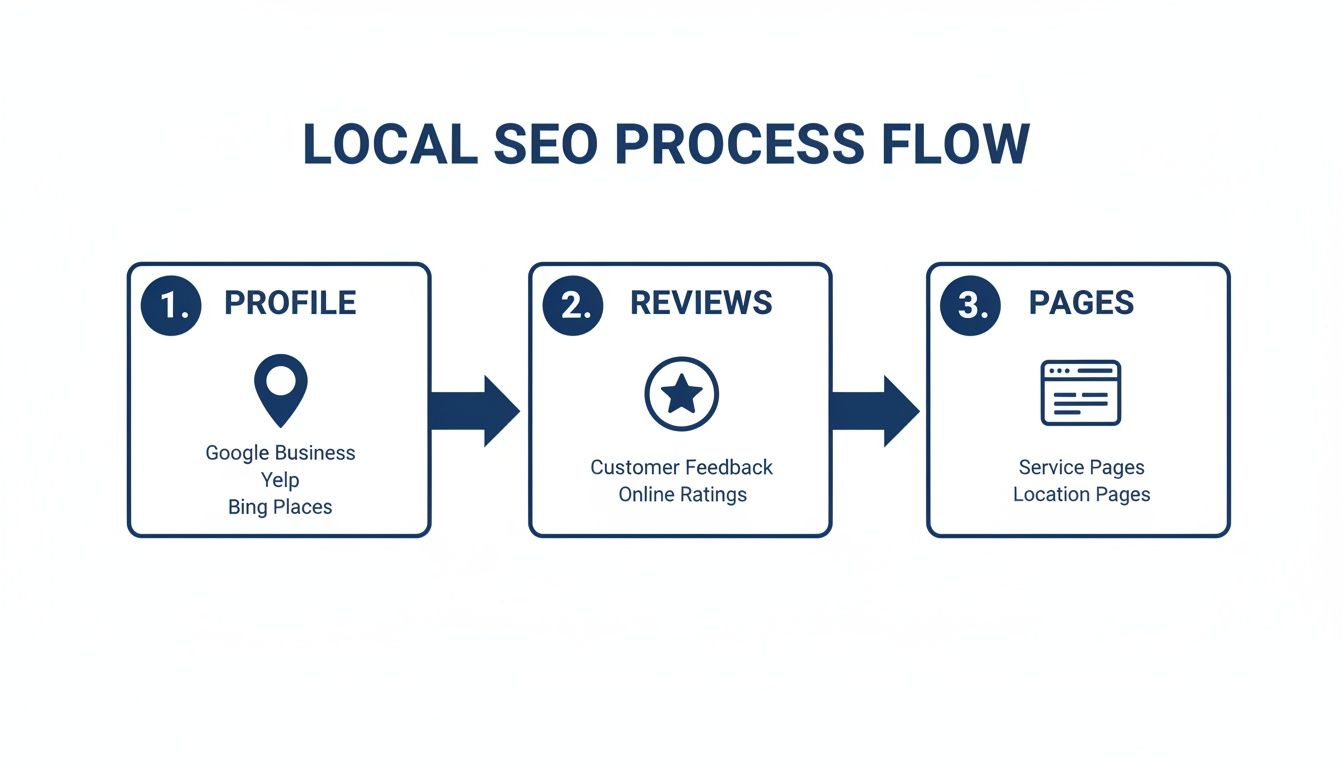
This kind of authoritative content works hand-in-hand with your other local SEO efforts. A strong Google Business Profile gets you reviews, which lends credibility and drives people to your pillar pages, reinforcing your expertise with both potential clients and search engines.
Answering Questions with Targeted Blog Posts
While pillar pages establish your broad authority, targeted blog posts are your snipers. They zero in on the very specific, high-anxiety questions people are typing into Google right now.
These shorter articles are your chance to connect with someone at their precise moment of need. They need to provide quick, scannable answers while still showing off your deep understanding of the law.
Here are a few examples of question-based posts that get real traction:
- "How Is Child Support Calculated in Los Angeles County?" This post should break down the state formula, explain what a judge actually looks at, and use hypothetical examples to make the math feel real.
- "What Are a Father's Custody Rights in California?" An article like this can cut through common myths, lay out the legal standards, and give a specific group of potential clients the critical information they're desperate for.
- "Is California a 50/50 State for Asset Division?" This tackles a huge misconception head-on, letting you explain community property laws in a way anyone can understand.
Crucially, every one of these posts should link back to your main pillar page on divorce or child custody. This creates a powerful web of helpful content that's not only great for clients but also signals to Google that your website is a true authority. If you're looking for more ideas, check out our in-depth guide on law firm content marketing.
The whole point of your content is to give away incredibly valuable information for free. That kind of generosity builds immense trust and makes your firm the obvious first call when someone is finally ready to move forward.
Writing with Compassion and Clarity
Let's be blunt: legalese is terrifying. For someone already drowning in stress, legal jargon is the last thing they need. The tone you use is every bit as important as the information you provide. Your writing has to be a beacon of clarity and compassion.
Always write with your client's emotional state in mind. Use short sentences. Short paragraphs. Break up the text with clear headings, bullet points, and bold text to make key information pop. Think of each article not as a legal brief, but as a real conversation with a real person who needs your help.
And the conversation doesn't have to stop on the blog. Using tools to create automated email marketing campaigns allows you to keep that connection going, delivering value right to their inbox and keeping your firm top-of-mind over time.
Using Paid Ads for Immediate Client Leads
While a rock-solid SEO strategy is your firm's foundation for long-term growth, pay-per-click (PPC) advertising is the accelerator. It’s what gets your name in front of potential clients the very second they start searching for help. Think immediate visibility and, more importantly, immediate phone calls.
I like to think of SEO as building a custom home, brick by brick. It’s a sturdy, valuable asset that will last for years. PPC, on the other hand, is like renting a massive billboard on the busiest freeway in town. You pay for the spot, and in return, you get instant exposure to everyone driving by who desperately needs a lawyer right now.
Structuring Campaigns Around Client Intent
The secret to great PPC isn't just throwing money at broad terms like "family lawyer." The real magic happens when you structure your campaigns around what a potential client is actually trying to accomplish—their intent. People searching for a family lawyer aren't just browsing; they have a distinct, often urgent, problem they need to solve.
Your ad campaigns should be a mirror of these problems. Instead of running one giant, generic campaign, break it down into smaller, laser-focused ad groups for each of your core services.
- Divorce & Separation: Target keywords that people in this headspace use, like "dissolving a marriage" or "legal separation asset division."
- Child Custody & Support: Zero in on the specific language parents use, such as "sole custody rights for fathers" or "child support calculator California."
- Prenuptial Agreements: Capture clients before the marriage with keywords like "prenup lawyer cost" and "how to protect assets before marriage."
- Mediation Services: Appeal to couples looking for a less contentious route with terms like "divorce mediation process" and "finding an amicable divorce lawyer."
When you segment your campaigns this way, you can write incredibly relevant ad copy that speaks directly to their pain point and send them to a dedicated page on your site that does the same. This precision doesn't just improve your ad performance; it dramatically increases the quality of the leads you get.
Finding Qualified Leads with Long-Tail Keywords
To make your ad budget work smarter, not harder, you have to get obsessed with long-tail keywords. These are longer, more specific search phrases that reveal exactly what a person is looking for. They might have a lower search volume, but the leads they produce are often far more qualified and cheaper to acquire.
Just look at the difference in intent:
- Broad Keyword: "divorce lawyer" (High competition, expensive, could be anyone from a student writing a paper to a serious client)
- Long-Tail Keyword: "emergency child custody lawyer in Orange County" (Low competition, less expensive, and an extremely high-intent search)
The person searching that second phrase has a critical, time-sensitive problem in a specific location. By bidding on these terms, you sidestep all the tire-kickers and connect directly with people who are ready to hire an attorney today. For a deeper dive, you might find our dedicated guide on Google Ads for lawyers useful.
Building Instant Trust with Local Service Ads
For family law firms, Google's Local Service Ads (LSAs) are an absolute game-changer. These ads show up at the very top of the search results—even above the standard PPC ads—and they come with the highly-coveted "Google Screened" badge. That little checkmark tells potential clients that Google has already done a background check on your firm, giving you an instant shot of credibility.
LSAs are brilliant because they run on a pay-per-lead model, not pay-per-click. You only open your wallet when a potential client actually calls or messages you through the ad. It’s a direct, measurable return on your investment.
When you're setting these up, think about incorporating click-to-call features right into your ads and landing pages to turn that interest into an immediate conversation. In a field with 56,970 family lawyers competing across the U.S., a staggering 72% of clients say they prefer to just pick up the phone. Combining LSAs with a direct line to your office creates a powerful, predictable system for generating a steady flow of high-quality, pre-vetted leads.
Humanizing Your Firm with Video and Social Media

In the emotionally charged world of family law, potential clients almost always make their final decision based on one critical factor: trust. They aren't just hiring a law firm; they’re hiring a person they believe will fight for them.
This is where video and social media become indispensable tools in your family law marketing toolkit. They move your practice beyond a faceless legal service and start creating genuine human connections.
Your website and ads can establish your expertise, but it's video that puts a face and a voice to that expertise. It's really the most effective way to bridge the digital divide, letting a potential client "meet" you before they ever set foot in your office. That initial connection can be the single thing that prompts them to make that first, incredibly difficult phone call.
Building Connections with Strategic Video Content
Video marketing for a law firm isn't about producing a Super Bowl commercial. It's about being helpful, approachable, and authentic. The goal is to demystify the legal process and show the real people behind your firm, building a sense of familiarity when clients are at their most stressed.
Here are a few practical video ideas that consistently deliver results:
- Attorney Bio Videos: A short, professionally produced video introducing each attorney is non-negotiable. This is where you share not just your credentials, but why you practice family law. This personal touch is how potential clients find an attorney they feel they can actually talk to.
- FAQ Videos: Create a series of short, 1-2 minute videos answering the most common questions you get during initial consultations. Topics like "What's the First Step in a Divorce?" or "How Does Mediation Work?" are perfect for YouTube, Instagram Reels, or your website's blog.
- "Meet the Team" Videos: Don't forget to showcase your paralegals, office managers, and other support staff. This highlights the entire team dedicated to a client's case and reinforces the fact that they'll be supported by a whole group of caring professionals.
By consistently sharing valuable video content, you position your firm as a trusted guide. For a deeper dive into creating these kinds of compelling assets, you might find our guide to attorney marketing videos useful.
Using Social Media to Build Community Trust
For family lawyers, social media isn't a place for aggressive selling. Think of it instead as a space to demonstrate your firm's values and its role in the community. The strategy here is about building brand recognition and top-of-mind awareness through helpful engagement, not direct lead generation.
Your social media presence should serve as a subtle, constant reminder that your firm is an active, caring part of the local community. This approach builds a foundation of trust that pays off in referrals and direct inquiries over time.
Instead of only posting about case wins, share content that reinforces your firm's human side. Highlight your team’s volunteer work at a local charity, sponsor a little league team and share the photos, or post updates about changes in local family court procedures. This kind of content shows you're more than just lawyers; you're invested members of the community you serve. It's a slow-burn approach to relationship building, but it's an essential—and often overlooked—part of a truly sophisticated family law marketing strategy.
Measuring What Matters in Your Marketing
A marketing strategy without measurement is just wishful thinking.
Pouring money and time into SEO, content, and ads without tracking the results is like flying a plane blind. You might be moving, but you have no idea if you’re headed in the right direction. This is where data steps in, giving you the clarity to ensure every dollar you spend is an actual investment in your firm's growth, not just an expense.
Effective family law marketing isn't about chasing vanity metrics like website visitors or social media likes. It’s about focusing on the numbers that directly translate into new clients and revenue. You need a clear framework to track what’s working and prove a positive return on your investment.
Identifying Your Key Performance Indicators
To get started, you have to nail down your Key Performance Indicators (KPIs). Think of these as the vital signs for your firm's marketing health—the specific, measurable data points that tell you if your efforts are actually paying off.
For a family law firm, the only KPIs that truly matter are those closest to getting a potential client on the phone or in your office. Here are the essentials to keep your eye on:
- Organic Keyword Rankings: Are you showing up on the first page of Google for terms like "child support lawyer in Santa Monica"? Tracking your rank for a handful of these high-value keywords shows if your SEO is gaining any real traction.
- Contact Form Conversion Rate: Of all the people who visit your "Contact Us" page, what percentage actually fill out the form? A low rate is a massive red flag that something on the page itself is broken or unconvincing.
- Cost Per Qualified Lead (CPQL): This is the bottom line for your ad campaigns. How much are you actually spending to get one genuinely qualified potential client on the phone? This is the ultimate measure of your ad campaign's efficiency.
- Google Business Profile Calls: How many direct phone calls are coming from people clicking the call button on your local map listing? This is a direct indicator of your Local SEO's real-world impact.
Tracking these numbers gives you a real-time pulse on your marketing performance, allowing you to make smart adjustments instead of just guessing.
To give you a clearer picture, here’s a breakdown of the most important metrics to watch across your marketing channels.
Essential KPIs for Family Law Marketing Success
| Marketing Channel | Primary KPI | Secondary KPI | What It Tells You |
|---|---|---|---|
| SEO & Content | New Qualified Leads from Organic | Organic Keyword Rankings | Is your content attracting the right people and converting them into potential cases? |
| Local SEO (GMB) | Phone Calls from GMB Listing | Clicks to Website/Directions | Are local searchers finding you and, more importantly, are they immediately taking action to call you? |
| PPC (Google Ads) | Cost Per Qualified Lead (CPQL) | Click-Through Rate (CTR) | How efficiently are your ad dollars turning into actual, viable leads for your firm? |
| Website Performance | Contact Form Conversion Rate | Bounce Rate | Is your website effectively turning visitors into contacts, or are they leaving without taking action? |
By focusing on these specific metrics, you move beyond guesswork and start making decisions based on what is actually driving new business for your firm.
Leveraging Free and Powerful Tracking Tools
You don't need an expensive suite of software to gather this crucial data. Honestly, two free tools from Google provide everything you need to start making smarter, data-driven decisions.
Your goal isn't just to collect data, but to turn that data into actionable insights. Knowing your conversion rate is good; knowing why it’s low and how to fix it is what drives growth.
Get these set up immediately to start tracking your performance:
- Google Analytics: This is the command center for your website. It tells you where your visitors are coming from, what pages they’re looking at, and how they’re (or aren't) interacting with your content.
- Google Search Console: This tool is all about your website's performance in Google search. It shows you which keywords are actually driving traffic and, critically, reveals technical issues that could be killing your rankings behind the scenes.
By regularly reviewing the data from these platforms, you’ll start to see clear patterns emerge. You’ll discover which blog posts are attracting the most potential clients or which ad campaigns are falling flat. This allows you to double down on what works, cut what doesn't, and continuously improve your marketing performance over time.
Common Questions We Hear About Family Law Marketing
Let's be honest, you got into law to help people navigate some of the toughest moments of their lives, not to become a digital marketing guru. It's completely normal to feel overwhelmed.
We get it. To cut through the noise, here are some straight-up answers to the questions we hear most often from family law attorneys just like you.
How Much Should My Firm Really Be Spending on Marketing?
There’s no magic formula, but a solid rule of thumb is to set aside 3-7% of your firm's gross revenue.
If you're a newer firm just trying to get your name out there, you'll probably lean toward the higher end of that range to build momentum. A more established practice with a steady stream of referrals might sit comfortably on the lower end.
The real key is to stop thinking of it as an expense and start seeing it as an investment. The whole point is to generate a positive return. Start with a budget you can manage, find out what actually brings qualified clients through the door, and then double down on what works.
If I Can Only Do One Thing, What Should It Be?
If you had to put all your chips on one number, it would be Local SEO. And the absolute starting point for that is your Google Business Profile.
Why? Because when a family is in crisis, they don't just search for "divorce lawyer"—they search for "divorce lawyer near me." That's where the battle is won or lost.
A well-tended profile puts your firm on the map, literally. It's the digital bedrock that makes everything else you do—from blogging to running ads—infinitely more powerful. Think about it: a recent study found that a staggering 80% of people said being easy to find online directly influenced which lawyer they chose.
A multi-channel strategy is always the end goal, but nothing else gives you the same visibility to high-intent, local clients as a dominant presence in local search. It's the modern equivalent of having the best office location in the entire city.
Is Social Media a Waste of Time for a Law Firm?
It can be, if you do it wrong. But used correctly, it’s an incredible tool. For a family lawyer, social media isn't about chasing likes or making a hard sell. It’s about building trust and showing the human side of your firm long before someone needs you.
Think of platforms like Facebook or LinkedIn as your digital community outreach. Use them to:
- Share genuinely helpful articles from your blog (without a sales pitch).
- Post about your team’s involvement in local charities or community events.
- Introduce your attorneys and paralegals with professional photos and short bios.
This isn’t about generating immediate leads. It's a long-term play that builds brand recognition and reinforces your firm as a caring, approachable local resource. When a referral comes up, people will already know and trust your name.
At Case Quota, we build marketing strategies that connect Southern California family law firms with the clients who need them the most. To see how we can help grow your practice, visit us at casequota.com.