

Marketing performance optimization in 2026: A revenue map for law firms
Marketing performance optimization in 2026 must move beyond clicks and rankings. Law firms need clear links between campaigns and revenue, and this guide shows how. Because partners demand measurable returns, we focus on KPIs that matter. Therefore you will learn to measure lead quality, conversions, ROMI, and CAC. In addition, we explain how AI tools and content repurposing tighten the revenue loop.
This introduction sets the stage. First, we define the ROI metrics that map marketing activity to firm revenue. Next, we show how to use AI for real-time campaign refinement and personalized content. Then, we cover content repurposing tactics that stretch budget and drive pipeline. Finally, we provide an action plan for law firms to test, measure, and scale efforts.
Current trends make this shift urgent. For example, web traffic patterns have declined and A/B tests take longer to reach significance. As a result, firms must use faster signals like lead quality and conversion velocity. Moreover, 2026 will bring wider AI adoption and new search behaviors, so SEO and content strategies must adapt. Meanwhile, law firms face pressure to prove ROMI and lower CAC while protecting compliance and client confidentiality.
Article overview
- What matters most: KPIs and how to calculate ROMI and CAC. We show simple formulas and interpretation.
- AI tools: How to use automation for attribution, creative testing, and personalization. We include practical vendor criteria.
- Content repurposing: Workflows to convert long-form counsel into email sequences, social clips, and paid ads.
- Measurement playbook: Dashboards, reporting cadence, and testing windows that fit legal workflows.
By the end you will have a data-driven, practical roadmap to turn marketing spend into measurable revenue growth. Thus your firm can allocate budget with confidence and drive higher ROI in 2026.
KPIs law firms must track for Marketing performance optimization in 2026
Law firms must measure outcomes, not activity. Therefore focus on KPIs that map campaigns directly to revenue. Below are the priority metrics and how to use them.
Core KPIs and why they matter
- Lead quality / MQLs: 39.4% of marketers say they monitor lead quality. High quality leads convert faster and cost less to close. As a result you reduce sales friction and boost ROMI.
- Conversion rates: 33.9% of marketers monitor conversions. Track conversion rates at each funnel stage. Then pinpoint drop off and optimize messaging accordingly.
- ROMI: 31.1% of marketers measure ROMI. ROMI proves the business case for campaigns. Calculate ROMI as (Revenue Generated – Marketing Expenses) / Marketing Expenses. Multiply by 100 to get a percentage. Use ROMI to compare channels and client segments.
- CAC: Customer acquisition cost affects profitability. Calculate CAC as Total marketing costs divided by the number of new customers acquired. Lower CAC by improving targeting and qualification.
- Lead volume: 29.2% of marketers track lead volume. Volume matters, however prioritize quality metrics over raw counts to avoid vanity metrics.
Reporting cadence and analysis
- Frequency: 44.2% of marketers run weekly analysis, 27.4% monthly, and 15.3% daily. Weekly cadence suits most law firms because it balances speed and signal reliability. However use daily checks for paid campaigns and rapid-response channels.
- Attribution: Map leads to revenue using multi-touch or weighted models. Then link closed matters to specific campaigns to inform budget allocation. This step helps map campaigns directly to revenue.
Practical tips
- Start with ROMI and CAC for every channel. Next layer on lead quality and conversion rates.
- Because search behavior is shifting, update SEO tactics and tracking. See Google Search documentation for best practices: Google Search Documentation.
- Finally, benchmark against industry data such as HubSpot’s State of Marketing report to set realistic targets: HubSpot’s State of Marketing.
Tracking these KPIs gives law firms a clear revenue map. Thus marketing becomes a measurable driver of firm growth.
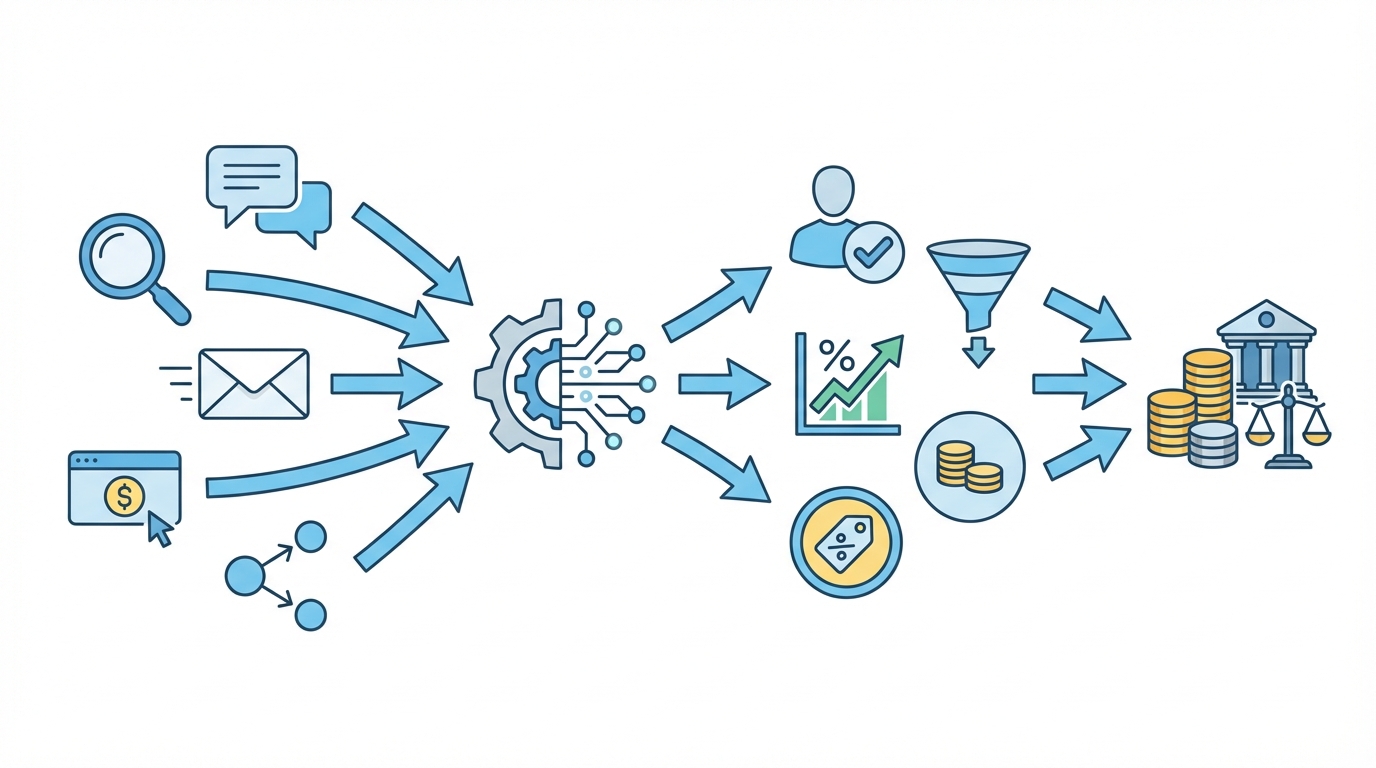
AI tools and adoption: the engine behind Marketing performance optimization in 2026
AI in marketing is no longer experimental. In fact, 94.6% of marketers use AI in some capacity. Moreover, 67.4% already use AI to optimize campaign performance. Therefore law firms must treat AI as a core capability, not an add-on.
Where AI moves the needle
- Real-time campaign refinement: AI analyzes signals instantly and adjusts bids, creative, and audiences. As a result you react faster than long A/B test cycles.
- Personalized content at scale: 48.6% of marketers use AI to create personalized content. Thus AI tailors messages by segment and stage.
- Attribution and lead scoring: Machine learning improves multi-touch attribution. Consequently you map leads to revenue with higher confidence.
- SEO for AI-driven search: 24% of marketers optimize for generative AI and 40.6% update SEO strategies. Therefore use AI to discover intent and optimize content structure.
Practical tools and vendors
Consider platforms with legal-grade controls and audit trails. For example HubSpot’s Marketing Hub provides automation, AI-assisted creative options, and attribution features. See HubSpot Marketing Hub: HubSpot Marketing Hub.
Because integrations matter, choose tools that connect CRM, billing, and matter management systems. Then you close the loop from lead to client and calculate ROMI and CAC accurately.
Adoption challenges and governance
- Data privacy and compliance are top concerns for law firms. Therefore establish strict access controls and logging.
- Integration complexity slows deployment. However phased rollouts reduce risk.
- Model quality and bias require human oversight. Thus pair AI insights with partner review.
Quick action steps for law firms
- Start with one use case such as lead scoring or creative optimization.
- Connect AI outputs to ROMI and CAC measurements.
- Monitor performance weekly and refine models.
AI adoption unlocks real-time campaign refinement and personalized content. As a result law firms can raise conversion rates, improve lead quality, and drive measurable revenue growth.
| Aspect | Traditional Methods | AI-Driven Methods | Benefits of AI |
|---|---|---|---|
| Testing and experimentation | A/B testing, manual hypothesis design, long time to statistical significance; nine weeks for some web tests | Multivariate optimization, continuous learning models, real-time campaign refinement | Faster insights, therefore quicker decisions; higher statistical power; improved ROMI and campaign ROI |
| Personalization and content | Manual segmentation, static email templates, one-off repurposing tasks | Automated content personalization, scalable content repurposing, generative content variants | Tailored messages at scale, as a result better lead quality; higher conversion rates; lower CAC |
| SEO and search | Manual keyword updates, periodic audits, reactive optimization | AI-based SEO for generative AI, intent discovery, automated content structure optimization | Faster adaptation to algorithm shifts; improved visibility for AI-driven search; sustained organic traffic gains |
| Attribution and measurement | Last touch models, spreadsheets, delayed reconciliation | Machine learning lead scoring, multi-touch attribution, real-time ROMI and CAC dashboards | More accurate mapping of campaigns to revenue; better budget allocation; clearer ROMI calculations |
| Speed and cadence | Weekly or monthly reporting cycles, slow creative iterations | Daily or real-time adjustments, adaptive bidding and creative testing | Capture short windows of opportunity; reduce CAC; increase conversion velocity |
| Resource requirements | High analyst hours, manual creative production | Automation, templates, AI-assisted creative workflows | Lower operational cost; scale content repurposing; free team time for strategy |
| Compliance and governance | Manual review workflows, conservative rollouts | Governed AI with audit trails, human in the loop controls | Maintain client confidentiality; reduce legal risk; deploy safely and at speed |
Conclusion
Marketing performance optimization in 2026 requires a clear revenue map. Focus on KPIs like lead quality, conversion rates, ROMI, and CAC. Use AI in marketing to enable real-time campaign refinement. Also repurpose content to stretch budget and increase pipeline velocity.
Adopting these tactics lets law firms link campaigns directly to revenue. Therefore partners see measurable returns and marketing gains credence. Because web traffic and testing windows have shifted, prioritize rapid signals over vanity metrics. As a result you improve conversion rates and reduce CAC.
Case Quota helps small and mid-sized firms apply Big Law strategies. They specialize in mapping legal marketing campaigns to revenue with data-driven playbooks. In addition they use AI tools, KPI frameworks, and content repurposing to drive ROMI. Visit Case Quota to learn how they support market dominance.
Start with one measurable use case and scale from there. For example, implement lead scoring, link it to ROMI, and repurpose winning content. Then monitor weekly and refine your models. With disciplined measurement and governed AI, law firms can convert marketing spend into predictable revenue growth.
In short, adopt KPIs, embrace AI-driven optimization, and systematize content repurposing. Thus you will turn marketing into a repeatable revenue engine for 2026 and beyond.
Frequently Asked Questions (FAQs)
What does marketing performance optimization in 2026 mean for law firms?
Marketing performance optimization in 2026 means linking every campaign to measurable revenue. Law firms must track lead quality, conversion rates, ROMI, and CAC. Because search behavior and testing windows have changed, firms need faster signals and governed AI. As a result marketing shifts from branding to predictable client acquisition. This approach helps partners evaluate spend and improves budget allocation.
Which KPIs should law firms prioritize and how do they measure them?
Prioritize lead quality, conversion rates, ROMI, CAC, and lead volume. In fact 39.4 percent of marketers monitor lead quality and 33.9 percent monitor conversions. ROMI equals Revenue Generated minus Marketing Expenses divided by Marketing Expenses. CAC equals Total marketing costs divided by the number of new customers acquired. Therefore calculate these metrics per channel and per matter type. Next use them to map campaigns directly to revenue.
How should law firms adopt AI and what challenges should they expect?
Start with high impact use cases like lead scoring and creative optimization. Keep in mind that 67.4 percent already use AI for campaign performance and 94.6 percent use AI in some capacity. Meanwhile 48.6 percent use AI for personalized content. Common challenges include data privacy, integration complexity, and model bias. Therefore implement governance, human review, and phased rollouts to reduce risk.
What are the benefits of content repurposing for legal marketing?
Repurposing stretches budget and extends reach. Because 35.1 percent of marketers repurpose content, firms can reuse long form counsel as email sequences, social clips, and paid creative. As a result you get more touch points with lower production cost. Also repurposing supports SEO and helps maintain consistent messaging across channels.
How can Case Quota help my firm implement these strategies?
Case Quota applies Big Law methods to small and mid sized firms. They build KPI frameworks, connect AI tools to CRMs, and run content repurposing workflows. In addition they focus on ROMI and CAC so partners see revenue impact. Learn more at Case Quota and begin with a single measurable use case.