

How to Start a Used Car Dealership: A Full-Funnel Marketing Playbook for Law Firms
The automotive market is booming, and demand for used cars remains strong because new vehicle prices keep rising. If you wonder how to start a used car dealership, this introduction will orient you. It highlights the business potential and explains why law firms need a full-funnel marketing strategy tailored to dealers.
Why this moment matters
Because consumers seek value, used cars sell fast. Therefore, entrepreneurs can capture market share with the right plan. Moreover, lenders still provide financing, and alternative funding options make startups feasible. As a result, the opportunity window is wide.
Benefits and potential of starting a dealership
Starting a used car dealership can deliver steady cash flow and strong margins. Additionally, dealerships allow multiple revenue streams. These include trade-ins, reconditioning services, warranties, and financing commissions. Furthermore, you can scale inventory through auctions, private sellers, and wholesale partners.
Why law firms should care
Law firms advising dealers can add value beyond compliance. For instance, firms can help with dealer license applications and sales tax permits. They can also draft compliant contracts and design advertising policies. As a result, legal counsel becomes a growth enabler, not just a risk manager.
The role of a full-funnel marketing strategy
A full-funnel marketing strategy aligns legal safety with scalable customer acquisition. First, build an SEO-friendly website that lists inventory and supports lead capture. Second, use social media and email to nurture buyers. Third, combine digital ads with local outreach to drive showroom visits. Finally, measure every touchpoint so legal teams can review claims and disclosures.
What you will get from this guide
This article provides practical steps and checklists for dealers and their legal partners. It covers licensing, sourcing, vehicle inspections, compliance, and marketing tactics. You will find guidance on choosing a location, handling financing, and creating a growth plan. Above all, the guide aims to make launching a dealership clearer and less risky.
Related keywords included in the body include used car dealership, dealer license, dealer financing, inventory sourcing, vehicle history reports, SEO, social media marketing, and compliance. These terms will help you find actionable sections quickly.
Startup Requirements at a Glance
Below is a concise table that compares the essential startup requirements for a used car dealership. It clarifies licenses, permits, funding, and inventory sourcing. Therefore, you can compare needs at a glance and plan next steps.
| Requirement | What it covers | Who issues or varies by | Typical documents required | Typical time and cost | Why it matters | Quick tips for law firms |
|---|---|---|---|---|---|---|
| Dealer license | State level authorization to sell vehicles retail | Typically the state DMV or motor vehicle agency; rules vary by state | Business plan, proof of location, lease or deed, sales tax ID, financial statements, surety bond or insurance | Time from two weeks to three months; fees from about fifty to one thousand dollars or more | Legal permission to operate and buy or sell titled vehicles; ensures compliance with title and consumer laws | Help assemble applications, verify bond and insurance, and draft compliance checklists |
| Permits and licensing | Sales tax permit, local business license, zoning clearance, signage or inspection permits | State tax agency plus city or county planning and building departments | Tax registration, lease or site plan, zoning approval forms, health or environmental permits if required | Time from days to months; local fee schedules vary | Required to collect tax and meet local land use rules; prevents fines and closures | Review local ordinances and permit timelines early to avoid delays |
| Funding options | Capital sources for inventory and operations | Banks, credit unions, SBA lenders, angel investors, crowdfunding platforms, grant programs | Business plan, financial projections, personal credit history, tax returns, investor term sheets | Funding can close in days to months; costs include interest, equity dilution, or platform fees | Secures cash flow for purchasing inventory and reconditioning | Review loan covenants and investor agreements to protect owner control and compliance |
| Inventory sourcing | Where vehicles come from for resale | Dealer auctions, wholesale networks, trade ins from customers, private party purchases, consignments | Titles or bills of sale, vehicle history reports, inspection reports, odometer statements | Ongoing process; costs include purchase price transport and reconditioning | Quality and source affect margins and dealer reputation | Require Carfax or AutoCheck reports and written purchase agreements to reduce legal risk |
Related keywords included here include used car dealership, dealer license, permits and licensing, funding options, auctions, trade ins, private sellers, vehicle history reports, and compliance. As a result, this table supports quick planning and legal review.
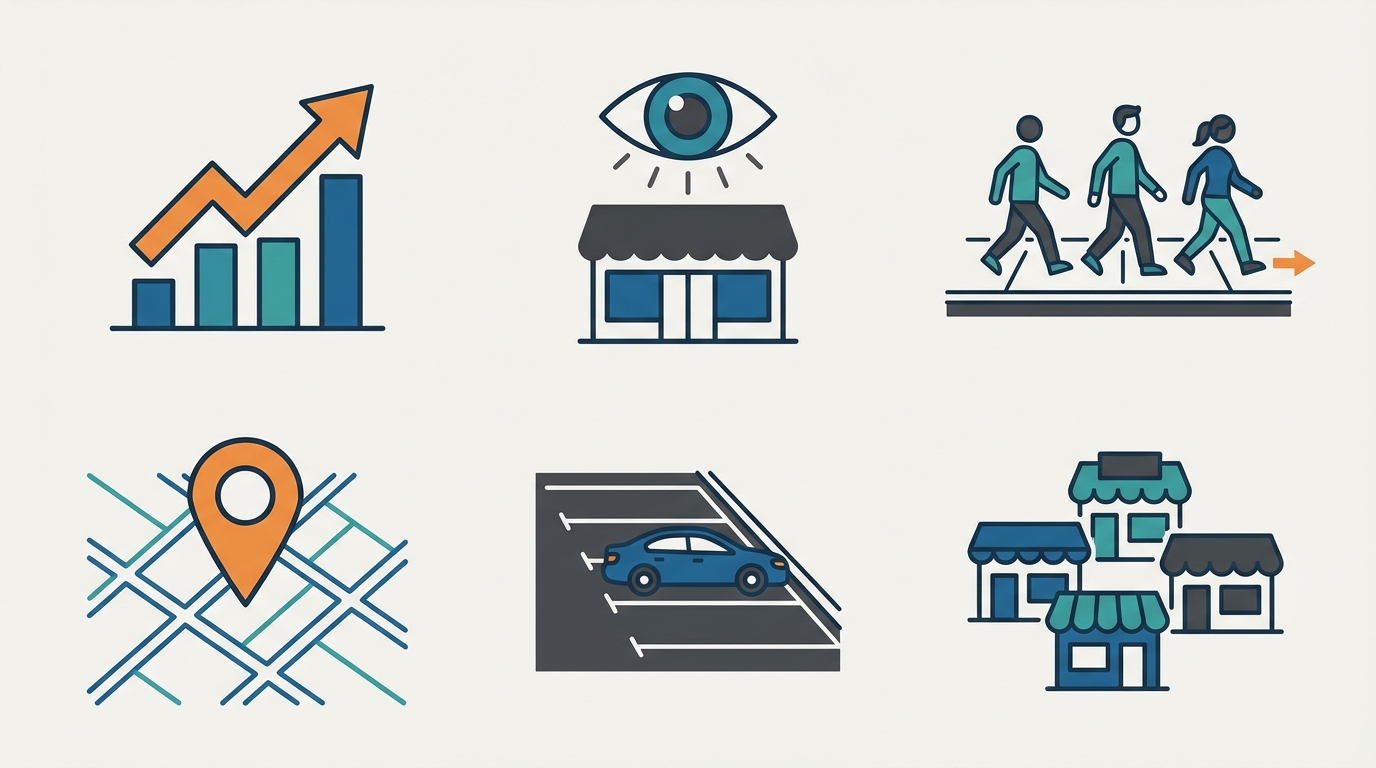
Image description: A clear, simple vector illustration showing six icons representing location selection factors: market demand (upward bar chart), visibility (eye over storefront), foot traffic (walking figures), zoning (map marker over parcel lines), parking availability (parking spaces with a parked car), and nearby businesses (clustered storefront silhouettes). The palette uses blue, teal, charcoal, and warm orange. No text appears in the image.
Licensing, Compliance, and Legal Considerations
Starting a used car dealership requires careful legal preparation. Because regulations vary widely, you must plan before signing a lease or buying inventory. This section explains core requirements and gives practical steps for dealers and their legal advisors.
Dealer License Acquisition
A dealer license is the foundation for legal sales. Most states issue licenses through the DMV or motor vehicle agency, and rules differ by state. Typical application items include a business plan, proof of location, sales tax permit, financial statements, and a surety bond or insurance certificate. Processing time ranges from weeks to months, and fees vary widely.
Actionable tips
- Create a checklist for your dealer license application. Include photos of the lot and a site plan.
- Obtain a sales tax permit early because many states require it before issuing a dealer license.
- Secure a surety bond and general liability insurance to meet state requirements.
- Use a legal advisor to review application packages. They can spot missing documents and speed approval.
Understanding Local and State Regulations
Permits and licensing extend beyond the dealer license. Local governments often require a business license, zoning clearance, signage permits, and building inspections. Additionally, state laws regulate contracts, consumer rights, warranty obligations, and advertising. Therefore, compliance touches daily operations and marketing.
Key compliance areas to monitor
- Contracts and disclosures: Provide clear written sales contracts and required state disclosures.
- Consumer rights and warranties: Honor state warranty rules, lemon laws, and implied warranty standards.
- Advertising regulations: Follow truth-in-advertising rules and finance disclosure requirements. Avoid deceptive claims and bait-and-switch tactics.
- Vehicle history and inspections: Keep Carfax or AutoCheck reports and inspection records for each sale.
Practical compliance checklist
- Maintain a compliance binder with licenses, permits, and bond certificates.
- Train staff on disclosure and odometer reporting rules.
- Run quarterly compliance audits and update a regulatory calendar.
- Consult a dealership attorney to draft contracts and pre-approve ad copy.
Legal compliance reduces risk and enables growth. As a result, invest time and counsel early to protect your business and build customer trust.
How to Start a Used Car Dealership: Build an Online Presence
An effective marketing plan starts online because most buyers search first. Therefore, create a fast website that lists inventory with clear photos and VINs. Also, optimize each vehicle page for search engines using model, year, and location keywords. For local visibility, claim your Google Business profile at Google Business and complete every field.
Use SEO best practices
- Target local keywords such as used car dealership near me and used cars in [city].
- Add structured data and inventory feeds for better indexing.
- Publish short blog posts about financing, inspections, and vehicle care to attract organic traffic.
How to Start a Used Car Dealership: Integrate Social Media and Local Advertising
Social media drives awareness and leads, especially on Facebook and Instagram. Set up business pages and run targeted ads using Facebook Business and Instagram Business. Then, retarget website visitors with carousel ads that show the exact cars they viewed.
Practical social media tactics
- Post short videos of walkaround tours and key features.
- Use Stories and Reels for time-limited promotions.
- Reply to comments and messages quickly to build trust.
Email marketing and lead nurture
Capture emails on your website and send segmented campaigns. For example, send new listings to shoppers who viewed sedans. Next, offer service discounts to past buyers to increase retention. Use clear subject lines and one strong call to action.
Traditional advertising and community outreach
Traditional channels still work for local dealers. Use local newspapers, radio spots, and sponsorships at community events. For instance, cross-promote with a local mechanic or car wash to widen reach. As a result, you increase foot traffic and brand recognition.
Integration tips and measurement
- Tie digital ads to phone tracking and showroom visits for attribution.
- Use a CRM to manage leads from all channels.
- Review metrics weekly and adjust budgets toward high-performing campaigns.
Combining SEO, social, email, and local ads creates a full funnel. Consequently, you attract shoppers, nurture leads, and convert sales efficiently.
Conclusion: How to Start a Used Car Dealership
Starting a used car dealership is promising but demands a solid legal and marketing foundation. Because regulations vary by state, you must secure the dealer license and sales tax permit early. Also, invest in compliance systems for contracts, warranties, and advertising rules.
Operational challenges are common, however they are manageable with planning. First, choose a visible location with parking and foot traffic. Second, build diverse inventory from auctions, trade-ins, and private sellers. Third, secure funding through loans, investors, or grants and manage cash flow closely.
Marketing and legal strategy must work together. Therefore, develop a full funnel that includes SEO, social media, email nurture, and local advertising. At the same time, ensure every ad and sales contract follows state laws. As a result, you reduce legal risk and boost customer trust.
Key takeaways
- Licensing and permits: Apply to the DMV and local agencies early to avoid delays.
- Compliance: Maintain inspection records and vehicle history reports like Carfax or AutoCheck.
- Marketing: Use targeted Facebook and Instagram ads plus local radio and events to drive showroom visits.
- Funding: Prepare clear financials for lenders or investors and understand loan terms.
For law firms and dealers, expert support accelerates growth. Case Quota helps small and mid-sized law firms dominate their markets through advanced legal marketing strategies. By partnering with specialists, you gain both compliance safety and better client acquisition.
In short, start with a compliant structure and a measurable marketing plan. Then, iterate based on leads and regulations. With focused legal counsel and a full funnel marketing approach, you can turn the booming used car market into a sustainable, growing business.
Frequently Asked Questions (FAQs)
What licenses and permits do I need to start a used car dealership?
– You must obtain a dealer license from the state DMV or motor vehicle agency.
– Also secure a sales tax permit, local business license, and zoning clearance.
– Many states require a surety bond and liability insurance.
– Tip: consult a dealership attorney and apply early to avoid delays.
How much funding will I need and where can I get it?
– Funding needs vary with inventory size and location costs.
– Typical sources include bank loans, SBA programs, and lines of credit.
– Additionally, consider angel investors, crowdfunding, and business grants.
– Prepare a clear business plan and financials to speed approval.
How should I source inventory safely and profitably?
– Use dealer auctions, wholesale networks, and trade-ins from customers.
– Private sellers and consignments can add variety and margin.
– Always obtain vehicle history reports like Carfax or AutoCheck and perform inspections.
– Keep written title and odometer records to reduce legal risk.
What matters most when choosing a dealership location?
– Prioritize visibility, foot traffic, and easy parking.
– Check zoning rules and nearby business mix before signing a lease.
– Also analyze local demand, competition, and demographic fit.
– For example, a busy commercial corridor often outperforms a tucked away lot.
How do I maintain legal compliance day to day?
– Use clear sales contracts and required state disclosures.
– Follow warranty, lemon law, and truth-in-advertising rules at all times.
– Train staff on odometer reporting and finance disclosures.
– Finally, schedule regular audits and consult legal counsel when needed.