

In a world drowning in generic ads, content marketing has become the single most reliable way for a law firm to attract high-value clients. It's about creating genuinely useful and relevant content—think blog posts, detailed guides, and videos—that builds your authority and establishes trust.
This approach turns your website into a long-term, lead-generating machine, freeing you from the endless cycle of paying for temporary advertising. You become the go-to resource, not just another name on a billboard, creating a client pipeline that actually lasts.
Why Content Is a Law Firm's Best Asset
For years, many law firms got stuck on the pay-per-click (PPC) treadmill. Sure, ads can bring in a quick burst of traffic, but it’s a rental model. The second you stop paying, the leads vanish. It's not just expensive; it fails to build any lasting foundation for your firm's growth.
A modern content marketing law firm strategy completely flips that script. Instead of renting attention, you're building an asset that you own outright.
Imagine a family law firm that publishes a comprehensive guide on "Navigating Child Custody Modifications in California." That one piece of content can pull in qualified leads from Google for years to come, creating a powerful, evergreen source of new cases.
From Disappearing Ads to Lasting Authority
The real difference here is building trust before a potential client ever decides to call. Someone facing a complex legal battle is searching for answers and reassurance, not just a phone number from a flashy ad. High-quality content gives them that initial value, positioning your attorneys as the experts who already understand their problem.
This builds the kind of authority that is absolutely essential for winning clients in the legal field. You're no longer just another ad; you're the trusted professional who has already started helping them. The numbers don't lie.
A staggering 89% of law firms rated content marketing as 'very important' to their overall strategy, with 13% reporting it delivered the highest ROI of any marketing channel.
This strategic pivot from temporary ads to permanent assets is what sustainable growth looks like.
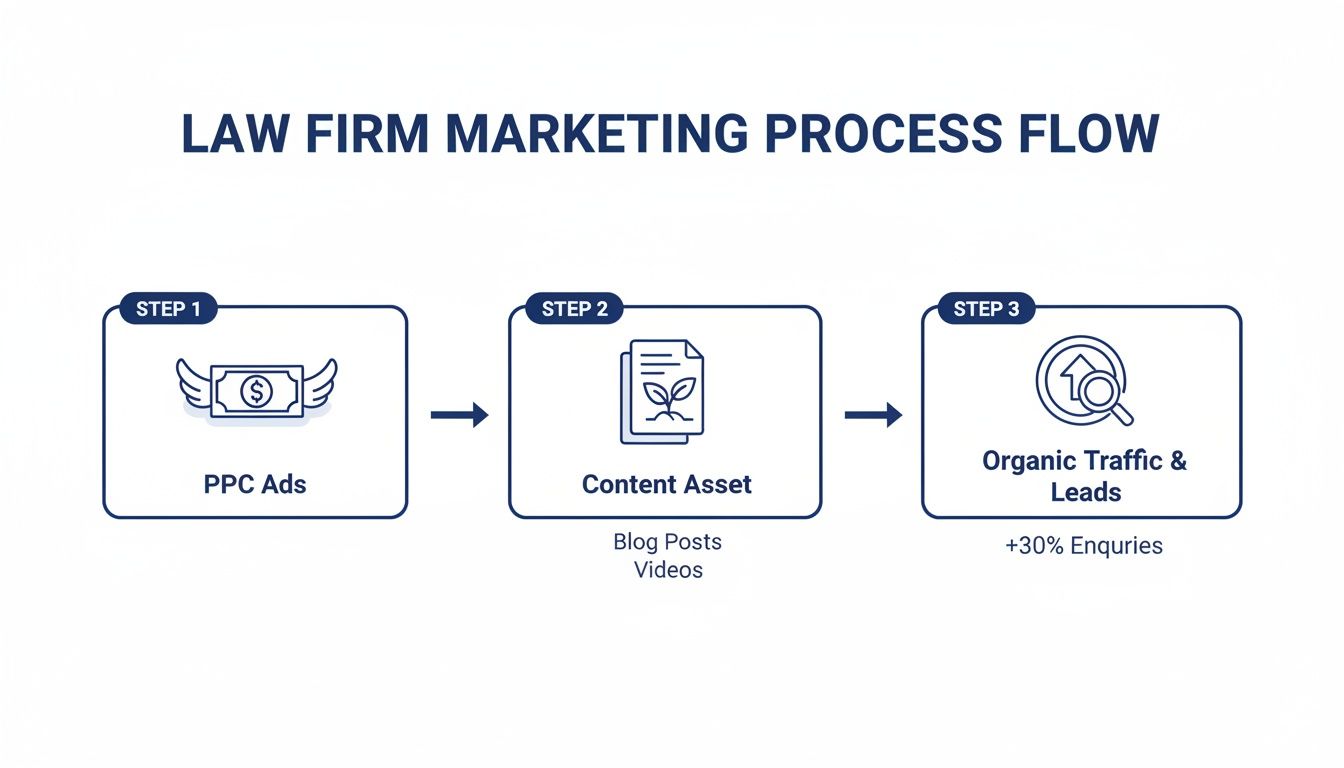
The flow is clear: PPC offers a short-term boost, but content cultivates an organic, ever-growing source of client leads. Better yet, SEO—which is fueled by great content—boasts a 7.5% conversion rate. That's more than three times higher than PPC's 2.2%.
The True ROI of Content
The return on your investment goes way beyond direct leads. A solid library of content strengthens your firm's brand, boosts your search engine rankings, and gives you a stockpile of material for social media and email campaigns.
As this guide on Content Marketing for Small Business Done Right shows, it’s simply a more reliable way to find and keep clients. When you invest in content, you're investing in a more predictable and profitable future for your practice. If you're ready to start, our guide on how to get more clients as a lawyer is the perfect next step.
Defining Your Ideal Client and Keyword Strategy
The biggest mistake law firms make with content is jumping straight into writing. Before you touch a keyboard, the real work begins with listening. You have to know, with almost uncomfortable precision, who you're trying to reach. Moving beyond a generic idea of "clients" is the only way to create content that actually gets the phone to ring.
This is where detailed client personas come in. Think of them as character profiles for your perfect client, built from real-world data. Instead of just targeting "people needing a will," you're zeroing in on "high-net-worth individuals over 55 in Orange County who are worried about estate taxes and protecting their assets for their kids."
See the difference? That level of detail changes everything. It dictates your tone, your topics, and the exact keywords you need to target, ensuring every article speaks directly to a potential client's most urgent problems.

Uncovering What Keeps Your Clients Up at Night
To build these game-changing personas, you have to dig for real information. Your goal is to understand their specific problems, their exact questions, and their underlying fears. The good news is, your firm is already sitting on a goldmine of this data.
Start with your own files. Review intake forms and notes from initial consultations. What are the top three questions every single potential client asks? What anxieties do they consistently bring up? This is raw, unfiltered insight into their mindset.
Then, go where they go online. A criminal defense attorney should be lurking in local community Facebook groups. A business lawyer might find incredible insights in the discussions on Reddit’s small business subreddits.
- Look for recurring questions: Find the themes and legal myths that pop up over and over again.
- Note their exact language: Pay attention to the phrases they use to describe their situation. This is pure keyword gold.
- Feel their frustration: Understanding their emotional state is key to writing content with genuine empathy that builds trust.
This isn't just research; it's the foundation for a content strategy that provides real answers to real people.
Moving From Broad Keywords to High-Intent Searches
Once you have a crystal-clear picture of your ideal client, keyword research suddenly becomes much simpler. Too many firms chase broad, insanely competitive keywords like "personal injury lawyer." It seems logical, but it's a losing battle against national firms with massive budgets, and it mostly attracts people who are just window shopping.
The real money is in long-tail keywords. These are longer, more specific phrases that signal a searcher is much further down the road and closer to actually needing a lawyer.
A person searching for "car accident lawyer" could be a student doing a research project. But someone searching "what to do after a rear-end collision in Los Angeles that wasn't my fault" is almost certainly looking for immediate legal advice.
This shift from targeting search volume to targeting search intent is everything. High-intent keywords might have fewer searches, but their conversion rate is exponentially higher. They connect you with potential clients who have a specific problem you can solve right now.
Putting It All Together: A Practical Framework
Tools like Ahrefs or Semrush are fantastic for uncovering these long-tail gems. Start with a broad topic central to your practice and drill down into the questions people are asking.
The table below illustrates how to move from a general practice area to a highly specific, client-focused topic that can form the basis of a powerful piece of content.
Practice Area Topic Ideation Framework
| Practice Area | Broad Keyword | Client-Focused Long-Tail Topic | Content Format Idea |
|---|---|---|---|
| Personal Injury | "slip and fall" | "Can I sue a grocery store if I slipped on a wet floor in California?" | In-depth blog post with a checklist |
| Criminal Defense | "DUI charge" | "What are the first steps to take after a first-time DUI arrest in Miami?" | Actionable "how-to" guide |
| Family Law | "child custody" | "How is child custody determined for unmarried parents in Texas?" | FAQ-style article |
| Estate Planning | "living trust" | "What is the cost to set up a revocable living trust for a small estate?" | Pillar page with a cost breakdown |
Each of these long-tail topics is a direct line to a highly qualified potential client. This methodical approach is the core of a successful content engine. To see how this fits into the bigger picture, you should explore our guide on understanding the fundamentals of SEO for law firms.
When you combine a deep understanding of your client with a smart, intent-driven keyword strategy, you stop just creating content. You start generating cases.
Alright, you know who you're talking to. That's half the battle. Now comes the real work: creating content that convinces a potential client you’re the only firm for the job. This isn't about churning out generic blog posts. It’s about building high-value assets that scream credibility.
Think bigger. That short article on "What is a trust?" isn't going to cut it. Instead, build an in-depth practice area guide like "The Ultimate Guide to Establishing a Revocable Living Trust in California." This kind of cornerstone content answers dozens of questions in one place, instantly positioning your firm as the go-to resource.
Other formats that pack a punch include:
- Compelling Case Studies: Anonymize the client details and walk readers through a complex problem you actually solved. Show them the challenge, the strategy you built, and the win you secured.
- Downloadable Checklists: Practical tools like "A Complete Checklist for California Business Formation" or "10 Questions to Ask Before Signing a Commercial Lease" deliver immediate value. They also make fantastic lead magnets.
These aren't just traffic magnets; they build a rock-solid foundation of trust before someone even thinks about picking up the phone.
Mastering Google’s E-E-A-T Framework
For any content marketing law firm, ignoring Google's E-E-A-T guidelines is a fatal mistake. E-E-A-T stands for Experience, Expertise, Authoritativeness, and Trustworthiness. Because legal advice falls under Google's "Your Money or Your Life" category, your content is scrutinized more intensely than almost any other industry.
Falling short here doesn’t just tank your rankings; it shatters the very trust you need to sign cases. That generic, AI-spun article? It won't work. Your content has to be infused with real legal precision and genuine human insight.
Here’s how you can demonstrate E-E-A-T in a way that actually works:
- Showcase Your Attorneys: Every single article needs a clear author bio that links back to that attorney's profile. That profile better be comprehensive—bar admissions, education, major case victories, and years of experience.
- Cite Your Sources: When you mention a specific statute, link directly to the official government source. Citing legal codes and recent case law is one of the most powerful ways to build authority.
- Make the Complex Simple: Ditch the dense legalese. Your job is to break down complicated legal topics into digestible information using analogies, clear headings, and short paragraphs. True expertise is making the complex easy to understand.
Trust is the currency of the legal profession. Your content is your primary tool for earning it online. Every article, guide, and case study must be a testament to your firm's integrity and deep expertise in your practice area.
By weaving E-E-A-T signals into everything you publish, you’re giving both Google and potential clients exactly what they’re looking for: an expert they can trust. For some great real-world examples, check out these examples of content marketing for lawyers to get some ideas flowing.
Accessibility as a Competitive Advantage
In the legal world, compliance is everything. So why do so many firms completely ignore one of the most critical areas of digital compliance—the Americans with Disabilities Act (ADA)? Making your website ADA-compliant isn't just about avoiding a lawsuit. It’s a savvy strategic move that boosts both user experience and your SEO.
An accessible website guarantees that everyone, including people with visual, auditory, or motor impairments, can get the vital legal information you're offering. It's the right thing to do, but it's also a powerful signal to search engines.
Here’s why ADA compliance gives you an SEO edge:
- A Better User Experience: Many ADA best practices—like clear navigation, readable fonts, and descriptive alt text for images—are also just fundamental SEO best practices. They keep people on your site longer and reduce bounce rates.
- Easier for Search Engines to Crawl: Screen readers, used by visually impaired users, navigate a website in a way that’s remarkably similar to how search engine bots crawl it. A well-structured, accessible site is simply easier for Google to read and index.
- Wider Audience Reach: By making your content accessible, you’re opening your virtual doors to a huge pool of potential clients that your competitors are probably ignoring.
When you commit to accessibility, you're building a site that works for everyone. That commitment to inclusivity strengthens your brand's reputation and gives you a tangible advantage in a crowded market. It proves your firm's dedication to the community is more than just talk—it's built right into your digital front door.
Expanding Your Reach with Video and Social Media
If your blog posts are the foundation of your content strategy, then video and social media are the highways that bring clients to your door. Too many attorneys write them off as unprofessional or a waste of billable hours. I've seen it time and again. But when approached strategically, these channels stop being distractions and start becoming powerful client-generation engines.
The objective here isn't to go viral with a dancing lawyer video. It’s to provide genuine value and build authority right where your potential clients are already scrolling. Think of it as the digital version of speaking at a local business association meeting. You're not chasing trends; you're creating helpful, practical content that simplifies complex legal topics and puts your firm's expertise on display.

Strategic Content Ideas for Attorneys
The most powerful social media and video content answers one specific question clearly and concisely. This isn't about selling; it's about helping. That simple shift in mindset positions you as an authority, not just another advertiser.
Here are a few high-impact ideas you can start with:
- Quick Q&A Videos: Grab your phone and record a 60-90 second video answering a question you get all the time. A criminal defense lawyer could do one on "Can I Refuse a Breathalyzer in California?" This is perfect for Instagram Reels, TikTok, and YouTube Shorts.
- Client Testimonial Clips: With full permission, a short, authentic video of a happy client is more persuasive than any polished ad you could run. It's instant social proof and builds trust before they even call you.
- Demystifying Legal News: When a big court ruling or new state law is in the headlines, create a quick video or post explaining what it actually means for the average person. This shows you're on top of your game and engaged in the community.
These formats are quick to produce and go straight to the heart of what your ideal clients are worried about. For a deeper dive, our guide on attorney marketing videos has a ton of other ideas.
Work Smarter with Content Repurposing
Nobody has time to create brand new content for every single platform. The real secret is to "create once, distribute many." That one well-researched blog post can be systematically dismantled into a dozen smaller pieces of content.
This isn't just a time-saver. It's about meeting people where they are, with content formatted for how they use that specific platform.
One long-form blog post can fuel your social media for weeks. A single 2,000-word article on estate planning can be repurposed into an infographic for LinkedIn, multiple quote graphics for Facebook, a short explanatory video for Instagram, and a quick text summary for X (formerly Twitter).
This is how you maximize the return on every single hour you invest in creating content.
Choosing the Right Platforms
Don't try to be everywhere at once. It's far better to be highly active and engaged on one or two key platforms than to have a ghost town presence on five. The right choice comes down to your practice area and your ideal client.
- LinkedIn: The go-to for any B2B practice like corporate law, IP, or employment law. It's built for sharing in-depth articles, case studies, and connecting with other professionals.
- Facebook: Still a powerhouse for B2C practices—family law, estate planning, personal injury. Its local groups feature can be a goldmine for community-focused firms.
- Instagram & TikTok: Don't sleep on these. They are surprisingly effective for reaching younger audiences. Short, educational videos that break down a complex issue perform incredibly well for criminal defense or PI attorneys.
The opportunity is massive. A staggering 24% of law firms use video marketing, yet there are 4.95 billion social media users worldwide. With platforms like Facebook and Instagram delivering an average ROI of 29%, this isn't something you can afford to ignore. For a full playbook, check out this guide on building a social media strategy tailored for lawyers. Focus your efforts on the right channels, and you'll connect with your next clients in a way that feels genuine and helpful.
You can't just create content and hope for the best. That’s a recipe for wasting time and money. A truly effective content strategy is a living thing—you have to listen to the data and adjust.
The real trick is learning how to measure what actually matters to your firm's bottom line. It’s about translating those clicks and views into actual, signed cases. Let’s ditch the vanity metrics and focus on the numbers that signal real growth, using powerful (and free) tools like Google Analytics 4 (GA4) and Google Search Console.

Key Metrics That Actually Drive Business
Don't get lost in a sea of data. Just a few core metrics will tell you almost everything you need to know. Focusing on these helps you make smarter decisions about where to double down.
Here’s what you should be obsessed with tracking:
- Organic Traffic to Key Practice Area Pages: Is your in-depth guide to "California Probate Law" seeing more visitors from search engines month over month? That's a direct sign your content is hitting the mark with the right audience.
- New Keyword Rankings: Pop into Google Search Console and see what terms are bringing people to your site. Spotting new rankings for high-intent phrases like "what to do after a truck accident in Los Angeles" is a massive win.
- Contact Form Submissions and Phone Calls: This is the endgame. You can set up conversion tracking in GA4 to see exactly which blog posts are pushing potential clients to pick up the phone or fill out your contact form.
The goal isn't just traffic; it's qualified traffic that converts. A single visit from a potential client searching for "emergency child custody lawyer" is infinitely more valuable than a hundred visits from students researching a school project.
Connecting these dots is crucial. For a deeper dive into the principles of ROI analysis that apply here, our guide on measuring advertising effectiveness is a great resource.
Conducting a Simple Content Audit
Your existing content is a goldmine, but it needs regular maintenance. A content audit isn't some complex, scary process. It's just a straightforward review of your articles to find opportunities for quick updates and improvements.
Think of it as digital housekeeping. A quick audit every quarter or so keeps your best articles from getting stale, losing their rankings, and feeding potential clients outdated information.
Your Content Audit Framework
You don't need a massive spreadsheet to get this done. Just ask a few simple questions for each of your most important pages.
- Is the information still accurate? Laws change. Statistics become outdated. Go through your articles and check for broken links or old legal information. In this field, accuracy is everything.
- Can it be better optimized? Revisit your keywords. Have search trends shifted? Could you add a new section answering a common follow-up question you're hearing from clients? A few tweaks can breathe new life into an old post.
- Is it actually generating leads? Check your analytics. If a page gets tons of traffic but no one ever contacts you from it, your call-to-action might be weak or buried. Sometimes a simple change can make all the difference.
By systematically measuring what works and periodically tuning up your existing content, you transform a collection of static articles into a dynamic, lead-generation engine. This is the final piece of the puzzle—the data-driven approach that separates the firms that get by from the firms that grow.
Common Questions on Legal Content Marketing
Jumping into content marketing for your law firm is bound to bring up some questions, especially with all the regulations in the legal space. Let's tackle some of the most common hurdles and concerns we see attorneys face when they start building out a real strategy.
How Long Until I Actually See Leads from My Content?
This is the big one, and the honest answer is: patience is key. While you might feel some early momentum—a bump in traffic, maybe a few inquiries—within the first 3 to 4 months, content marketing is a long-haul investment, not a quick win.
Most law firms start seeing a consistent, meaningful flow of leads after about 6 to 12 months of dedicated, high-quality work. This timeline can bend depending on how competitive your practice area is, the size of your local market, and, frankly, how good your content actually is.
But here’s the upside: unlike a Google Ad that vanishes the second you stop paying, a well-written blog post is an asset that keeps on giving. An article you publish today can continue to attract and convert clients for years to come, delivering a fantastic return on that initial time investment.
What Are the Big Ethical Rules I Can't Ignore?
For any law firm creating content, ethical compliance isn’t just a box to check—it’s the foundation of your entire strategy. One wrong move can have serious repercussions, so every single piece of content must align with your state bar's advertising rules. No exceptions.
Here are the hard lines you can never cross:
- No Guarantees. Period. Never, ever use language that even hints at a specific outcome. Words like "guarantee," "we promise," or "ensure a win" are massive red flags.
- Stick to the Facts. Every claim, statistic, or legal explanation you publish must be 100% accurate and verifiable. There is zero room for misleading information.
- Use Clear Disclaimers. Your blog posts, guides, and videos need to state clearly that the information is for educational purposes only and does not create an attorney-client relationship.
Treat your blog with the same ethical rigor you'd apply to a legal brief. It’s not just good practice—it's essential for protecting your firm, your reputation, and your license. Always have a qualified attorney review content before it goes live.
Can AI Tools Write My Legal Content for Me?
Artificial intelligence can be an incredibly useful assistant in your content workflow, but it’s not ready to replace the nuanced expertise of a real attorney. It's best to think of AI as a highly capable paralegal, not as a partner making final decisions.
AI is fantastic for things like:
- Brainstorming topic ideas and creating initial outlines.
- Whipping up a rough first draft to get you past the blank-page problem.
- Summarizing dense legal documents for your own internal use.
But any text that comes out of an AI tool must be meticulously edited, fact-checked, and rewritten by a qualified legal professional. That human oversight is what ensures accuracy, injects real-world experience, and satisfies the high E-E-A-T (Experience, Expertise, Authoritativeness, and Trustworthiness) standards Google demands from legal websites.
Use AI to make your firm more efficient, but never let it substitute for the authentic authority that only a human expert can build.
Which Is More Important: SEO or the Content Itself?
Asking whether SEO or content is more important is like asking if a car needs an engine or wheels. You can’t have one without the other. They are completely codependent, and focusing on just one will get you nowhere.
Search Engine Optimization (SEO) is the technical scaffolding. It's how your website is built, the keyword research you conduct, and all the behind-the-scenes work that helps search engines find and understand what your content is about.
Content Marketing is the value you deliver on that scaffolding. It's the expertly written articles, helpful guides, and informative videos that actually answer a potential client’s question, build trust, and convince them that you're the right person to call.
You could have the most technically perfect site in the world, but without compelling content, nobody has a reason to visit. On the flip side, you could write the most brilliant legal analysis ever seen, but without solid SEO, nobody is ever going to find it. The only path to sustainable growth is a unified strategy where both work together.
Ready to turn your firm's expertise into a client-generating machine? At Case Quota, we specialize in creating SEO-driven content marketing strategies that build authority and drive measurable growth for law firms. Let's build your case pipeline together.