

For lawyers, thinking of social media as an optional add-on is a surefire way to get left behind. It’s no longer an experiment—it's a primary engine for client acquisition, connecting your firm directly with people who need your help and building digital trust in a crowded legal market.
Why Social Media Is a Must-Have for Modern Law Firms
The days when a firm’s reputation was built exclusively on courtroom victories and word-of-mouth are long gone. Today, your next client is almost certainly going to find, research, and vet your firm on a platform like LinkedIn or Facebook before they even think about picking up the phone. A strong social media presence is the new handshake, and it’s often your very first impression.
This isn't about just being online; it's about meeting potential clients right where they already are. A personal injury firm might find its next client in a local Facebook community group. A corporate law practice, on the other hand, will likely connect with C-suite executives on LinkedIn. An effective social media marketing lawyers strategy closes the gap between your expertise and the people actively looking for it.
The Real-World Benefits for Your Practice
At its core, a smart social media strategy is a powerful tool for growth. The upside goes far beyond just getting your name out there—it translates directly into tangible results for your firm.
- Become the Go-To Authority: When you consistently share genuinely useful content, you position your attorneys as the experts. This keeps your firm top-of-mind, so you’re the first call when a legal need pops up.
- Generate Actual Cases: Social media isn’t just for branding; it’s a proven channel for bringing in qualified leads. In fact, a staggering 71% of lawyers report that they’ve successfully landed new business directly from social platforms. You can get more details in our complete guide on social media for law firms.
- Build Lasting Relationships: It’s a fantastic tool for nurturing trust with prospects, but it’s also key for staying connected with past clients. That loyalty is what turns a one-time case into a stream of valuable referrals.
- Gain a Competitive Edge: Let’s be blunt: if your competitors are active on social media and you aren’t, you’re handing them clients. A proactive presence is non-negotiable for staying relevant in your local market.
The numbers don't lie. Social media has become a powerhouse for generating legal leads, with a huge number of lawyers now pulling in new clients from platforms like LinkedIn and Facebook.
Key Benefits of Social Media Marketing for Your Law Firm
To put it simply, investing your time and resources into building a strong digital presence pays off in several critical ways. This table breaks down the most significant advantages.
| Benefit | Impact on Law Firm Growth |
|---|---|
| Lead Generation | Directly connects you with potential clients seeking legal guidance, filling your intake pipeline with qualified inquiries. |
| Brand Authority | Establishes your firm as a thought leader in your practice area, building credibility and trust before the initial consultation. |
| SEO Support | Drives targeted traffic to your website, which can positively influence your search engine rankings and online visibility. |
| Community Engagement | Humanizes your practice by showcasing firm culture and community involvement, making you more relatable to local clients. |
Ultimately, a well-executed social media strategy doesn't just get you seen—it gets you hired. It’s about building a system that consistently brings in the right kind of clients for your practice.
Choosing the Right Platforms for Your Practice
Trying to be on every social media platform is a surefire way to burn through your marketing budget with very little to show for it. I've seen countless firms make this mistake. A truly effective social media strategy starts by getting focused. You need to be on the one or two platforms where your ideal clients actually spend their time.
The key is to match the platform to your practice area. A corporate lawyer trying to land tech startups has a completely different audience than a family law attorney serving the local community. Being everywhere at once just means your message gets lost in the noise.
This flowchart maps out how social media fits into the modern client journey—it’s not a side project anymore; it's a direct line from awareness to signed cases.
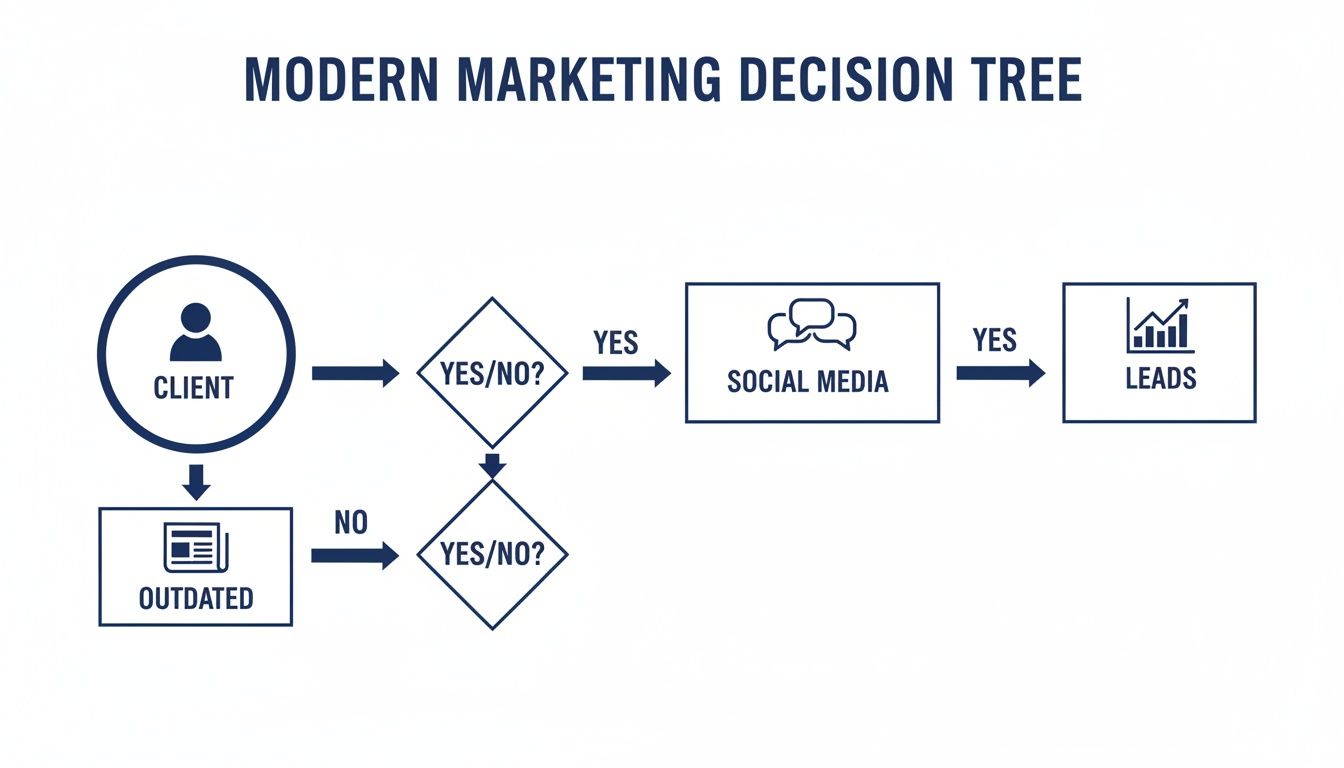
As you can see, social media isn't just an optional add-on. It's the engine that can drive qualified leads directly to your firm's front door.
LinkedIn: The Professional Networking Powerhouse
For any attorney in a B2B practice—think corporate, IP, or employment law—LinkedIn is non-negotiable. This platform is basically a 24/7 professional networking event where you can build real credibility and, more importantly, generate referral partnerships.
On LinkedIn, you’re not talking to the general public. You’re connecting directly with the C-suite execs, HR managers, and in-house counsel who have the authority to hire you. The content that works here isn't flashy; it’s substantive. Share insightful articles about recent legislative changes or offer your take on emerging industry trends.
LinkedIn is your digital soapbox. It’s where you prove your expertise not just to potential clients, but also to the accountants, consultants, and fellow attorneys who will become your most valuable referral sources.
This strategic approach is why a staggering 79% of law firms now have a presence on at least one social media platform. The game has changed.
Facebook and Instagram: The Community Connection Hubs
While LinkedIn is for professional circles, Facebook and Instagram are where you connect with your local community. For B2C practices like personal injury, family law, criminal defense, and estate planning, these platforms are absolute goldmines. Why? Their incredibly powerful and hyper-local ad targeting.
With Facebook, you can run ads aimed at people in specific zip codes, age brackets, and even those who've experienced life events—think "newly engaged" for a family lawyer. This level of precision means every dollar you spend is going toward reaching people in your service area who are far more likely to need you. For a deeper look at this, check out our guide on effective Facebook advertising for lawyers.
Instagram, being more visual, is perfect for humanizing your firm. A personal injury lawyer could post a quick video on the "3 Things to Do After a Fender Bender." It makes legal advice feel accessible and helps you become a familiar, trusted name in town.
YouTube: The Authority-Building Search Engine
Don't sleep on YouTube. It's the world's second-biggest search engine, and for law firms, it’s a long-term asset for building true authority. When people have complex legal questions, they increasingly turn to video for clear, digestible answers. This is especially true for practice areas like bankruptcy or estate planning.
Imagine an estate planning attorney creating a video series on topics like "What is a trust?" or "Common mistakes people make in their wills." Those videos can rank on both YouTube and Google for years, constantly bringing in new viewers and establishing the firm's expertise.
This kind of "evergreen" content positions you as an educator and a guide. You build a relationship with potential clients before they even think about picking up the phone. You're no longer just another lawyer; you're the authority they found when they needed help the most. By picking the right platform, you stop shouting into the void and start having meaningful conversations with the people who need you.
Creating Content That Builds Trust and Attracts Clients
So you’ve figured out where to post. Now for the million-dollar question: what do you actually say? This is where most law firms stumble. The key is to stop thinking like a marketer and start thinking like a valuable resource. Your social media feed shouldn't be a digital billboard; it should be the go-to place for answers and insights in your practice area.
I’ve found that a simple but incredibly powerful framework—Educate, Engage, and Convert—is the secret sauce. This approach gives every single post a clear purpose, methodically guiding a potential client from being a passive follower to a signed case. It’s all about building authority and trust organically, not through a hard sell.

When you stick to this structure, you create a content engine that doesn't just get likes—it nurtures real relationships. It makes your firm the obvious, and only, choice when someone finally needs legal help.
Educate Your Audience with Valuable Insights
Trust starts with expertise. The "Educate" phase is where you generously share your knowledge to answer the questions your ideal clients are already typing into Google. This isn't about giving away legal advice; it's about positioning yourself as a helpful authority long before they ever need to pick up the phone.
Forget posts like "Call us for your car accident case." Instead, a personal injury firm could post a quick, practical video titled, "5 Things You Must Do Immediately After a Car Wreck." See the difference? One is an ad, the other is a lifeline. That second post is helpful, shareable, and proves your competence without being pushy.
Here’s what this looks like in the real world:
- A family law attorney: Designs a simple infographic showing the typical timeline for a divorce proceeding in their state.
- An estate planning lawyer: Posts a short, text-based explanation of the difference between a will and a trust. Plain English, no jargon.
- A criminal defense firm: Shares a quick video tip on what to say (and what not to say) if you're pulled over.
This type of content becomes the backbone of a solid law firm content marketing strategy, building a library of resources that serves your audience and even gives your SEO a boost.
Engage Your Community to Humanize Your Firm
Okay, you've shown them you're smart. Now, show them you're human. The "Engage" phase is all about sparking two-way conversations and making your firm feel approachable. People hire people, not faceless corporations.
This is your chance to pull back the curtain and showcase your firm's culture. A candid photo of your team volunteering at a local charity event or a short video introducing a new paralegal can do more for building a personal connection than a dozen polished headshots.
Engagement content is what turns followers into a community. It’s the proof that there are real, dedicated people behind the logo who are invested in their clients' success and their local area.
To really connect, law firms should consider incorporating proven social media video strategies into their plan. Think about a live Q&A on Instagram where an attorney answers general, non-case-specific questions. It immediately breaks down the intimidating barrier that often exists between the public and the legal profession.
Convert Followers into Qualified Leads
Finally, it’s time to gently guide interested followers toward taking the next step. The "Convert" phase is where you make it clear how you can help, but it has to be done with a soft touch. After providing so much value upfront, a subtle call-to-action feels helpful, not desperate.
A conversion post never screams, "Hire us now!" It simply offers the next logical step in their journey.
Here’s how that plays out:
- After a series of posts on the probate process, an estate planning firm could say: "Navigating probate can be overwhelming. We put together a free checklist to help you get started. Download it here."
- A personal injury firm, after sharing safety tips for cyclists, might offer: "If you've been in an accident and have questions, we offer a no-obligation consultation to review your case."
The goal is to invite a conversation, not demand a sale. This approach respects the potential client and cements the trust you've worked so hard to build.
A Sample One-Month Content Calendar
Consistency is everything. Here’s a simple, adaptable content calendar you can run with. The idea is to rotate through the Educate, Engage, Convert framework to keep your feed balanced and working for you.
| Week | Monday (Educate) | Wednesday (Engage) | Friday (Educate/Convert) |
|---|---|---|---|
| Week 1 | Post a "Myth vs. Fact" graphic for your practice area. | Share a "Meet the Team" spotlight on an attorney. | Post a client testimonial (with permission and disclaimers). |
| Week 2 | Share a short video answering a common client question. | Run a poll asking followers about a relevant local topic. | Link to a detailed blog post on your site about a legal process. |
| Week 3 | Post a tip-of-the-week related to your legal field. | Post photos from a firm event or community sponsorship. | Offer a free resource download (e.g., a checklist or guide). |
| Week 4 | Explain a complex legal term in simple language. | Host a live Q&A session on Instagram or Facebook. | Share a case study or success story (anonymized). |
This balanced schedule ensures you’re consistently providing value, building relationships, and, most importantly, creating a steady stream of opportunities for new client inquiries.
How to Run Your First Paid Social Media Ad Campaign
Organic content is fantastic for building trust over time, but when you need to sign more cases now, paid social media advertising is your most powerful tool. It lets you get your firm’s message directly in front of the precise people who need your help, often right at the moment they’re looking for it.
This is about so much more than just “boosting” a post. We're talking about building a strategic campaign from the ground up to generate a predictable stream of qualified leads.
Think of a paid campaign as a hyper-focused digital direct mailer, but with far better targeting and completely measurable results. You aren’t just blanketing a zip code with flyers; you’re placing a specific, helpful message directly into the social feeds of individuals who match a very particular profile.
Defining Your Ideal Client Audience
The single most critical element of a successful ad campaign is targeting. Get this right, and you're filling your intake pipeline. Get it wrong, and you're just wasting money.
Platforms like Facebook and LinkedIn have incredibly powerful tools that let you move past broad demographics and zero in on the exact person you want to reach. Forget generic approaches; you need to get hyper-specific.
Here’s what that actually looks like for different practice areas:
- Estate Planning Attorney: You could target individuals aged 55+ within a 20-mile radius of your office who have shown interest in topics like "inheritance," "financial planning," or "wills and trusts."
- Family Law Firm: Your audience might be people in your county, aged 30-50, whose relationship status recently changed to "separated" or who have shown interest in parenting groups or divorce support pages.
- Personal Injury Lawyer: You can target users by location (like near a major highway intersection known for accidents) and even behaviors, such as recent visits to an auto repair shop’s website or physical location.
The goal is to create an audience so well-defined that when they see your ad, it feels less like an advertisement and more like a timely, relevant solution to a problem they're actively facing.
This level of detail ensures your ad spend is directed only at those most likely to become a client, dramatically improving your return on investment. The granular control offered by today's ad platforms is a core component of effective social media advertising for lawyers, allowing for a precision that was simply impossible a few years ago.
Crafting Ad Creative That Connects
Once you know exactly who you're talking to, you need to figure out what to say. The biggest mistake lawyers make here is leading with legal jargon and self-promotion. Your potential clients are often in a vulnerable or stressful spot; your ad needs to connect with empathy and offer a clear, helpful path forward.
Let’s compare two ads for a personal injury firm.
- The Ineffective Ad: "We are a premier litigation firm specializing in tort law. Our attorneys have decades of experience securing maximum compensation under statute 34.5. Call now for a consultation." This ad is cold, confusing, and all about the firm. It completely misses the client's emotional state.
- The Effective Ad: A short, 15-second video of an attorney looking directly at the camera. "If you've just been in an accident, you're probably overwhelmed. The first thing to do is get medical attention. The second is to understand your rights. We can help with that part. Tap below for a free, no-pressure guide on what to do next."
The second example just works. It's empathetic, client-focused, and offers immediate value with a low-commitment call-to-action. It builds a sliver of trust before asking for the consultation. Your ad creative should always answer the client's unspoken question: "How can you help me right now?"
Setting a Realistic Budget and Measuring Success
You don't need a massive budget to see if paid social ads can work for your firm. In fact, many firms get their start and see real results with as little as $20-$50 per day.
The key is to ignore vanity metrics like likes and shares. For a law firm, the only numbers that truly matter are the ones tied directly to client acquisition.
Here are the key performance indicators (KPIs) you need to live and breathe:
- Cost Per Lead (CPL): This is your north star. It tells you exactly how much you're spending to get one person to fill out your contact form, send a message, or call your office. If you spend $500 on ads and get 10 qualified inquiries, your CPL is $50.
- Click-Through Rate (CTR): This shows how many people who see your ad actually click on it. A low CTR is a huge red flag that your ad creative isn't compelling or your audience targeting is off.
- Conversion Rate: This is the percentage of people who click your ad and then complete your desired action (like submitting a form on your website).
Start with a small, experimental budget for your first campaign. Run it for a week or two, then dive into the data. Analyze your CPL and see what's working. Maybe your video ad is outperforming your image ad, or your "inheritance" audience is more responsive than your "financial planning" one. Paid advertising is all about testing, learning, and optimizing to continuously lower your cost per lead and bring in more of the right cases for your firm.
Navigating State Bar Rules and Ethical Compliance
Let's talk about the single most important aspect of social media for lawyers: walking the ethical tightrope. While these platforms are fantastic tools for growth, they are also minefields of State Bar rules and advertising regulations you absolutely cannot ignore. One wrong move—a casual comment that gives legal advice or an unvetted client testimonial—can land you in serious trouble.
This isn't just about avoiding a letter from the Bar. It's about protecting the integrity and reputation you've spent your entire career building. The goal is to market your firm with confidence, but always within the strict boundaries of your professional obligations. That means you need a proactive, informed approach to every single post, comment, and direct message.

Avoiding Common Ethical Pitfalls
Social media is fast-paced and informal, which makes it incredibly easy to forget you're operating as a legal professional. There are a few common traps that I’ve seen attorneys fall into time and again.
The biggest risk? Accidentally forming an attorney-client relationship. Someone sends you a direct message with the details of their case. You reply with specific guidance. Boom—you may have just created a professional duty of care. The only safe play is to never give legal advice online. Your one and only goal should be to move the conversation offline and into a formal consultation.
Another major red flag is guaranteeing outcomes. Using language like, “We’ll win your case,” or promising, “We always get the maximum settlement,” is a clear violation in every jurisdiction. All your marketing must be truthful and not misleading. Stick to the facts about your experience, your process, and your team.
The Art of the Compliant Testimonial
Client testimonials are pure gold for social proof, but they are also a regulatory minefield. You can't just copy and paste a glowing review from a client and call it a day.
Most state bars require specific disclaimers to go along with any testimonial. A common one is a statement clarifying that past results don't predict or guarantee future outcomes. This is completely non-negotiable.
Here's a real-world scenario:
A former client comments on your firm's Facebook post: "You guys are amazing! Got me a massive settlement, way more than I ever expected!"
- The Wrong Way (Public): "Thanks, John! We were so happy to get you that huge win. We do it for all our clients!" This implies a guarantee and is an unqualified boast.
- The Right Way (Public): "Thank you for your kind words, John. We were proud to have represented you." Then, you take that testimonial and turn it into a graphic for a separate post. At the bottom, in clear text, you add the disclaimer: "This testimonial does not constitute a guarantee, warranty, or prediction regarding the outcome of your legal matter."
That simple addition lets you leverage powerful social proof while staying perfectly compliant.
Public Comments Versus Private Legal Counsel
Engaging with your audience is critical, but you have to draw a hard line between offering general information and providing specific legal advice. This is especially true when you're responding to public comments and questions.
The second you apply legal principles to a specific person's set of facts, you’re giving legal advice. Think of your social media content as a public library of general knowledge, not a private consultation room.
Given the tight restrictions, effective social media and reputation management is absolutely essential. A single misstep can tarnish a reputation that took years to build. For a much deeper dive into the specific rules, our guide to https://casequota.com/navigating-rule-7-2-a-guide-to-ethical-attorney-advertising-in-california/ offers principles that attorneys nationwide can learn from.
A Checklist for Ethical Social Media Marketing
To keep your firm safely on the right side of the rules, you need a bulletproof review process for everything that goes out. Use this checklist as your starting point.
- Is a disclaimer needed? Always include "This is attorney advertising" and "Past results do not guarantee future outcomes" on your profile bios and any relevant posts.
- Are we making promises? Read every word. Are you using language that could be seen as a guarantee, like "win," "always," or "promise"? Cut it.
- Are we giving advice? Make sure all replies to comments or DMs guide people toward a formal consultation, never toward specific answers online.
- Is our specialty stated correctly? You can only call yourself a "specialist" or "expert" if you are officially certified by your State Bar or an approved organization.
- Have we gotten consent? Never, ever post client names, photos, case details, or testimonials without their explicit, written permission.
When you bake these ethical checks right into your workflow, you can build your firm’s online presence and connect with new clients without ever putting your license on the line.
Answering Your Social Media Marketing Questions
When law firms decide to get serious about social media, the same handful of questions always pop up. Getting straight answers is the key to building a plan you can actually stick with—one that brings real business into your firm.
Let's clear up the most common concerns I hear from attorneys.
How Much Time Does This Actually Take?
For most small to mid-sized firms, you can get a surprising amount of traction with a focused 3-5 hours per week. This isn't about being glued to your phone 24/7; it’s about being smart and efficient with your time.
That time breaks down into a few key activities: creating your posts (and yes, templates are a lifesaver here), scheduling them out so you're not posting on the fly, and then checking in to respond to comments and messages. The real secret is consistency over quantity. It's far better to publish three genuinely helpful posts every week than it is to churn out ten generic ones. Once you get in a groove and see results, you can decide if it's worth investing more time or delegating some of the work.
What's the Biggest Mistake Lawyers Make on Social Media?
Easy. Treating it like a digital billboard. I see it constantly—lawyers just blasting out promotional content full of legal jargon. Think posts like, "Hurt in an accident? We secure maximum compensation!" That approach just doesn't work here.
Social media is a conversation, not a megaphone. It's where you build trust long before someone ever needs to hire you.
The winning strategy is to give, not just take. Offer real value by answering the questions potential clients are already asking. Break down confusing legal topics into plain English. Show the human side of your firm. When you do that, you build authority and make people feel like they know you. That's what makes them pick up the phone when they need help.
How Do I Actually Measure the ROI?
You have to look past the vanity metrics. "Likes" and "followers" are nice, but they don't pay the bills. To understand the real business impact, you need to connect your social media activity to your bottom line.
Here’s how you can track what really matters:
- Track Website Clicks: Use a tool like Google Analytics to see how many people are clicking from your social profiles over to your website. That’s a direct signal of interest.
- Monitor Direct Inquiries: Keep a simple log of how many DMs, contact form fills, or phone calls mention finding you on social media.
- Analyze Ad Performance: If you're running ads, the only number that truly matters is your Cost Per Lead (CPL). It tells you exactly what you’re spending to get a qualified person to contact your firm.
One of the simplest and most powerful things you can do is add a "How did you hear about us?" field to your client intake form. It provides cold, hard proof of where your new cases are coming from.
Should I Use My Personal Profile or a Business Page?
For your firm's marketing, you absolutely need a dedicated business page. No question. Business pages on platforms like Facebook and LinkedIn give you access to analytics, ad tools, and other professional features you just can't get with a personal profile. It also keeps a clean line between your personal and professional life.
That said, individual attorneys should definitely use their personal profiles—especially on LinkedIn—to share the firm's content. It’s a huge amplifier. Think of the business page as your firm's official headquarters, and your personal profile as your own professional networking tool that drives people to that headquarters.
At Case Quota, we build social media strategies that are not only compliant and ethical but are designed from the ground up to drive measurable growth for law firms. If you're ready to make social media a consistent source of new clients, we should talk.
Learn more about our approach at https://casequota.com.