

When someone's facing criminal charges, they aren't casually browsing. They're in crisis, searching for a lifeline. Criminal lawyer marketing is all about strategically connecting with these individuals at their most urgent moment of need. It's a precise blend of digital strategy—think SEO and targeted Google Ads—built on the bedrock of a trustworthy brand and a website that screams competence.
Building Your Client-Attracting Foundation

Before you even think about running an ad, the most successful defense firms have already laid the groundwork. This isn't just about throwing up a website. It's about meticulously crafting a digital presence that instantly communicates authority, trust, and—most importantly—immediate help.
The goal is simple: make a potential client feel they've found the right advocate before they even dial your number.
This all starts with defining your firm’s brand. In a sea of local attorneys, what makes you the choice? Your unique selling proposition (USP) has to be crystal clear and hammered home across every single thing you do.
Crafting a Brand That Resonates in a Crisis
Your brand is far more than your logo or letterhead. It’s the promise you make to every client. Are you the bulldog trial attorney who will fight tooth and nail in the courtroom? Or are you the calm, reassuring guide who can demystify the intimidating legal process for a first-time offender?
You need to pick a lane. Here are a few brand pillars I've seen work incredibly well:
- Decades of Courtroom Experience: You’re not a rookie. You've seen it all, and your history of litigation proves it.
- Laser-Focused Niche: You are the absolute go-to expert for DUIs, federal cases, or domestic violence charges. No one else comes close.
- A Client-First Communication Guarantee: Your clients are never in the dark. You promise accessibility and constant, clear updates.
- Impressive Case Dismissal Rates: You get results. Hard numbers build instant confidence like nothing else.
Whatever your angle is, it needs to be woven into your website headlines, your Google Ads, and every piece of content you produce. That consistency is the first step toward a marketing machine that actually works.
A strong brand answers a potential client's most urgent, unspoken question: "Can I trust you with my future?" Your website and marketing materials must answer with a resounding 'yes' in the first five seconds.
The Non-Negotiable Elements of a Law Firm Website
Here's a hard truth: nearly 75% of consumers will check out a law firm's website before they do anything else. If your site is slow, confusing, or looks like it was built in 2005, that lead is gone. Forever. Your website is your digital office, and it needs to be optimized for one thing: conversion.
Your site absolutely must have these components:
- Mobile-First Design: Over 64% of legal searches are happening on a smartphone, often in a car or a police station waiting room. Your site has to be flawless on mobile, with tap-to-call numbers and dead-simple navigation.
- Lightning-Fast Load Times: A site that takes more than three seconds to load loses almost half its visitors. Speed isn't a feature; it's a necessity for someone in a panic.
- Clear Calls-to-Action (CTAs): Don't make people hunt. Every single page should have big, obvious buttons like "Call for a Free Consultation" or a "24/7 Emergency Line" banner.
- ADA Compliance: Making your website accessible for users with disabilities isn't just a legal box to check. It's the right thing to do, and it opens your services to everyone in the community.
A solid digital foundation isn't optional. To make sure you cover all your bases, I'd suggest using a proven law firm marketing plan template to keep your strategy organized. Investing time and resources here makes every dollar you spend on advertising later work ten times harder.
Mastering Local SEO for When a Client Needs You Right Now

Unlike most professional services, the search for a criminal defense lawyer is almost never casual. It’s local, it's urgent, and it's driven by a crisis. When someone's phone lights up with a search, they aren't just browsing—they're looking for the best possible help, in their city, immediately.
This reality makes local search engine optimization (SEO) the single most powerful tool in your marketing arsenal.
Your entire goal should be to dominate the local search results, especially that all-important Google "Map Pack." You know the one—it's the block of three local businesses that appears right at the top for searches like "DUI lawyer near me" or "best criminal attorney in [Your City]." Those top three results get the overwhelming majority of clicks. Getting there isn't about luck; it's a direct result of a meticulous strategy built around your Google Business Profile (GBP).
Your Google Business Profile Is Your Most Powerful Local Weapon
Think of your GBP as more than a digital business card. It's an active, dynamic platform for connecting with potential clients and proving your authority before they even click to your website. So many firms just set it and forget it, and that’s a massive mistake. A fully optimized, active profile sends all the right signals to Google that you are a relevant and trusted local authority.
First, the absolute basics: get your Name, Address, and Phone Number (NAP) 100% consistent across your website and every other online directory. I mean exactly the same. A tiny difference, like using "St." on one profile and "Street" on another, can confuse search engines and water down your local ranking power.
Now, let's dig into the features most of your competitors are ignoring:
- Drill Down on Service Categories: Don't just settle for "Criminal Defense Attorney." Get specific. Use every relevant primary and secondary category for your practice areas. Think "DUI Lawyer," "Drug Crime Attorney," and "Domestic Violence Attorney." This is how you show up for those specific, high-intent searches.
- Own the Q&A Section: Don't wait for people to ask questions—pre-emptively populate this section yourself. List the top 5-10 questions you get on every initial call ("Do you offer free consultations?" "What's the first thing I should do after an arrest?") and answer them completely. This shows your expertise and addresses client fears head-on.
- Use Google Posts Weekly: This is your chance to show you're an active, operating firm. Share sanitized case results (ethically, of course), link to new blog posts, or announce firm news. Posts have a shelf life, so consistent activity tells Google you're current and engaged.
These might feel like minor tweaks, but they add up to a major advantage. For an even deeper dive, our guide lays out proven Google Business Profile for attorneys tweaks that can help you own local search in your area.
Building Local Authority Beyond Your GBP
While your Google profile is the hub, true local dominance requires building a web of authority around it. This comes down to two things: local citations and valuable backlinks.
Citations are simply mentions of your firm's NAP on other websites. Think of them as digital breadcrumbs that verify your location and legitimacy. Consistency here is everything.
Every citation from a quality directory like Avvo, Justia, FindLaw, or even your local Chamber of Commerce adds another layer of trust, telling Google that you are a permanent and respected fixture in your community's legal scene.
Link building takes it to the next level. A single backlink from a respected legal blog or a local news story covering one of your cases is pure gold. It passes authority directly to your website, giving a serious boost to both your local and organic rankings. This isn't passive; it requires creating content and doing outreach to earn those links.
To really get ahead, you should be integrating modern AI SEO strategies to guide your content and outreach, ensuring you're creating what both search engines and potential clients are looking for.
By methodically optimizing your GBP and building a strong network of local signals, you ensure that when someone in your city searches for help in their worst moment, your firm is the first and most trusted name they find.
Running High-ROI Google Ads for Valuable Cases
While a strong Local SEO presence is your long-term foundation, paid ads are the jet fuel. It’s how you get in front of a potential client the very second they’re desperately searching for help on their phone.
But let’s be clear: in the high-stakes arena of criminal lawyer marketing, a poorly managed Google Ads campaign is one of the fastest ways to burn through cash with absolutely nothing to show for it. I’ve seen it happen time and time again.
The secret isn't about outspending your competition; it's about outsmarting them. A successful campaign is a well-oiled machine, targeting the right people with the right message at the exact moment they need you most. This means ditching the old "set it and forget it" mentality and adopting a data-obsessed approach.
The Foundation of a Profitable Campaign
Before you even think about writing an ad, you have to understand the battlefield. Marketing costs for criminal defense have gone through the roof, with certain keywords commanding an astronomical price for a single click. Yet, the sharpest firms are actually lowering their cost per lead by using laser-focused targeting and smart tech integrations. A recent analysis on skyrocketing law firm marketing expenses highlights how some practices are navigating these costs effectively.
Your first move is meticulous keyword research. You're not just looking for broad, expensive terms like "criminal lawyer." You're hunting for high-intent, long-tail keywords that scream urgency and a specific need.
Get inside the head of someone in a crisis. What are they actually typing?
- "Emergency DUI lawyer available now"
- "First-time assault charge attorney [Your City]"
- "How to get someone out of jail in [Your County]"
These longer, more specific phrases often have less competition and a much higher conversion rate. Why? Because they capture people who are past the research phase. They’re ready to hire.
Structuring Campaigns for Specific Practice Areas
One of the biggest mistakes I see is firms lumping all their services into a single, generic ad campaign. A person facing a complex federal white-collar charge has a completely different mindset—and a different set of fears—than someone arrested for a misdemeanor DUI.
To get a real return on your ad spend, you must structure your campaigns around specific practice areas. Build out separate ad groups for DUI, domestic violence, drug offenses, theft, and so on. This simple step lets you tailor every single piece of the puzzle:
- Ad Copy: Your DUI ad can speak directly to the fear of losing a license and the immediate need for a DMV hearing.
- Keywords: You can target hyper-specific terms like "DUI breathalyzer refusal attorney."
- Landing Pages: Direct that click to a page on your website dedicated only to your DUI defense services.
A dedicated landing page is the most critical and most often overlooked component of a high-ROI Google Ads campaign. Sending a user who clicked a "DUI Defense" ad to your generic homepage creates instant confusion and friction. They'll just hit the back button.
Your landing page has to be a seamless continuation of the ad's promise. It needs a clear, powerful headline, bullet points outlining exactly how you help, social proof like client testimonials or case results, and a can't-miss call-to-action—a click-to-call phone number and a simple contact form are non-negotiable.
For a much deeper dive into campaign structure and optimization, check out our complete guide on running Google Ads for lawyers.
By segmenting your campaigns this way, you deliver a highly relevant experience from the initial search to the final phone call. This is how you dramatically increase the odds that an expensive click turns into a valuable new case for your firm.
Using Content to Build Unshakeable Trust
In criminal defense, your marketing isn’t just about being found—it’s about being trusted.
When potential clients land on your site, they're in the middle of a crisis. They aren't looking for a sales pitch; they’re desperately searching for an expert who shows competence and compassion. This is where content marketing stops being simple advertising and becomes your single most powerful tool for building a rock-solid reputation.
Your whole content strategy should be about connecting with and educating your community long before they ever need to call you. Forget the generic firm announcements and holiday greetings. The real goal is to create genuinely helpful resources that cement your firm as the go-to authority on criminal law in your city.
Moving Beyond the Digital Billboard
A classic mistake I see criminal defense lawyers make is treating their social media and video channels like a digital billboard. Just posting your phone number and a slogan won't cut it. You have to provide real value first.
Think about the most urgent questions and fears racing through someone's mind when they're facing an arrest or investigation. Your content needs to tackle these issues head-on. This approach instantly transforms your online presence from a simple ad into a vital public resource, building incredible goodwill and top-of-mind awareness.
Consider adding these powerful formats to your content plan:
- "Know Your Rights" Video Series: Film short, easily shareable videos for YouTube and Facebook. Explain exactly what to do during a traffic stop, what to say if law enforcement shows up at your door, or why they should never give a statement without you.
- Process Demystification Articles: Write blog posts that walk people through the legal maze in plain English. Break down confusing terms like "arraignment," "discovery," and "plea bargain." This empowers potential clients and immediately reduces their anxiety.
- Ethically Shared Success Stories: With your client's full permission, create sanitized case studies (video or written) that highlight your strategic approach and the positive outcomes you secured. This provides the powerful social proof people are looking for.
By consistently creating this kind of educational content, you build a library of assets that works for you 24/7. It answers questions and builds trust while you're in court, focused on your cases. To see how this plugs into a bigger plan, check out our complete guide to law firm content marketing strategy.
Choosing the Right Platforms for Your Message
Not all social media platforms are created equal. A smart approach means picking the channels that actually align with your firm's goals. You don't need to be everywhere; you need to be effective where it matters most.
In criminal defense, content isn't just about what you say; it's about where you say it. Matching your message to the right platform is the key to connecting with both potential clients and valuable referral sources.
For instance, a polished video testimonial will do wonders on your website's homepage, but a quick, informal Q&A might be perfect for a Facebook Live session. LinkedIn is an incredible channel for sharing more in-depth articles to connect with professional peers who can become a steady stream of referrals. Meanwhile, YouTube is the ideal home for your educational video series, turning your channel into a searchable knowledge base for your community.
Firms that still rely only on referrals are finding it harder and harder to grow. A multi-channel digital strategy is what's changing the game. Recent data shows that leads for criminal defense firms are up 14% year-over-year, with a jaw-dropping 84% of firms now generating cases through organic social media. You can dive deeper into these criminal defense digital marketing trends to see how other firms are adapting. This shift hammers home the power of a consistent, value-driven content plan in today's market.
Creating a System for Positive Reviews and Reputation
Let's be blunt: in criminal defense, your online reputation is everything. It’s the single most valuable marketing asset you have. Trust is the only currency that matters, and a constant flow of positive reviews is the ultimate form of social proof.
Think about it from your potential client's perspective. They are scared, stressed, and looking for the best possible person to trust with their future. A strong set of 5-star reviews is the digital equivalent of a close friend saying, "This is the lawyer you need to call." It often becomes the deciding factor.
But building this kind of reputation doesn't just happen. You need a deliberate, ethical system designed to capture client satisfaction right when it peaks—at the conclusion of a successful case. That's the moment their relief is highest and their gratitude is most sincere.
Automating the Ask for Feedback
The secret to generating reviews consistently is making it incredibly easy for your clients. Manually chasing down every closed case with one-off emails is a surefire way to miss opportunities. It’s just not scalable. Instead, you need a simple, automated workflow.
This can be as straightforward as a templated email that automatically triggers from your case management software a few days after a case is officially closed. The goal isn't to be aggressive; it's a gentle, professional nudge.
An effective review request has a few critical parts:
- Keep it Personal: Always use the client’s first name and make a general, confidential reference to their case.
- Show Gratitude: Thank them for trusting your firm during what was likely one of the most difficult times in their life.
- Make a Simple, Direct Ask: Clearly explain that their feedback is invaluable and helps others facing similar situations find the right help.
- Provide Direct Links: Don't make them search. Include easy-to-click links to your most important profiles, like your Google Business Profile and Avvo.
Responding to Every Single Review
Getting the review is only half the battle. Responding to all of them—both good and bad—is non-negotiable. It shows you’re engaged, you care about the outcome, and you stand by your work.
For positive reviews, a simple, "Thank you, [Client Name]. It was a privilege to represent you," is perfect. It reinforces the positive experience. For the rare negative review, a calm, professional response that acknowledges their feedback without ever violating confidentiality is crucial. Something like, "We take all client feedback seriously and are committed to providing the best possible representation," is a good start.
Your public responses aren't just for the person who wrote the review. They're for every single potential client who is researching your firm. How you handle criticism can be just as powerful as the praise you receive.
Beyond actively seeking feedback, you have to proactively manage your digital footprint. You can learn more with these excellent online reputation management tips. Our agency also provides comprehensive support in this area, and you can see our full approach to reputation management for attorneys in our detailed guide.
This flowchart shows how different content pieces, including testimonials, all work together to build that critical layer of trust with potential clients.
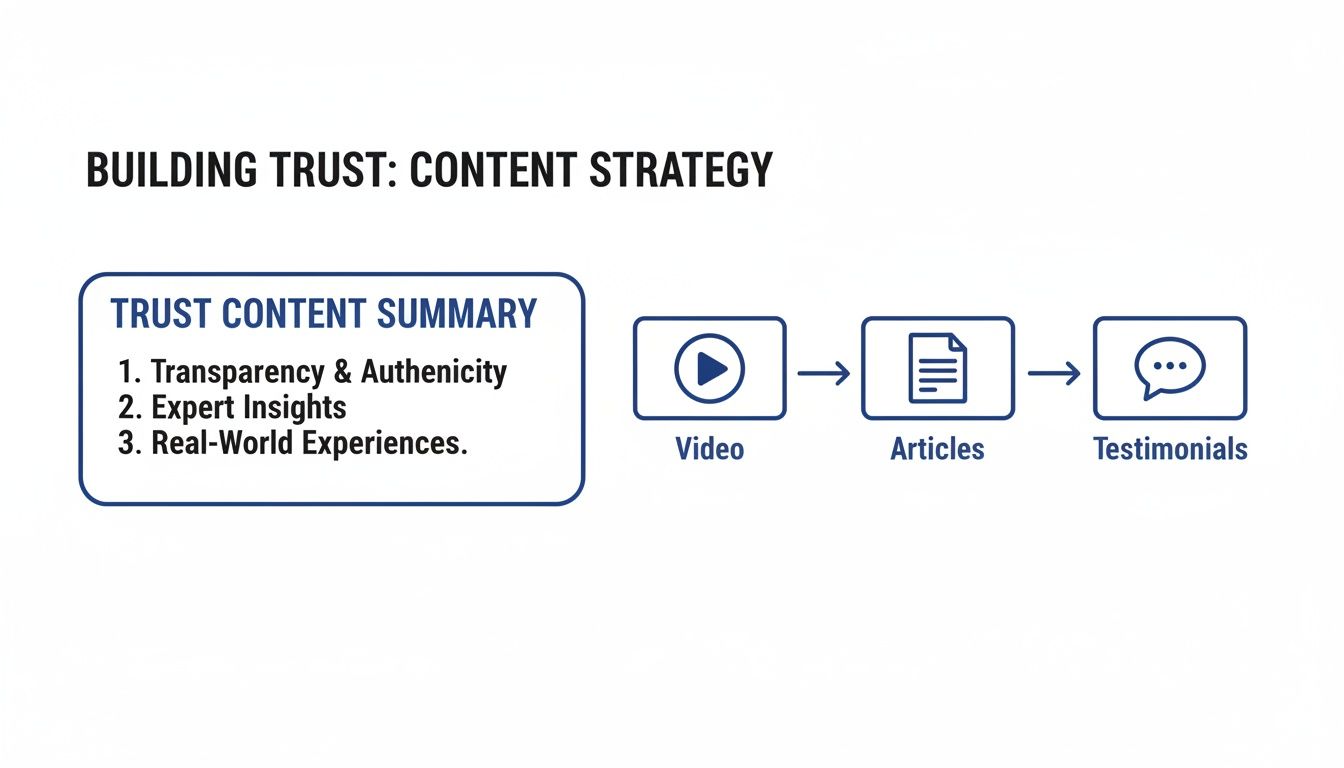
By weaving together video, in-depth articles, and powerful testimonials, you create a compelling and persuasive argument for your firm's expertise. In the high-stakes world of criminal defense, where the outcome is all that matters, building credibility through reviews isn't just a good idea—it's a proven strategy for growth.
Common Questions About Marketing a Criminal Law Practice
Diving into digital marketing can feel like you're stepping into a whole new world, especially when the stakes are as high as they are in criminal defense. I talk to attorneys all the time, and I hear the same pressing questions about where to put their time and money to actually get results.
This isn't about theory. It's about giving you direct, actionable answers to help you cut through the noise and make smarter decisions for your firm's growth. Let's tackle the big ones: budgeting, what really works, whether you should do it yourself, and how long it all takes.
How Much Should a Criminal Defense Firm Budget for Marketing?
There’s no magic number, but a solid rule of thumb is to set aside 5% to 15% of your firm's gross revenue for marketing.
If you're just starting out or you're trying to make a name for yourself in a tough market like a major city, you absolutely need to be pushing that 15% mark. Think of it as an investment in your future caseload, not just another bill to pay. A smart plan is what turns that spend into a profit center.
So, how do you break that down? A balanced budget usually looks something like this:
- 40-50% on High-Intent Channels: This is your "right now" money. It goes straight into platforms like Google Ads and Local Services Ads to capture people who need a lawyer today.
- 30-40% on Long-Term Assets: This is your investment in SEO and content. It’s the work that builds your firm’s authority and creates a steady, reliable stream of organic leads down the road.
- The Rest for Reputation and Brand: Use the remainder for things like review management software and social media. These build the trust that gets people to actually pick up the phone.
Here's the most important takeaway: Start with a number you can live with, track every single dollar, and once you see what's working, double down on it. If your Google Ads are consistently bringing in good cases, boosting that budget isn't a gamble—it's a data-backed business decision.
What Is the Single Most Effective Marketing Channel?
If you want immediate, high-quality leads, nothing beats Local SEO, with a perfectly tuned Google Business Profile (GBP) as its engine.
Picture this: someone just got arrested, or their family member is in trouble. The first thing they do is pull out their phone and frantically search for "DUI lawyer near me" or "best criminal attorney in [Your City]." Getting your firm into that top 3 "map pack" for those searches is the holy grail. It delivers the most valuable leads you can get.
Sure, Google Ads can buy you a spot at the top of the page, but a powerful organic local ranking builds a level of trust that money can't buy, all at a much lower long-term cost. It's so effective because you're meeting a potential client at their absolute moment of need. When they see your name in the map pack, backed up by a long list of 5-star reviews, you immediately become the obvious, most credible choice.
Should I Do My Own Marketing or Hire an Agency?
You can definitely handle some of the basics yourself. But for real, sustained growth, hiring a specialized legal marketing agency is almost always the smarter move. The digital marketing world for lawyers is just too complex and competitive to treat as a side project.
First off, our industry is tangled in strict ethical rules for advertising. On top of that, platforms like Google have their own complicated policies just for law firms. A good legal marketing agency lives and breathes these rules. They know how to navigate them without putting your license at risk.
Beyond that, they bring an entire arsenal to the fight—sophisticated tools, data from hundreds of other law firm campaigns, and proven strategies you just can't access on your own. When you outsource the technical work like SEO, content, and ad management, it frees you up to do what you do best: practice law and take care of your clients.
How Long Does SEO Take to Generate Cases?
SEO is a marathon, not a sprint. It’s about building a real asset for your firm. You might see some encouraging signs—like your keyword rankings starting to climb—within 3 to 4 months, but it typically takes 6 to 12 months to see significant, case-generating results. We're talking about first-page rankings for the really valuable search terms.
The timeline really depends on a few key things:
- Your Website's History: An older site with some history often gets traction faster than a brand-new one.
- Local Competition: Trying to rank in a place like Los Angeles is a completely different ballgame than in a smaller town.
- Campaign Intensity: The more resources you put into creating great content and building authority, the faster you'll see the payoff.
Those first few months are all about laying a rock-solid foundation: fixing technical issues on your website, building out your local directory listings, and making sure your on-page content is perfect. Over time, as you keep publishing helpful articles and earning links from other credible sites, you'll see your rankings climb. The work you put in today will keep bringing you clients for years to come.
At Case Quota, we take the guesswork out of marketing for criminal defense lawyers. We build strategies that drive real growth, so you can focus on winning cases. To see how we can help your firm own your local market, visit us at https://casequota.com.