

When someone's world is turned upside down by a criminal charge, your law firm’s marketing isn't just advertising—it's a lifeline. It's about building a credible, authoritative presence that connects with people in their most desperate moments. A solid marketing plan makes your firm the obvious, trusted choice when everything is on the line.
Building Your Digital Foundation
Before you even think about running a single ad, you need a rock-solid digital foundation. Your website isn't an online brochure; it's your firm's 24/7 client acquisition machine. It has one job: turn an anxious person searching for help into a retained client.
This means moving past generic advice and focusing on the high-stakes reality of criminal defense. It all starts with deep, hyper-local market research. You need to know the most valuable and frequently searched case types in your specific city or county, not just what’s trending nationally.
The goal is to engineer a website for both potential clients and search engines. We're talking about a mobile-first design, lightning-fast load times, and dead-simple navigation that lets a distressed user find information on their specific charge—DUI, assault, drug possession—in seconds. You have to establish trust and credibility from the very first click.
Understanding Your Local Market First
Criminal defense is intensely local. Before you write a single word of copy, you have to get inside the unique legal landscape of your service area. What are the most common charges filed in your jurisdiction? Are you in a college town where DUIs and MIPs are constant, or a major city with more complex felony cases?
Fire up tools like Google Trends and Google Keyword Planner, but filter them down to your specific location. Dig for the long-tail keywords people actually use when they're in trouble, like "first offense DUI lawyer in Dade County" or "what to do after a domestic violence arrest in Tampa." This research is the blueprint for your entire strategy, ensuring your website's pages speak directly to the most urgent local needs.
I see this mistake all the time: firms build generic "felony" or "misdemeanor" pages. That's not how real people search. A potential client is looking for a "shoplifting defense lawyer" or an "attorney for assault charges." Your digital foundation has to be built on pages that target these specific, high-intent searches.
This process isn't just a technical exercise; it's about getting into your client's mindset from the very beginning.
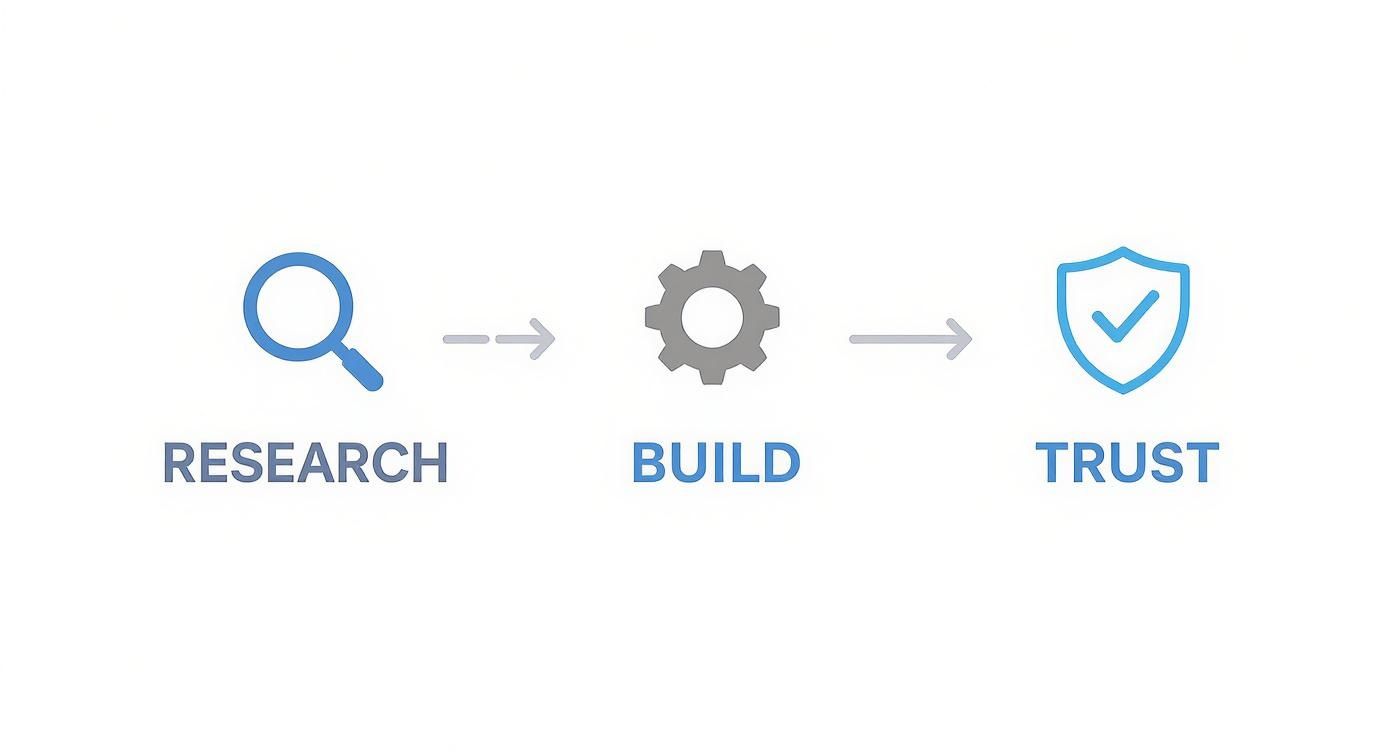
This simple flow—Research, Build, Trust—is the key. A winning website is a strategic asset, not just a collection of code and images.
Core Components of a Client-Winning Website
Your website is the first real interaction a potential client has with your firm. It has to do more than look good; it has to be a finely tuned conversion tool. Think about it: nearly 75% of consumers check out a law firm's website before doing anything else. If your site fails to inspire immediate confidence, that lead is gone forever.
To build a site that actually generates cases, you absolutely must focus on the essentials. I've put together a quick table outlining the non-negotiable elements every criminal defense site needs to have.
Core Components of a Client-Winning Website
| Component | Key Objective | Real-World Example |
|---|---|---|
| Mobile-First Design | Ensure a flawless experience for users on smartphones, where most urgent searches happen. | Large, tap-friendly phone numbers and "Call 24/7" buttons that are always visible on the screen. |
| Blazing-Fast Speed | Load instantly to prevent a stressed-out user from abandoning the site for a competitor. | Optimizing images and using a high-performance host to get load times under 2 seconds. |
| Clear Calls-to-Action | Make it ridiculously easy for a visitor to take the next step and contact you. | Placing a "Free & Confidential Consultation" form prominently on every single practice area page. |
| Prominent Trust Signals | Build instant credibility and reduce the perceived risk of hiring your firm. | Showcasing recent case results (ethically), five-star client reviews, and "Super Lawyers" badges. |
These components are the bedrock of a website that doesn't just attract traffic, but actively converts that traffic into consultations.
Nailing this digital home base is the most important step you'll take. For a more detailed breakdown, you can learn more about how to improve a law firm website and transform it into a genuine lead-generation powerhouse.
Dominating Local Search for Urgent Leads
When someone is slapped with a criminal charge, their world shrinks. Fast. They aren't looking for a lawyer across the country; they're frantically searching for help right here, right now. This is where your marketing has to hit hardest—winning the local search game is everything because that's where your best clients are.
Your most powerful weapon in this fight is your Google Business Profile (GBP). I see too many firms treat their GBP like a static Yellow Pages ad. It’s not. It's a dynamic lead-gen machine and, for most prospects, the very first time they'll ever encounter your firm. A neglected profile is like having a "closed" sign on your digital front door.
A properly optimized GBP is active, informative, and builds trust before anyone even thinks about clicking to your website.

Transforming Your GBP Into a Lead Magnet
To turn that profile from a passive listing into a client-generating powerhouse, you need to work its features. Consistently. Think of it as a mini-website that demands regular attention.
A great starting point is the Q&A section. Don't wait for people to ask questions—pre-populate it yourself. Answer the panicked questions you know potential clients have, like "Do I have to talk to the police?" or "What's the first thing I should do after a DUI arrest?" This instantly positions you as a helpful authority and gobbles up valuable keyword real estate.
Next, get comfortable with Google Posts. These are your firm's real-time updates.
- Share anonymized case results: "Successfully argued for dismissal of drug possession charges in Orange County."
- Post firm news: "Welcoming a new associate specializing in juvenile defense."
- Promote educational content: "Just published a new blog post on recent changes to state expungement laws."
Finally, get granular with your services. Don't just list "Criminal Defense." Break it out into every specific thing you do: "Felony Assault," "Petty Theft," "Domestic Violence Defense," "Probation Violations." Each one is another hook in the water, another chance to rank for a high-intent search. For a much deeper tactical guide, check out these proven Google Business Profile for attorneys tweaks.
Building a Bulletproof Citation Profile
Now, let's look beyond Google. Your firm’s digital footprint needs to be rock-solid and consistent everywhere online. This comes down to citations—every mention of your firm's Name, Address, and Phone number (NAP). When NAP data is inconsistent across different websites, it confuses search engines and torpedoes your local rankings.
Your first priority should be the big legal directories. These sites carry real authority and are often where prospects go to comparison-shop attorneys.
A consistent citation profile isn't just an SEO box to check; it’s a fundamental trust signal. Imagine someone in crisis seeing your firm's correct information on Avvo, FindLaw, and Yelp. It screams legitimacy and stability. But if the address is wrong on one and the phone number is old on another? It creates doubt when they need absolute certainty.
Get this right. Make sure your firm’s profile is complete and 100% identical on key sites like:
- Avvo
- FindLaw
- Justia
- Nolo
- Yelp
It’s painstaking work, but it builds the foundation for your local search authority. It makes you an undeniable fixture in your local legal market.
Driving Reviews and Ranking with Geo-Targeted Pages
Positive client reviews are the lifeblood of a local law firm. They are one of the biggest ranking factors for the Google map pack and provide the powerful social proof needed to turn a searcher into a caller. You need a simple, ethical system for requesting reviews from satisfied clients when their cases wrap up.
The final piece of the local puzzle is creating location-specific service pages on your website. These pages are designed to capture people searching for your service in their city. A page titled "Austin DWI Defense Attorney" will always outperform a generic "DWI" page for a user in Austin. It's just that simple.
These geo-targeted pages need to feel local. Mention nearby landmarks, courthouses, and neighborhood-specific details to prove your relevance to both users and Google. Kick it up a notch by embedding videos that explain local legal processes. To make sure that video content gets seen, you'll want to implement some smart YouTube SEO best practices. This is how you connect with the right clients at the exact moment of their most critical need.
Running an AI-Powered Paid Ad Strategy
While a strong SEO presence is your long-term engine for growth, think of paid ads as the nitrous boost. They rocket you to the top of search results, which is absolutely critical when your potential client is in crisis and needs help now.
But this instant visibility comes at a steep price. Without a precise, data-driven strategy, your ad budget can evaporate with nothing to show for it.
The real key to winning with paid ads in the high-stakes world of criminal defense is to move beyond just bidding on keywords. It’s about letting AI maximize every single dollar you spend. This isn't some futuristic trend; it's a fundamental shift that allows smaller, nimbler firms to compete head-on with the giants.
Harnessing AI for Smarter Bidding
Google's ad platform has gotten incredibly smart. The days of manual bidding are over. AI-driven tools are now far better at finding your ideal client at the exact moment they’re ready to pick up the phone. This is where you gain your edge.
Campaign types like Performance Max use machine learning to analyze thousands of signals in real-time—from a user's search history to their device and location—to put your ad in front of the people most likely to become a client. It's so much more powerful than just targeting a broad keyword like "DUI lawyer."
You need to be using smart bidding strategies. Period.
- Maximize Conversions: This strategy tells Google's AI one thing: get me the most calls and form submissions you possibly can within my daily budget.
- Target CPA (Cost Per Acquisition): This gives you more control over your return on investment. You tell Google the maximum amount you're willing to pay for each new lead, and the AI works to hit that number.
These tools are working 24/7 to optimize your campaigns, making micro-adjustments that would be impossible for any human to manage. For a deeper dive into making this work, check out this excellent AI-powered performance marketing guide.

The Google Ads platform is your command center. It's where you define your audience, set your budget, and unleash the AI to hunt down the most valuable clicks for your firm.
Crafting Compliant Ad Copy That Converts
Your ad copy has a tough job. It has to grab attention, show empathy, and drive action—all within a few short lines and without violating your state bar’s strict advertising rules. You can't promise outcomes or create unjustified expectations.
Focus on the user's immediate fear and their urgent need for a solution.
Your ad headline isn't just text; it's a direct response to someone's panic. Phrases like "24/7 DUI Defense Help" or "Arrested? Talk to a Lawyer Now" connect on an emotional level and offer an immediate solution. This is far more effective than a generic "Experienced Criminal Attorney."
Your goal is to be a beacon of calm, professional help. In the wider legal world, paid search is a brutal battlefield. The average cost-per-click (CPC) for legal ads is already $8.50, and the average cost per lead can hit nearly $130. Every single click has to count.
The Non-Negotiable Landing Page
Sending paid traffic to your website's homepage is one of the most common—and expensive—mistakes a law firm can make. A homepage is full of distractions and isn't laser-focused on a single action.
Every single ad campaign you run must point to a dedicated landing page. No exceptions.
This page has one job and one job only: get the conversion. It should be a seamless extension of your ad, with a headline and message that match what the user just clicked on.
A high-converting landing page must have:
- A Powerful, Reassuring Headline: Match the promise from your ad (e.g., "Get Immediate Help for Your Drug Charge").
- Prominent Trust Signals: Put your awards, "Super Lawyers" badges, and five-star client testimonials front and center.
- A Flawless Mobile Experience: Your page has to load instantly and be ridiculously easy to use on a phone, with big, easy-to-tap "click-to-call" buttons.
- A Simple Contact Form: Ask for the absolute bare minimum—name, phone, and a quick message. That's it.
This focused approach is what turns an ad click into a new client consultation. If you're looking for more advanced paid search tactics, our guide on Google Ads for lawyers in California offers a playbook on outsmarting the big-budget competition.
Building Unshakeable Credibility with Content
In criminal defense, your reputation is everything. When a potential client is facing the worst day of their life, they aren't just looking for an attorney—they're desperately searching for a credible, authoritative expert who can give them hope.
Content marketing is how you build that unshakable credibility at scale. It positions your firm as the undeniable authority in your local market long before anyone picks up the phone.
This is about so much more than just having a blog. It’s about creating a digital ecosystem that consistently answers the urgent, panicked questions your ideal clients are typing into Google. Think about the searches that happen at 2 a.m.: "what are my rights after a DUI arrest?" or "first steps after a domestic violence charge." Answering these questions builds immediate trust and funnels high-quality organic traffic right to your website.
Answering Urgent Questions with Your Content
When someone is in legal trouble, they aren't casually browsing. They are on a mission for information, and your website’s content has to meet that desperate need with clear, accessible answers. This is the heart of effective content marketing for a defense firm—you become a vital resource first, and their trusted legal counsel second.
Your content plan should be built on two main pillars:
- Authoritative Practice Area Pages: These are the cornerstones of your site. Each page, whether it’s for assault, theft crimes, or fraud, must be a comprehensive resource. It needs to detail the specific charges, potential penalties, and common defense strategies relevant to your state.
- Problem-Solving Blog Posts: These articles are where you address the specific, long-tail questions clients actually ask. Think about titles like, "Can a Misdemeanor Charge Be Dropped?" or "What to Expect at Your First Court Appearance."
The goal is to make your website the single most helpful resource in your city for anyone facing a criminal charge. When you publish content that genuinely eases someone's fear and uncertainty, you're not just selling a legal service; you're building a powerful emotional connection.
This strategy does the heavy lifting for you. It establishes you as an expert and pre-qualifies your leads, because the people who find you this way are already convinced of your knowledge. For a closer look at how firms are executing this, you can review more examples of content marketing for lawyers to see these principles in action.
Using Video to Build a Personal Connection
Text is king for SEO, but video is unmatched for building a genuine human connection. In a field where trust is everything, seeing and hearing you speak can make all the difference. Video puts a face to the name, making your firm feel far more approachable to someone in a vulnerable and frightening situation.
And you don't need a Hollywood production budget. Simple, well-lit videos shot on a smartphone can be incredibly effective.
Focus on creating short, informative clips that:
- Introduce your team: A quick "meet the attorney" video demystifies the process.
- Explain complex legal processes: Break down what an arraignment is or how bail works in a simple, two-minute clip.
- Answer Frequently Asked Questions: Turn your most common client questions into a library of helpful video content.
These videos perform exceptionally well on your website, in your Google Business Profile, and across social media. They capture attention and convey empathy in a way that text alone simply can't.
Managing Your Reputation Through Reviews
Let's be clear: your online reviews are the modern-day referral. For many potential clients, they are the single most important factor in their decision. Actively managing your reputation isn't an afterthought; it’s a core component of your marketing strategy.
A steady stream of positive reviews provides the social proof that hesitant clients need to feel confident enough to call you. The absolute best time to ask for a review is at the conclusion of a successful case, when your client's gratitude is at its peak. A simple, polite request is often all it takes.
It's also crucial to respond to every single review, both positive and negative. Thanking clients for their positive feedback shows you appreciate them. More importantly, responding professionally and calmly to a negative review demonstrates that you are reasonable and take feedback seriously—which can be just as reassuring to future clients.
Optimizing Your Intake for Maximum Conversion

All the SEO, paid ads, and content creation you do leads to this one, critical moment: a potential client reaching out. This is where your marketing spend either pays off or goes down the drain. Getting the lead is only half the battle; the real work is turning that anxious, fearful person into a retained client.
This is exactly where so many firms drop the ball. A clunky website, a call that rings out, or a slow email response will send a high-value lead straight to your competitor in a heartbeat. Your client intake process can't be an afterthought—it needs to be a well-oiled machine built for speed, empathy, and efficiency.
From their first click to the moment they sign a retainer, the entire journey has to be frictionless. Think about their state of mind. They're stressed, probably scrolling on their phone, and desperately need immediate reassurance. Your whole online presence has to cater to that urgency.
Engineering Your Website for Instant Action
When a potential client lands on your site, you have a razor-thin window to grab their attention and guide them toward making contact. Your conversion tools can't be buried at the bottom of a page; they need to be front and center, everywhere.
To give yourself the best shot at turning a visitor into a lead, your website needs a few non-negotiable elements working together.
- 24/7 Live Chat: An automated (but empathetic) chatbot or a live answering service can engage visitors instantly. They can answer basic questions and collect contact info even if it's 3 a.m. on a Sunday.
- Prominent Click-to-Call Buttons: Your phone number has to be impossible to miss and instantly tappable on mobile. A "sticky" header that stays on-screen as the user scrolls is perfect for this.
- Simple, Mobile-Friendly Contact Forms: Keep your forms brutally simple. Name, phone number, and a brief message. That’s it. A long, complicated form is a guaranteed conversion killer.
These features tear down the barriers and make it incredibly easy for someone in crisis to take that crucial first step: reaching out for help.
Your marketing generates the opportunity, but your intake process secures the client. Every missed call or delayed email response isn't just a lost lead—it's a person you couldn't help and revenue you'll never see. Speed and compassion are your greatest competitive advantages at this stage.
Training an Empathetic and Effective Intake Team
Once the phone rings or a form hits your inbox, the responsibility shifts to your intake team. This is a high-stakes conversation that requires a unique blend of empathy and precision. Your intake specialist is often the very first human interaction a potential client has with your firm, and that first impression is everything.
They need to be trained to handle frantic calls with a calm, reassuring voice while efficiently pulling out the essential details. The goal is simple: quickly qualify the lead (is this a case type you handle?) and get a consultation booked with an attorney. Every call should follow a clear, practiced script that balances compassion with information gathering.
This is where the marketing investment truly pays off. And the data backs it up. One report showed that criminal defense firms with advanced digital marketing and structured intake saw a 14% year-over-year increase in total leads. Even better, leads from advertising surged by 21% when tracked through a proper legal CRM. All of this happened while the average cost per lead actually dropped. You can find more insights about criminal defense digital marketing growth on Scorpion.co.
Using a legal CRM like Clio or Lawmatics is a game-changer here. It lets you track every lead from its source, automate follow-up emails and texts, and make sure no opportunity ever slips through the cracks. This systematic approach transforms your intake from a chaotic mess into a predictable engine for firm growth.
Measuring Success to Scale Your Growth
You can't just throw money at marketing and hope for the best. Not in this field. Effective criminal defense marketing isn't about guesswork; it's a game of numbers. If you aren't measuring, you're just gambling with your budget.
Tracking your performance is what separates the firms that stagnate from the ones that scale. It’s how you move your marketing from a frustrating expense to a predictable investment, giving you the clarity to double down on what’s actually bringing in cases and cut everything else.
Identifying Your Most Important KPIs
To get a real pulse on your marketing's health, you need to ignore the vanity metrics and focus on the Key Performance Indicators (KPIs) that actually hit your bottom line.
There are really only a few numbers that matter:
- Cost Per Lead (CPL): This is the raw cost to get one potential client to call your office or fill out a form. A low CPL means your campaigns are running efficiently.
- Cost Per Acquisition (CPA): This is the one that truly counts. It’s your total marketing cost to sign one new, paying client. Your entire goal is to drive this number as low as possible while keeping it far below the average value of a new case.
- Lead-to-Client Conversion Rate: This percentage tells you how good your intake team is. It reveals how many of those qualified leads actually turn into retained clients.
Tracking these KPIs shows you the real-world ROI of your marketing efforts. For a much deeper dive, our guide on measuring advertising effectiveness breaks down the entire framework specifically for law firms.
You might have a Google Ads campaign with a phenomenal click-through rate, but if none of those clicks ever become paying clients, the campaign is a failure. Period. Focusing on CPA forces you to measure what actually builds your practice—profitability.
Setting Up Your Measurement Tools
You can't track what you can't see. Getting the right tools in place is non-negotiable for any serious marketing plan, and thankfully, it's not as technical as it sounds.
Your essential toolkit is pretty straightforward:
- Google Analytics 4 (GA4): This is the free, powerhouse tool from Google that shows you exactly how people find and behave on your website. You’ll want to set up "conversion events" to track every single time someone submits your contact form.
- Call Tracking Software: A platform like CallRail is a must. It assigns unique phone numbers to each of your marketing channels—your website, Google Business Profile, a specific ad, you name it. This is the only way to know for sure which marketing effort made the phone ring.
With this setup, you can finally connect the dots. You’ll know precisely which search term, social media ad, or Avvo listing is bringing in your best cases. That's the data that empowers you to make confident decisions and scale your firm's growth predictably.
This data-first approach is more critical than ever when you look at the numbers. Recent industry data shows that 49% of a law firm's yearly budget is now dedicated to marketing activities. It gets even more serious at the top, where the top 200 firms in the U.S. report spending an average of $2.35 million a year on marketing. You can see more of these trends and law firm marketing statistics on Onthemap.com.
With that level of investment on the line, you have to know what's working.
Here’s a quick look at the core metrics you should have on your dashboard.
Essential Marketing Metrics for Defense Firms
This table provides an overview of the essential KPIs to track for measuring the success and ROI of your marketing campaigns.
| Metric (KPI) | What It Measures | Why It's Important |
|---|---|---|
| Cost Per Lead (CPL) | The average cost to generate a single new lead from a specific marketing channel. | Indicates the efficiency of your ad spend and helps you compare channel performance. |
| Cost Per Acquisition (CPA) | The total cost to acquire one new, signed client. | This is your ultimate ROI metric; it tells you the real cost of getting a paying case. |
| Conversion Rate | The percentage of website visitors or leads that take a desired action (e.g., call). | Measures the effectiveness of your website, landing pages, and calls-to-action. |
| Case Sign-Up Rate | The percentage of qualified leads that become retained clients. | Directly measures the performance of your intake process and sales funnel. |
| Return on Ad Spend (ROAS) | The total revenue generated for every dollar spent on advertising. | Provides a clear, dollar-for-dollar view of your campaign profitability. |
| Client Lifetime Value (CLV) | The total revenue a single client is expected to generate for your firm over time. | Helps you understand the long-term value of your clients and justify higher CPA targets. |
Keeping a close eye on these numbers is what turns marketing from a guessing game into a science, allowing you to scale your efforts with confidence.
Answering Your Top Questions
When it comes to marketing a criminal defense firm, I hear the same questions over and over. You're trying to figure out where to put your money, which strategies actually work, and how to do it all without crossing any ethical lines. Let's clear up the confusion.
How Much Should My Firm Actually Spend on Marketing?
There's no magic number here, but I can give you a solid benchmark. A healthy marketing budget is typically between 5-15% of your firm's gross revenue.
If you're just starting out or fighting for visibility in a packed market like Los Angeles or Miami, you need to be on the higher end of that range, closer to 15%. You're not just maintaining; you're actively trying to take market share. But the raw number isn't the whole story. The real focus should be on tracking your return on every single dollar to make sure your budget is bringing profitable cases through the door.
Should I Focus on SEO or Google Ads?
This is the classic "either/or" question, but it's the wrong way to think about it. The smart money is on both, working together.
Here’s how I see it:
- SEO is your long-game. It’s about building a powerful asset that generates high-quality, organic leads for years to come. Think of it as owning the real estate.
- Google Ads are your rapid-response team. They get you in front of people in urgent, desperate situations right now, which is the reality for most of your potential clients.
A great strategy uses ads to capture immediate demand while your SEO foundation builds the authority and trust that will sustain your firm for the long haul.
The most successful criminal defense marketing plans don't choose between SEO and paid ads; they integrate them. Ads capture the urgent, panicked searches, while SEO builds the trusted, authoritative presence that wins clients for years to come.
How Do I Market My Firm Without Getting into Ethical Trouble?
This is non-negotiable. Getting this wrong can cost you your reputation and even your license.
First, go directly to your state bar’s website and read their specific rules on attorney advertising. They are all different, but the core principles are usually the same: don't promise outcomes, don't create unrealistic expectations, and be completely truthful in your claims.
Any ad, landing page, or social media post needs to be clearly marked as advertising material if there's any ambiguity. My best advice? When in doubt, have an ethics expert or a trusted senior colleague review your marketing campaigns before you spend a dime. It's the smartest insurance policy you can buy.