
Unlock the power of search engine optimization to transform your law firm's online visibility, attract high-value clients, and establish market dominance through strategic digital marketing.
Introduction
The legal industry has undergone a seismic shift in how potential clients find and evaluate attorneys. Today, over 96% of people seeking legal services begin their search online, making law firm marketing SEO not just an option but an absolute necessity for survival and growth in the competitive legal marketplace.
Law firm marketing SEO represents the strategic process of optimizing your legal practice's digital presence to rank higher in search engine results pages (SERPs), thereby increasing visibility to potential clients actively searching for legal services. Unlike traditional marketing methods that cast a wide net hoping to catch interested prospects, SEO targets individuals at the precise moment they need legal assistance—when they're typing queries like "personal injury lawyer near me" or "best divorce attorney in [city]" into Google.
The stakes couldn't be higher. Research shows that 75% of users never scroll past the first page of search results, and the top three organic search results capture approximately 54% of all clicks. For law firms, this means that without a strong SEO foundation, you're essentially invisible to the vast majority of potential clients, regardless of your expertise, experience, or case success rate. Meanwhile, competitors who have invested in comprehensive SEO strategies are capturing those high-intent prospects and converting them into valuable clients.
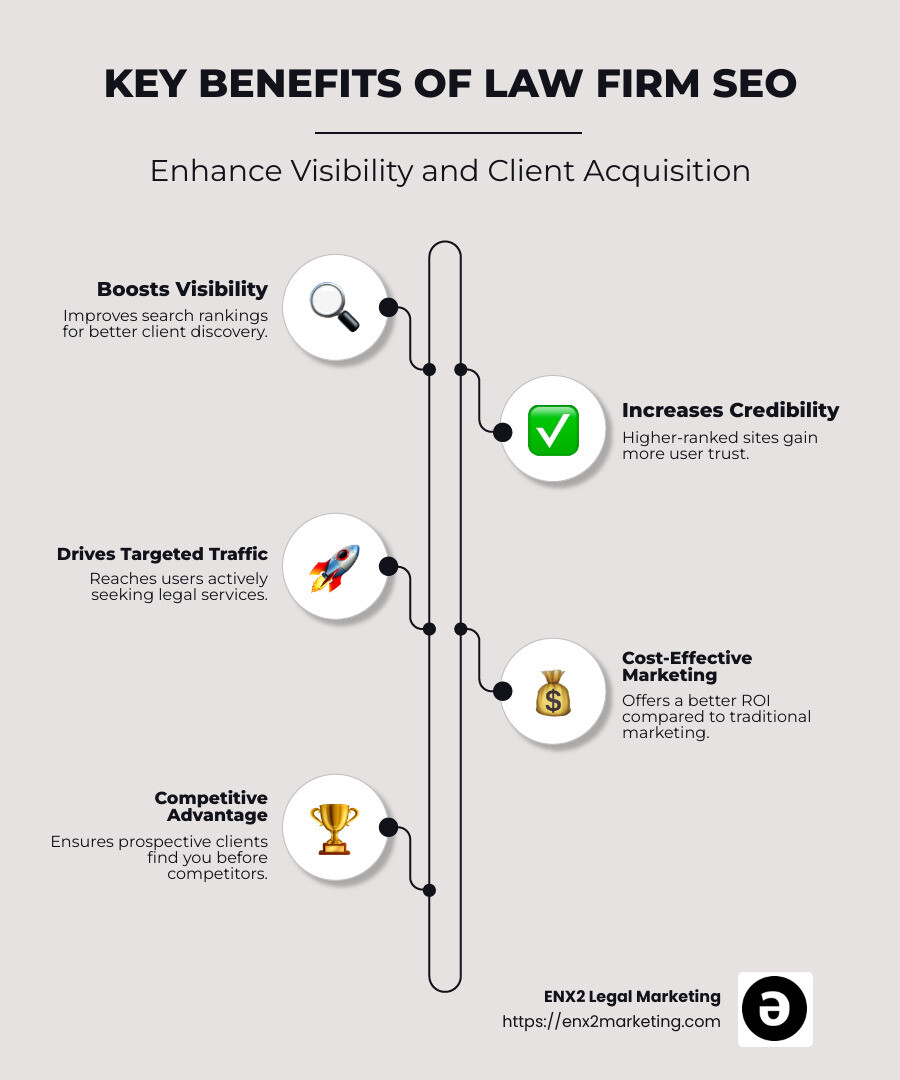
What makes SEO particularly powerful for law firms is its ability to deliver qualified leads with exceptional ROI. Unlike paid advertising where costs per click in legal verticals can exceed $100-300 for competitive keywords, organic search traffic—once established—continues generating leads without ongoing per-click costs. A well-executed SEO strategy compounds over time, with content and authority building upon itself to create sustainable competitive advantages that become increasingly difficult for competitors to overcome.
However, seo for lawyers presents unique challenges that differentiate it from SEO in other industries. Legal services fall under Google's "Your Money or Your Life" (YMYL) category, meaning search engines apply heightened scrutiny to legal websites, requiring exceptional expertise, authoritativeness, and trustworthiness (E-A-T). Additionally, the legal industry faces intense competition, strict advertising regulations, and the need to balance technical SEO requirements with ethical considerations governing attorney marketing.
This comprehensive guide will walk you through every aspect of attorney seo marketing, from foundational technical optimization to advanced content strategies. You'll discover how to conduct effective keyword research specifically for legal services, optimize your website architecture for maximum search visibility, create compelling content that converts prospects into clients, build authoritative backlinks that boost your domain authority, and implement local SEO tactics that dominate your geographic market.
Whether you're a solo practitioner looking to establish your first online presence, a small firm aiming to compete with larger competitors, or a multi-location practice seeking to scale your digital marketing efforts, this guide provides actionable strategies tailored to the unique demands of legal seo services. By the end, you'll have a clear roadmap for implementing a comprehensive SEO strategy that generates consistent, high-quality leads and positions your firm as the go-to authority in your practice areas.
The digital transformation of legal marketing isn't coming—it's already here. The question isn't whether your firm needs to invest in SEO, but rather how quickly you can implement these strategies to capture market share before your competitors do.
Understanding the Legal Case Quota Platforms such as enableSEO Landscape and Market Dynamics
The Unique Challenges of SEO for Attorneys
Search engine optimization for lawyers operates within a distinctly complex environment that sets it apart from virtually every other industry. The legal sector faces unprecedented competition in the digital space, with thousands of law firms vying for visibility in the same practice areas and geographic markets. This saturation has driven cost-per-click rates in paid search to astronomical levels—often $150-400 for premium keywords like "car accident lawyer" or "mesothelioma attorney"—making organic search visibility not just valuable but economically essential for sustainable growth.
The regulatory landscape adds another layer of complexity. Attorney advertising rules vary by state bar association, with specific restrictions on testimonials, guarantees, case outcomes, and even certain promotional language. These regulations directly impact content creation strategies, requiring legal marketers to balance persuasive copywriting with strict ethical compliance. A single violation can result in bar complaints, sanctions, or worse, making it critical that every piece of content undergoes compliance review before publication.
Google's E-A-T (Expertise, Authoritativeness, Trustworthiness) standards hit legal websites particularly hard because legal services directly impact people's lives, finances, and fundamental rights. Search engines scrutinize legal content more rigorously than almost any other category, requiring demonstrable credentials, author attribution, citation of authoritative sources, and evidence of real-world legal expertise. Generic content or poorly attributed articles can actively harm your rankings rather than help them.
Why Traditional Marketing Falls Short in the Digital Age
The shift from traditional to digital marketing represents more than just a change in medium—it reflects a fundamental transformation in how consumers research, evaluate, and select legal services. Traditional marketing methods like Yellow Pages advertising, billboards, television commercials, and radio spots operate on an interruption model, pushing messages to broad audiences regardless of their immediate need for legal services. This approach generates awareness but lacks the precision and measurability that modern law firms require.
Digital marketing, particularly SEO, operates on an attraction model. Rather than interrupting potential clients during their daily activities, SEO positions your firm to be discovered exactly when someone actively searches for the legal services you provide. This intent-based targeting means that traffic from organic search converts at dramatically higher rates than traditional advertising channels because these prospects have already self-identified their need and begun the evaluation process.
The measurability advantage cannot be overstated. Traditional marketing channels provide limited feedback—you might know how many people saw a billboard, but you can't track how many visited your office as a result or what their lifetime value became. SEO and digital marketing provide granular data on every interaction: which keywords drove traffic, which pages visitors viewed, how long they engaged with content, what actions they took, and ultimately which marketing efforts generated actual clients and revenue.
The Evolution of Search Engine Algorithms for Legal Queries
Search engines have become increasingly sophisticated in understanding user intent behind legal queries and delivering results that match not just keywords but the underlying needs those keywords represent. Early SEO focused primarily on keyword density and backlink quantity, but modern algorithms employ machine learning, natural language processing, and hundreds of ranking factors to evaluate content quality, relevance, and authority.
For legal queries specifically, Google has implemented specialized algorithm components that prioritize local relevance, professional credentials, and content freshness. When someone searches for "divorce lawyer," the algorithm doesn't simply match those words—it interprets the searcher's location, evaluates whether they need information or representation, considers their likely budget and case complexity, and delivers results calibrated to those inferred needs.
The introduction of Google's BERT (Bidirectional Encoder Representations from Transformers) and subsequent MUM (Multitask Unified Model) updates has revolutionized how search engines process legal queries. These natural language processing technologies understand context, synonyms, and even the relationships between different legal concepts. This means that content must be genuinely comprehensive and authoritative rather than simply optimized for specific keyword phrases.
Current SEO Trends Reshaping Legal Marketing
Voice search has emerged as a significant factor in legal SEO, with studies showing that approximately 27% of the global online population uses voice search on mobile devices. Voice queries tend to be longer, more conversational, and question-based ("What should I do after a car accident?") rather than keyword-focused ("car accident lawyer"). This shift requires content strategies that address natural language questions and provide direct, concise answers suitable for voice assistants.
Mobile-first indexing has become the standard, with Google now predominantly using the mobile version of websites for indexing and ranking. For law firms, this means that mobile optimization isn't optional—sites that don't deliver excellent mobile experiences face ranking penalties regardless of their desktop performance. This includes fast loading speeds, touch-friendly navigation, click-to-call functionality, and content formatted for smaller screens.
The rise of zero-click searches presents both challenges and opportunities. Google increasingly provides direct answers in featured snippets, knowledge panels, and local packs, meaning users can get information without clicking through to websites. While this reduces click-through rates, capturing these featured positions establishes authority and brand recognition that drives traffic through other channels.
How Legal Consumers Research and Select Attorneys
The modern legal consumer journey follows a predictable pattern that smart SEO strategies can intercept at multiple touchpoints. The process typically begins with a triggering event—an accident, arrest, divorce decision, or business dispute—that creates immediate legal need. The initial search is often informational ("do I need a lawyer for a fender bender") as the person tries to understand their situation and options.
As understanding develops, searches become more specific and solution-oriented ("personal injury lawyer free consultation"). At this stage, consumers begin evaluating specific firms, reading reviews, examining credentials, and comparing options. They typically visit 3-5 law firm websites before making contact, spending an average of 2-4 minutes on each site reviewing attorney profiles, case results, and client testimonials.
The decision phase involves direct comparison and often includes searching for firm names specifically, reading third-party reviews on Google, Avvo, or Yelp, and potentially seeking recommendations from friends or family. Approximately 88% of consumers trust online reviews as much as personal recommendations, making reputation management an integral component of effective legal SEO.
Understanding this journey allows law firms to create content and optimization strategies that address each stage. Informational content captures early-stage researchers, service pages convert mid-stage evaluators, and strong local SEO with positive reviews closes deals with late-stage decision-makers. A comprehensive SEO strategy ensures your firm appears at every stage of this journey, building familiarity and trust that culminates in client acquisition.
Comprehensive Keyword Research for Legal Services
Identifying High-Value Legal Keywords for Your Practice Areas
Effective keyword research forms the foundation of successful seo attorney strategies, yet most law firms approach this critical task with insufficient rigor or strategic thinking. High-value legal keywords aren't simply those with the highest search volume—they're terms that indicate strong intent, align with your specific services, and represent cases your firm actually wants to handle. A personal injury firm might rank #1 for "legal advice" and receive thousands of visitors, but if those visitors need estate planning or immigration services, that traffic generates zero revenue.
The keyword research process begins with brainstorming seed keywords—the fundamental terms that describe your practice areas. For a personal injury firm, these might include "personal injury lawyer," "car accident attorney," "slip and fall lawyer," and "wrongful death attorney." For a family law practice, seeds might include "divorce lawyer," "child custody attorney," "alimony modification," and "prenuptial agreement lawyer." These seeds serve as starting points for expansion into more specific, targeted keyword variations.
Keyword research tools like Ahrefs, SEMrush, or Moz Keyword Explorer reveal search volumes, competition levels, and related keyword suggestions. However, raw data requires interpretation through the lens of legal marketing realities. A keyword showing 1,000 monthly searches might be far more valuable than one with 10,000 searches if the former represents high-intent prospects seeking immediate representation while the latter attracts information seekers with no intention to hire an attorney.
Geographic modifiers dramatically impact keyword value for law firms. "Personal injury lawyer" is a generic term with massive competition and unclear intent, while "personal injury lawyer in Austin Texas" indicates someone specifically seeking local representation. These geo-targeted keywords typically convert at 3-5 times higher rates than generic terms because they represent prospects who have already decided on their location preference and are further along in the decision-making process.
Understanding Search Intent Behind Legal Queries
Search intent categorization—understanding what users actually want when they type specific queries—separates sophisticated legal SEO strategies from amateur efforts. Legal searches generally fall into four intent categories: informational (seeking knowledge), navigational (looking for a specific firm or attorney), transactional (ready to hire), and commercial investigation (comparing options before hiring).
Informational intent queries include terms like "what is a deposition," "how long does a divorce take in California," or "do I need a lawyer for a DUI." These searches represent early-stage prospects who may not yet be ready to hire but are educating themselves about legal processes. Content targeting these keywords should be educational, comprehensive, and position your firm as a knowledgeable resource without aggressive sales language. Blog posts, guides, and FAQ pages serve these queries effectively.
Commercial investigation queries reveal prospects actively comparing options: "best personal injury lawyer in Miami," "top-rated divorce attorney reviews," or "how much does a bankruptcy lawyer cost." These searchers are closer to hiring decisions and need content that differentiates your firm from competitors. Service pages with clear Case Quota Platforms such as enablevalue propositions, attorney profiles highlighting credentials and experience, case results demonstrating success, and client testimonials building trust serve these queries.
Transactional intent keywords indicate immediate readiness to engage: "personal injury lawyer free consultation," "hire DUI attorney tonight," or "emergency custody lawyer." These high-value keywords require optimized landing pages with prominent calls-to-action, easy contact methods (click-to-call buttons, contact forms), and clear next steps. These pages should minimize friction and make it as easy as possible for prospects to take action.
Long-Tail Keywords: The Secret Weapon for Legal SEO
Long-tail keywords—longer, more specific keyword phrases typically containing three or more words—represent one of the most underutilized opportunities in lawyer seo marketing. While these terms individually generate lower search volumes than broad keywords, they collectively account for approximately 70% of all search traffic and convert at significantly higher rates due to their specificity.
Consider the difference between "lawyer" (extremely broad, highly competitive, unclear intent) and "truck accident lawyer for commercial vehicle collision in Dallas" (specific, lower competition, crystal-clear intent). The latter phrase might only generate 50 searches monthly compared to tens of thousands for "lawyer," but every single one of those 50 searches represents someone with a precise need that matches your services exactly. The conversion rate on long-tail traffic often exceeds 10-15% compared to 1-3% for broad terms.
Long-tail keywords also provide content creation opportunities that address specific questions and scenarios potential clients face. Phrases like "can I sue if I was partially at fault for car accident," "how to modify child support when I lost my job," or "what happens if I refuse a breathalyzer test" represent real questions people ask. Creating dedicated content answering these specific queries positions your firm as helpful and knowledgeable while capturing traffic that competitors ignore.
The competitive advantage of long-tail keywords is substantial. While every law firm in your market fights for rankings on "personal injury lawyer [city]," far fewer target "dog bite injury lawyer for children in [neighborhood]." This lower competition means faster rankings, less link building required, and the ability to dominate niche segments that larger competitors overlook. Over time, ranking for hundreds of long-tail keywords generates more qualified traffic than ranking for a handful of competitive head terms.
Local SEO Keywords and Geographic Targeting
For most law firms, local search dominates lead generation, making geographic keyword targeting absolutely essential. Local SEO keywords combine practice area terms with location modifiers at various levels of specificity: city-level ("divorce lawyer Chicago"), neighborhood-level ("divorce lawyer Lincoln Park"), and even landmark-based ("divorce lawyer near Willis Tower"). Each variation captures different segments of your local market.
The "near me" phenomenon has transformed local legal search. Searches for "lawyer near me" have grown over 500% in recent years as mobile search has expanded and voice search has become mainstream. These queries rely heavily on Google's local pack results and require robust Google Business Profile optimization, consistent NAP (Name, Address, Phone) citations, and strong local relevance signals throughout your website.
Multi-location firms face additional complexity in geographic targeting. Each office location requires dedicated location pages optimized for that specific market, with unique content that goes beyond simply changing the city name in a template. Google penalizes duplicate content across location pages, so each page needs genuinely unique information about that office, the attorneys who work there, the local community, and location-specific legal considerations.
Neighboring cities and suburbs represent expansion opportunities for geographic keyword targeting. If your firm is located in a major city, potential clients in surrounding communities often search for lawyers in their own towns. Creating content targeting these adjacent markets—even if you don't have physical offices there—can capture additional traffic from prospects willing to travel to your location or conduct consultations remotely.
Competitive Keyword Gap Analysis
Understanding which keywords your competitors rank for that you don't reveals immediate opportunities for traffic growth. Competitive keyword gap analysis involves identifying the top-ranking competitors in your market, analyzing their keyword portfolios, and discovering gaps where they've achieved visibility that you haven't. These gaps represent proven opportunities—if competitors are successfully ranking for these terms and generating traffic, you can too.
Tools like SEMrush and Ahrefs offer dedicated competitive gap analysis features that compare your domain against up to five competitors simultaneously, highlighting keywords where competitors rank in the top 10 but your site doesn't appear at all. This analysis should focus on competitors with similar firm sizes and practice areas rather than mega-firms with vastly greater resources, as their keyword strategies may not be replicable for smaller practices.
Beyond identifying gaps, analyze why competitors succeed with certain keywords. Examine the content they've created, the backlinks supporting those pages, the user experience elements they employ, and how they've structured information. This competitive intelligence informs your own content creation