

In the legal world, your website isn't just a digital business card—it's the engine of your entire business development strategy. Great web design for attorney practices is all about building immediate trust, showing off your expertise, and gently pushing potential clients toward that "contact us" button.
A professional, easy-to-use site is often the one thing that convinces a client to choose you over the firm down the street.
Why Your Website Is Your Most Important Partner
Think of your website as the digital front door to your firm. It’s the very first impression most people will have of your practice, and they’ll make a judgment call in seconds.
An outdated, slow, or confusing website doesn't just fail to bring in business; it actively scares it away, sending good leads straight to your competition. In a market where every single case matters, that's a mistake you can't afford.
Your site is the central hub for all your marketing. Whether someone finds you on Google, sees a social media post, or gets a referral, their next move is almost always a visit to your website. This is where they decide if you’re the real deal.
The Credibility Gap in Legal Web Design
Having a website is table stakes now. In fact, 94% of firms are online. But there's a huge difference between just having a site and having one that actually works for you.
Here’s a shocking number: a full 29% of firms haven't touched their websites in over two years. That’s a massive opportunity for attorneys who are paying attention. You can check out more legal marketing stats on andava.com to see just how big that competitive advantage can be.
This "set it and forget it" attitude means a lot of law firm websites are suffering from:
- Outdated Information: Showing off old attorney bios, wrong phone numbers, or irrelevant case results.
- A Terrible Mobile Experience: They’re basically unusable on a smartphone, which is where most clients start their search.
- Security Holes: Lacking basic security, which completely shatters client trust.
Your website isn’t just another marketing line item. It's a direct reflection of your firm's professionalism, attention to detail, and commitment to your clients. A neglected site signals a neglected practice.
Your Hardest-Working Team Member
A well-built website works for you 24/7. It answers basic questions, demonstrates your expertise with blog posts and case studies, and helps pre-qualify the exact types of cases you want.
Smart web design for attorney professionals builds a site that doesn’t just look good, but acts as a lead-generation machine.
It streamlines your intake, educates potential clients, and builds a foundation of trust long before you ever pick up the phone. By focusing on a clean, modern design that puts the user first, you create a space where clients feel confident and understood. Proper website optimization for law firms turns your site from a static brochure into an active partner in your firm's growth, paving the way for long-term success.
Building Your Digital Strategy Before You Build Your Site
A high-performing attorney website doesn't start with picking a color scheme or a fancy font. It begins with a rock-solid digital strategy. Think of it as the blueprint for every design choice, piece of content, and call-to-action you create.
Without this foundation, even the most beautiful site is just a digital brochure floating aimlessly in cyberspace.
Jumping straight into design is like building a house without architectural plans. Sure, you might end up with something that looks okay, but it won't be functional, efficient, or capable of hitting your firm's growth targets. A strategic approach ensures your investment in web design for attorney services actually delivers a tangible return.
Define Your Website's Primary Goals
Before a single line of code gets written, you have to define what success actually looks like. And no, vague goals like "get more clients" just don't cut it. Your objectives need to be specific, measurable, and tied directly to what your firm needs to grow.
Here are a few concrete examples:
- Increase qualified consultation requests for our family law practice by 25% within six months.
- Become the top-ranking local resource for "criminal defense attorney in [Your City]" to drive organic traffic.
- Attract five new high-value corporate litigation cases through the website this year.
Setting clear goals helps you and your web design team make smart decisions from day one. A site designed to attract high-volume, quick-turnaround cases will look and function very differently from one built to secure complex, high-stakes litigation clients. This upfront planning is a core part of building a successful law firm marketing plan template that aligns your online presence with your real-world business goals.
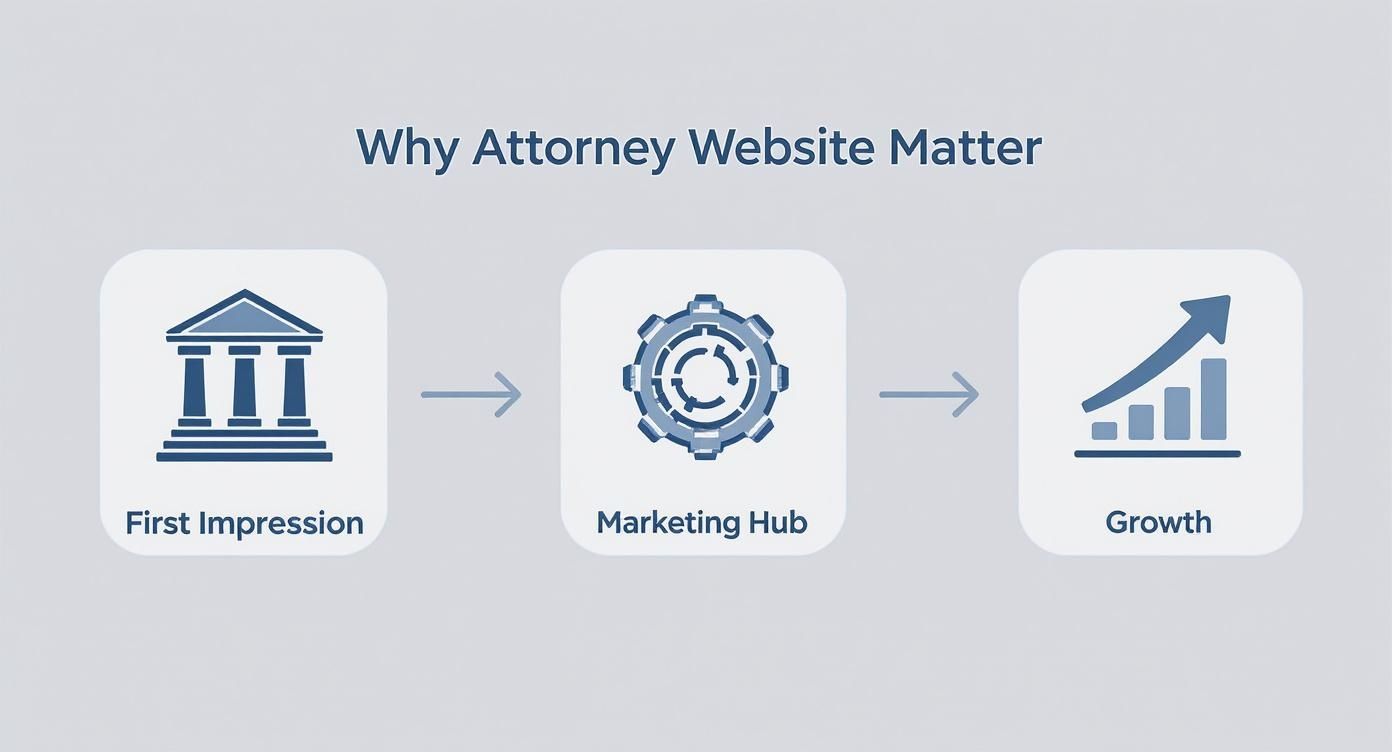
As you can see, a professional website is the central hub that converts that first flicker of interest into measurable growth for your firm.
Understand Your Ideal Client's Mindset
Once your goals are set, the next critical step is getting inside the head of your ideal client. Who are you actually trying to reach? What keeps them up at night? Answering these questions is how you build a website that connects on a human level, not just a professional one.
Someone searching for a personal injury lawyer after a car accident is in a completely different headspace than a business owner needing a contract reviewed. The first person is likely stressed, in pain, and desperate for immediate reassurance. The second is analytical, cost-conscious, and looking for proven expertise. Your website's tone, imagery, and content have to speak directly to their specific situation.
A great attorney website doesn't just list services; it answers the unspoken questions and calms the specific fears of its target audience. It shows empathy before it shows expertise.
This deep understanding influences everything. For instance, 68% of law firms now have mobile-responsive sites, which is absolutely essential because many potential clients are searching for legal help on their phones in a moment of crisis.
In fact, a staggering 60% of smartphone users will contact a firm directly from Google search results. That makes a seamless mobile experience critical for capturing leads the moment they arise.
With your digital strategy locked in, you can then explore proven strategies to improve website conversions. This strategic groundwork ensures your final website isn't just a pretty design, but a powerful, purpose-built asset for your law firm.
Design Choices That Build Instant Credibility and Trust

You have about three seconds. That’s the window you get when a potential client lands on your website. In that tiny sliver of time, they’re making a snap judgment about your firm, and every design choice you've made is either building their confidence or sending them running.
This is where great design becomes more than just looks; it's a powerful tool for conversion. A professional, trustworthy site acts as your digital handshake. It conveys authority and competence long before a visitor reads a single word about your legal victories. It's not about flash or gimmicks. It's about creating a clean, modern, and intuitive experience that reassures people they’ve found the right counsel.
The Power of a Clean and Modern Aesthetic
An outdated, cluttered website is the online equivalent of a disorganized office with stacks of paper everywhere. It screams chaos and a lack of attention to detail—two qualities no one wants in their lawyer. A modern, clean design, on the other hand, immediately communicates efficiency, focus, and professionalism.
This is why minimalism and white space are your best friends. Giving your content room to breathe guides the visitor's eye directly to what matters most: your value proposition, your practice areas, and your contact information. It’s not boring; it's direct.
Your website’s design is a visual promise of the client experience you offer. A clear, professional design signals a clear, professional approach to their case. It’s the first piece of evidence you present to build trust.
Think about the feeling you want to convey. A family law practice might use calming blues to create a sense of stability during a stressful time. A high-stakes corporate litigation firm could use a bolder, more assertive color palette to project strength. Consistency is everything. For a great example of this in action, check out Philbrook Law's approach and see how their design choices build their brand.
Crafting an Intuitive Navigation Experience
If someone can't find what they're looking for in a couple of clicks, they're gone. They won't struggle through a confusing menu; they'll just hit the back button and find a competitor whose site is easier to use. That's why intuitive navigation isn't a feature—it's a fundamental requirement.
Keep your main menu simple and logical. Visitors have predictable questions they need answered right away. Your navigation should cater to them.
- Attorney Profiles: Who are these lawyers? What's their background?
- Practice Areas: Can they actually handle my specific problem?
- Case Results / Testimonials: Have they won cases like mine before?
- Contact Us: How do I get in touch with them now?
When you structure your site around what the user needs, you remove friction. You show them you respect their time, which immediately positions your firm as helpful and accessible—a huge step toward earning their business.
Essential Pages Your Law Firm Website Needs
Every law firm website needs a core set of pages to inform visitors, build trust, and drive conversions. Think of these as the non-negotiable foundation of your online presence. Each page serves a distinct purpose, and together, they guide a potential client from initial curiosity to making that first call.
| Page Type | Primary Goal | Key Content Elements |
|---|---|---|
| Homepage | Make a strong first impression, funnel visitors to key areas. | Compelling headline, clear value proposition, overview of practice areas, client testimonials, clear call-to-action. |
| About Us / Firm Overview | Build a personal connection and establish firm credibility. | Firm's story/mission, partner bios, professional photos of the team, awards and recognitions. |
| Attorney Profiles | Showcase individual expertise and build personal trust. | Detailed bio, education, bar admissions, notable cases, professional headshot, direct contact info. |
| Practice Area Pages | Attract targeted traffic and demonstrate specific expertise. | In-depth explanation of the legal service, types of cases handled, client-focused FAQs, relevant case results. |
| Case Results / Testimonials | Provide social proof and validate your firm's track record. | Detailed case summaries (protecting confidentiality), direct client quotes, video testimonials, tangible outcomes. |
| Blog / Resources | Demonstrate thought leadership and attract organic search traffic. | Informative articles, legal updates, guides answering common client questions, organized by category. |
| Contact Us | Make it incredibly easy for leads to get in touch. | Contact form, phone number, physical address with map, email address, hours of operation. |
Having these pages well-executed is table stakes for a successful legal website. They answer the critical questions every potential client has and provide the proof they need to feel confident in choosing your firm.
Strategic Placement of Trust Signals
Beyond the overall design, your site must be peppered with "trust signals"—the little pieces of evidence that prove you're the real deal. These are the logos, awards, and testimonials that back up your claims of expertise.
But just having them isn't enough. You have to place them where they'll have the most impact, right at the moment a visitor might be feeling a bit of doubt.
Think about these strategic placements:
- Powerful Testimonials: Don't just bury them on a dedicated page. Put your best client quote right on the homepage or at the top of a relevant practice area page.
- Case Result Highlights: After explaining a legal service, immediately follow up with a short, punchy summary of a major win in that area.
- Awards and Badges: Display logos from organizations like Super Lawyers or Avvo in your website's footer or on your "About Us" page so they're always visible.
- Professional Photography: Ditch the stock photos. Nothing screams "impersonal" like a generic photo of a gavel. Use high-quality, professional headshots of your actual team.
These elements work together to build a powerful, convincing case for your firm. You can see how top firms integrate these trust signals by checking out these examples of the best attorney website design. By making these thoughtful, client-first design choices, your website will do more than just exist online—it will become your most effective advocate.
Weaving SEO into Your Website's DNA

A beautiful website that no one ever finds is like delivering a masterful closing argument to an empty jury box. It’s pointless. For a law firm, real success online comes from baking Search Engine Optimization (SEO) into your site’s architecture right from the start.
This isn’t something you bolt on later. It has to be part of the blueprint. When SEO is woven into the design, every decision—from the way you structure your pages to how you name your image files—is made with one goal in mind: attracting your ideal client. Trying to retrofit a pretty-but-invisible website for search engines is a painful, uphill battle you don't want to fight.
Uncovering What Your Clients Actually Search For
The bedrock of any solid legal SEO strategy is getting inside the head of a potential client who's in trouble. They aren't Googling "tortious interference." They're typing in things like "my business partner stole money" or "best child custody lawyer near me." That's where keyword research comes in.
This is the process of using specialized tools to figure out the exact phrases and questions your target audience is using. The goal is to pinpoint the terms that show someone is ready to hire a lawyer, especially in your city or region.
- Long-Tail Keywords: Think of these as conversational phrases, like "how to file for an uncontested divorce in Florida." They might get fewer searches, but the person searching has a very specific problem and is much closer to making a call.
- Local Intent Keywords: These are pure gold. Phrases like "Phoenix DUI attorney free consultation" signal that the searcher isn't just researching; they're looking to hire someone now. Your site has to be built to show up for these.
When you build your website content around these exact phrases, you stop guessing what clients need. You meet them exactly where they are with the precise answers they're looking for.
Structuring Your Content for Maximum Visibility
Once you know the keywords you're targeting, you have to organize your website to show Google what you're all about. This involves everything from the technical elements on each page to the overall sitemap.
Think of each practice area page as its own focused hub of expertise. A single, generic page for "Family Law" is way too broad. It's much more effective to create dedicated pages for "Divorce," "Child Custody," "Alimony," and "Prenuptial Agreements." This strategy lets you target hyper-specific keywords on each page, dramatically increasing your chances of ranking.
A well-organized site with a clear, logical hierarchy makes it easy for search engines to understand your firm's expertise. That clarity is rewarded with higher rankings—it's that simple.
Here are a few technical on-page elements that are absolutely critical to get right:
- Title Tags: This is the clickable headline in Google's search results. It needs your main keyword and location (e.g., "Austin Car Accident Lawyer | The Smith Law Firm").
- Meta Descriptions: This is the little blurb of text under the title tag. It doesn't directly impact your rank, but a well-written one can be the difference between a user clicking on your site or your competitor's.
- Headings (H1, H2, H3): Use these to structure your content. The main page title should be your H1, with subtopics organized under H2s and H3s. This helps both users and search engines follow the flow of your information.
Nailing these details is a huge part of outmaneuvering local competitors. If you want to go deeper, check out this guide on understanding the fundamentals of SEO for law firms to build an even stronger foundation.
Building Authority with a Resource Center
One of the most powerful SEO moves a law firm can make is creating a blog or "resource center" that answers the questions potential clients constantly ask. This does more than just bring in traffic; it establishes your firm as a trusted authority long before someone is ready to sign a retainer agreement.
Just think about the questions you hear over and over again in your initial consultations. Every single one is a potential blog post.
- "What Are the First Steps After a Car Accident in California?" This kind of article attracts people right at the beginning of their journey, when they need guidance most.
- "How Is Property Divided in a Texas Divorce?" You can provide immense value to someone considering divorce, positioning your firm as the go-to expert.
- "Do I Need a Trust or a Will?" Answering this common estate planning question can bring in highly qualified, high-value leads.
Creating this kind of helpful content accomplishes two critical things. First, it pulls in organic traffic from people who aren't quite ready to hire an attorney but are desperate for information. Second, it builds a deep library of content that signals to Google that your website is a credible source, which in turn boosts the SEO performance of your entire site.
Staying Compliant: Web Accessibility and Attorney Ethics
For any law firm, a website is much more than a marketing brochure. It's a direct reflection of your practice, and it comes with serious legal and ethical weight. Get it wrong, and you could be looking at demand letters, lawsuits, or even a state bar investigation that puts your reputation on the line.
But this isn't about boxing yourself in. Thinking about these rules from the start is about building a more inclusive, trustworthy brand. An accessible and ethically sound website doesn't just protect you—it widens your reach to all potential clients and cements your status as a credible authority in your field.
Making ADA Compliance a Top Priority
The Americans with Disabilities Act (ADA) has made it clear that public accommodations must be accessible, and courts have consistently ruled that websites fall into that category. If someone using a screen reader can't navigate your site, or a video explaining a complex legal issue has no captions, you’ve essentially locked your digital doors to a whole segment of the population.
This isn't just a legal hoop to jump through; it's a business reality. Over 61 million adults in the United States live with some form of disability. An inaccessible website tells that massive potential client base that your firm isn't for them.
So, what does this look like in practice?
- Alt Text for All Images: Every image needs descriptive "alt text" so screen readers can explain the visual content to users who can't see it.
- Full Keyboard Navigation: Can someone navigate your entire site—menus, forms, links—using only a keyboard? This is absolutely essential for users with motor disabilities.
- Captions and Transcripts: All videos must have accurate, synchronized captions. It's also best practice to provide full transcripts for both video and audio content.
- Readable Color Contrast: Your text needs to stand out clearly against its background. Low-contrast color schemes can make your site unreadable for users with vision impairments.
For a deep dive into every requirement, our ADA compliance checklist for websites is the perfect resource to walk you through it all, step by step.
Playing by the State Bar's Advertising Rules
As every lawyer knows, advertising is a tightly regulated area. Your website is advertising, plain and simple. While the specific rules can differ between states, the core principles are the same everywhere. Violating them can bring serious heat from your state bar.
First and foremost, your website copy has to be truthful and can't be misleading. This means no guarantees, no inflated claims about your success rate, and no language that creates false hope. A phrase like "We always win" is a massive red flag and a clear ethical breach.
Your website's content is held to the same ethical standard as a TV ad or billboard. Every claim must be verifiable, and every word should reflect your professional responsibility.
Think hard about how you present your track record. Instead of making sweeping promises, focus on providing factual, helpful information that showcases your experience and empowers potential clients to make an informed decision.
Writing Copy That's Ethically Sound
Striking the right balance between persuasive marketing and your ethical duties is a skill. You want to build trust and encourage potential clients to reach out, but you can't cross the line. This means being deliberate about every word on your site, from attorney bios to practice area pages.
Here are a few critical points to keep in mind:
- Disclaimers are Non-Negotiable: You need a clear statement that the information on your site is for informational purposes only and does not create an attorney-client relationship. Stick this in the footer of every page so it's always visible.
- Don't Claim to Be a "Specialist" (Unless You Are): In most states, you can't call yourself an "expert" or "specialist" unless you hold an official board certification. Instead, use phrases like "focuses on," "practices primarily in," or "concentrates on."
- Handle Testimonials with Care: Client testimonials are incredibly powerful, but they must be real and not misleading. Some states have very specific rules on how you can use them, so always double-check your local bar association's guidelines.
By weaving ADA compliance and strict ethical standards into your web design from the beginning, you're not just protecting your firm from liability. You're building a stronger, more reputable online presence that serves every potential client with the integrity they deserve.
Common Questions About Attorney Web Design
Even with a solid game plan, starting a new website project always brings up a bunch of questions. How much is this really going to cost? Can't I just build it myself with one of those DIY tools?
Getting straight answers to these questions upfront is key. It helps you set realistic expectations and make the right calls for your firm's most important marketing asset. Let's tackle the questions we hear most often from attorneys, based on our years of experience in web design for attorney clients.
How Much Should a Law Firm Website Cost?
This is always the first question, and the honest answer is: it depends. A simple, template-based website might only run you a few thousand dollars. But a completely custom-designed site, packed with great content and optimized for search engines, can easily cost $25,000 or more.
So, what drives that price? A few key things:
- Custom vs. Template Design: A unique design built from the ground up costs more than a pre-made template. The tradeoff? A custom site lets you build a brand and user experience that speaks directly to your ideal client.
- Content Creation: Are you writing all the copy for your practice area pages and attorney bios, or are you hiring a pro? High-quality, SEO-driven content is an investment in itself.
- Number of Pages: It's simple math. A basic five-page site is a lot cheaper to build than a 50-page site with deep legal resources and a dozen practice area pages.
- Advanced Features: Need a secure client portal? Online payment options? Complex intake forms? Any custom functionality adds to the development time and, naturally, the cost.
The best way to think about your website isn't as an expense, but as a long-term investment. A well-built site that brings in even one or two high-value cases can pay for itself many times over, year after year.
Can I Use a DIY Builder Like Squarespace or Wix?
Look, DIY website builders are popular for a reason. They’re simple, cheap, and for a solo attorney on a shoestring budget, they can seem like a great option. And for a lot of small businesses, they're perfectly fine.
But for most law firms trying to compete in a crowded market, they come with serious limitations. A DIY site is a hundred times better than no site at all, but it often lacks the professional credibility, custom features, and SEO firepower you need.
A professional site built on a more serious platform like WordPress gives you the room to grow. The real difference is control. With a DIY builder, you’re stuck inside their walled garden. With a WordPress site, you (or your agency) have total control over the design, the features, and the SEO—all of which are critical for attracting local clients and building a brand that inspires trust. Professionals specializing in web design for attorney clients can turn that control into a powerful marketing engine.
How Long Does It Take to Launch a New Attorney Website?
Building a professional law firm website isn't an overnight job. A realistic timeline, from the first strategy call to flipping the switch and going live, is usually somewhere between 6 and 16 weeks.
That might sound like a long time, but a lot has to happen to get it right:
- Strategy and Planning: We have to define your goals, nail down your target audience, and map out the site's structure.
- Design Mockups: This is where we create the visual look and feel of the site for your approval.
- Content Development: Someone has to write and gather all the text, photos, and videos.
- Coding and Development: Our team takes the approved designs and turns them into a living, breathing website.
- Testing and Revisions: We check everything to make sure it works perfectly on every phone, tablet, and computer out there.
Honestly, the biggest thing that impacts the timeline is often you—the client. The project moves as fast as your firm provides feedback, approves designs, and delivers content like attorney bios or case results. Clear communication and a shared commitment to the schedule are what make for a smooth, successful launch.
Are you ready to build a website that not only looks professional but also acts as your firm's most powerful client acquisition tool? The team at Case Quota has over 15 years of experience creating SEO-first, ADA-compliant websites that help attorneys stand out. Learn more about our web design services and schedule a consultation today.