
Product liability law is constantly evolving, shaped by landmark cases that set new precedents and redefine corporate responsibility. For personal injury attorneys, understanding the nuances of these historical battles is not just an academic exercise; it’s a masterclass in strategy, evidence, and courtroom tactics. Studying these pivotal product liability case examples offers a direct line into the minds of the litigators who shifted legal paradigms and held some of the world’s largest corporations accountable.
This article moves beyond surface-level summaries to provide a deep strategic analysis of six influential cases. We will dissect the specific legal arguments, tactical decisions, and key pieces of evidence that led to groundbreaking verdicts and settlements. The goal is to furnish a practical playbook for modern personal injury law firms, translating historical legal victories into replicable strategies for today’s complex litigation landscape.
Readers will gain actionable insights into:
- Evidence Discovery: Uncovering and leveraging damaging internal corporate documents.
- Narrative Framing: Shaping the case narrative around public safety and corporate negligence.
- Expert Testimony: Strategically deploying experts to dismantle corporate defenses.
- Precedent Setting: Understanding how these cases created new legal standards for design defects, failure to warn, and punitive damages.
By examining the mechanics behind these landmark rulings, from the Ford Pinto’s infamous cost-benefit analysis to the decades-long litigation over Johnson & Johnson’s talcum powder, you will find concrete tactics applicable to your own practice. This is not just a review of legal history; it is a strategic guide to winning challenging product liability claims.
1. Ford Pinto Gas Tank Defect (1970s)
The Ford Pinto case stands as one of the most notorious product liability case examples in American history, serving as a powerful lesson on the catastrophic consequences of prioritizing profits over consumer safety. The case centered on a critical design flaw in the Pinto’s fuel tank system. Its placement behind the rear axle and lack of reinforcement made it highly susceptible to rupture and explosion during low-speed rear-end collisions.
Internal documents, later revealed during litigation, showed that Ford’s engineers were aware of this deadly defect before the car even went to market. However, the company performed a now-infamous cost-benefit analysis. This memo calculated that the cost of recalling and fixing the cars would be significantly higher than the projected cost of paying settlements for burn deaths and injuries. This decision to consciously endanger the public for financial gain became the central, damning piece of evidence in subsequent lawsuits.
Case Spotlight: Grimshaw v. Ford Motor Co. (1981)
The most prominent case was Grimshaw v. Ford Motor Co., involving Richard Grimshaw, a passenger who suffered devastating burns when his Pinto burst into flames after a rear-end collision. The driver, Lilly Gray, was killed in the incident.
The plaintiff’s legal team built their case around Ford’s reckless disregard for human life. Their strategy hinged on exposing the internal “Pinto Memo,” which clearly demonstrated Ford’s calculated decision to forego safety improvements.
Strategic Tactic: The plaintiff’s attorneys focused heavily on the moral and ethical failures of the company, not just the technical design defect. By framing the case around corporate malice and a cold-hearted financial calculation, they successfully invoked the jury’s outrage, paving the way for a massive punitive damages award.
The jury found Ford liable and awarded an initial verdict of $125 million in punitive damages (later reduced to $3.5 million by the judge), one of the largest product liability awards of its time. This verdict sent a powerful message to corporations nationwide that consciously disregarding consumer safety would have severe financial consequences.
Visualizing the Pinto Timeline
The following timeline highlights the key events that defined this landmark case, from the car’s launch to the revealing of the internal memo and the landmark verdict.
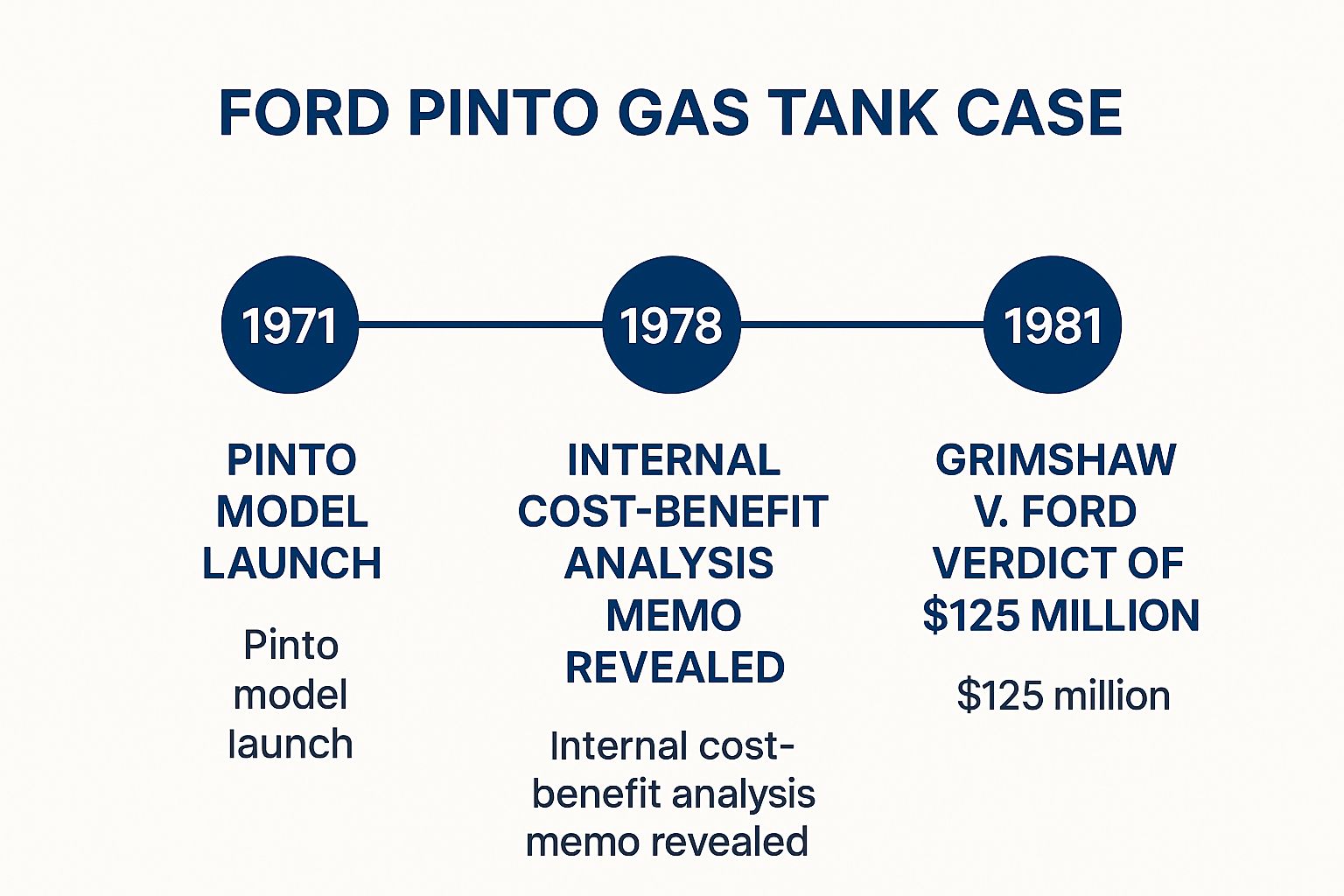
This progression shows a decade-long gap between the product’s launch and the final court verdict, underscoring the lengthy battle required to hold the company accountable.
Actionable Takeaways for Personal Injury Attorneys
The Ford Pinto case offers timeless strategies for attorneys handling product liability claims, particularly those involving corporate negligence.
- Prioritize Discovery of Internal Documents: The “smoking gun” is often found in the defendant’s own files. Focus discovery efforts on internal memos, safety test results, engineering reports, and internal cost-benefit analyses. These documents can prove the defendant’s prior knowledge of the defect.
- Frame the Narrative Around Corporate Malice: Jurors respond strongly to evidence of intentional wrongdoing. If you can show that a company knew about a danger and chose not to act, it shifts the case from a simple negligence claim to a story of deliberate endangerment, justifying significant punitive damages.
- Utilize Expert Witnesses: In Grimshaw, experts effectively explained the design flaw and the simple, inexpensive fixes Ford could have implemented. Use engineers and industry insiders to break down complex technical issues and highlight the feasibility of safer alternatives.
2. McDonald’s Hot Coffee Case – Liebeck v. McDonald’s (1994)
Often mischaracterized in popular media as a frivolous lawsuit, the case of Liebeck v. McDonald’s Restaurants is one of the most significant and misunderstood product liability case examples in modern history. It highlights a corporation’s liability for failing to warn consumers about a known, severe danger associated with its product. The case involved 79-year-old Stella Liebeck, who suffered third-degree burns to her pelvic region when a cup of McDonald’s coffee, served at a dangerously high 180-190°F, spilled on her lap.

The severe injuries required extensive skin grafts and eight days of hospitalization. What transformed this from a simple accident into a landmark case was the revelation during discovery that McDonald’s had received over 700 prior reports of customers being burned by its coffee. Despite this extensive history of injuries, the company had made no effort to reduce the temperature or provide more adequate warnings, believing the number of complaints was statistically insignificant compared to the millions of cups sold. This deliberate indifference to a known hazard became the core of the plaintiff’s case.
Case Spotlight: Liebeck v. McDonald’s Restaurants (1994)
The legal battle centered on McDonald’s failure to warn and its defective product policy. Stella Liebeck initially only sought to cover her medical expenses, around $20,000, but McDonald’s refused to settle for more than $800. This refusal pushed the case to trial, where the full extent of the company’s negligence was exposed.
The plaintiff’s attorney, S. Reed Morgan, focused his strategy on demonstrating the severity of the burns and McDonald’s long-standing awareness of the danger. He argued that coffee served at that temperature was not just hot but unreasonably dangerous, capable of causing full-thickness burns in seconds.
Strategic Tactic: The legal team shifted the narrative from a simple “spilled coffee” incident to a story of corporate neglect. They used expert testimony to establish that coffee at 180-190°F is unsafe for human consumption and presented the 700 prior complaints as irrefutable evidence that McDonald’s knew its product was causing serious harm. This effectively countered the defense’s “common knowledge” argument that coffee is supposed to be hot.
The jury found McDonald’s 80% responsible for the incident and awarded Liebeck $200,000 in compensatory damages (reduced to $160,000) and $2.7 million in punitive damages. The judge later reduced the punitive award to $480,000, and the parties eventually settled out of court for an undisclosed amount. The case became a catalyst for tort reform debates but also forced a nationwide re-evaluation of product safety standards in the food and beverage industry.
Actionable Takeaways for Personal Injury Attorneys
The Liebeck case provides a masterclass in overcoming public perception and focusing a jury on corporate responsibility.
- Humanize the Plaintiff’s Suffering: The plaintiff’s team used graphic photos of Liebeck’s third-degree burns. This visceral evidence was crucial in helping the jury understand that this was not a minor incident but a life-altering injury caused by an unreasonably dangerous product.
- Leverage Prior Complaints as a Pattern of Negligence: The 700 previous burn reports were the cornerstone of the case. In any product liability claim, aggressively pursue discovery for prior similar incidents. This evidence transforms the defendant from a one-time offender into a company with a documented history of ignoring a known defect.
- Reframe the Narrative to Preempt Defenses: McDonald’s argued that customers want their coffee hot. The plaintiff’s team successfully reframed this by asking, “How hot is too hot?” By establishing a clear line between “hot” and “dangerously defective,” they dismantled the defense’s core argument and educated the jury on the defendant’s unreasonable standards.
3. Johnson & Johnson Talcum Powder Asbestos Cases (2010s-2020s)
The ongoing litigation against Johnson & Johnson (J&J) concerning its talc-based baby powder is one of the most significant mass tort product liability case examples of the 21st century. The core allegation is that J&J’s iconic product was contaminated with asbestos, a known carcinogen, and that the company knew about this risk for decades but actively concealed it from the public. This failure to warn allegedly led to thousands of cases of ovarian cancer and mesothelioma among long-time users.
The legal battle has uncovered a trove of internal J&J documents, including memos and lab reports dating back to the 1970s. These records suggest that the company’s own scientists and executives were aware of the potential for asbestos contamination in the talc mined for its products. Despite this knowledge, J&J consistently maintained that its talcum powder was safe and asbestos-free, a stance that has been directly challenged by the evidence presented in numerous trials.
Case Spotlight: Ingham v. Johnson & Johnson (2018)
A landmark case in this massive litigation was Ingham v. Johnson & Johnson, a consolidated trial in Missouri representing 22 women who developed ovarian cancer. The plaintiffs’ attorneys argued that J&J engaged in a multi-decade campaign to hide the truth about the asbestos in its popular baby powder.
The legal strategy focused on meticulously connecting the internal documents to J&J’s public statements, creating a powerful narrative of corporate deceit. They demonstrated how the company influenced regulatory bodies and scientific literature to support its safety claims, all while possessing internal data that suggested otherwise.
Strategic Tactic: The plaintiffs’ counsel presented a compelling, long-term narrative of corporate concealment. By showing a pattern of behavior spanning decades, they successfully argued that J&J’s failure to warn was not a simple oversight but a deliberate, profit-driven decision to place consumers at risk. This approach was crucial in justifying the enormous punitive damages award.
The St. Louis jury delivered a staggering verdict, ordering J&J to pay $4.69 billion in damages, including $4.14 billion in punitive damages. Although the award was later reduced on appeal to $2.1 billion, the verdict was a monumental victory for the plaintiffs. It validated their claims on a national stage and intensified the legal and financial pressure on the corporate giant, ultimately leading J&J to discontinue sales of its talc-based baby powder in the U.S. and Canada.
Actionable Takeaways for Personal Injury Attorneys
The J&J talc litigation provides a modern playbook for attorneys taking on powerful corporations in complex product liability cases.
- Build a Narrative of Deception: Like the Ford Pinto case, the J&J litigation shows the power of framing the case around corporate cover-ups. Use discovery to unearth documents that contrast the company’s internal knowledge with its public marketing and safety assurances.
- Leverage Scientific and Medical Experts: The connection between talc, asbestos, and cancer is scientifically complex. Use credible and articulate experts in fields like oncology, epidemiology, and mineralogy to educate the jury and clearly link the defendant’s product to your client’s specific injury.
- Consolidate Cases for Greater Impact: For mass torts involving numerous victims with similar injuries, consolidating cases (as in the Ingham trial) can be a powerful strategy. It allows for pooling resources, presenting a unified front, and demonstrating the widespread harm caused by the defendant’s product, which can lead to larger verdicts.
4. Toyota Unintended Acceleration Recall (2009-2010)
The Toyota unintended acceleration crisis is a modern, complex example of product liability case examples that demonstrates the intersection of mechanical defects, electronic systems, and corporate crisis management. Beginning in 2009, Toyota recalled over 9 million vehicles worldwide due to reports of sudden, uncontrollable acceleration. The defects were initially attributed to two primary causes: floor mats entrapping the accelerator pedal and a “sticky pedal” mechanism that was slow to return to idle.
As investigations deepened, questions arose about the reliability of Toyota’s electronic throttle control system (ETCS). While Toyota steadfastly denied electronic flaws, the widespread nature of the incidents and the ensuing public panic led to congressional hearings, intense media scrutiny, and a flood of litigation. The crisis severely damaged Toyota’s long-standing reputation for quality and safety.
Case Spotlight: U.S. Government Investigation & Multi-District Litigation
Unlike a single landmark lawsuit, the Toyota crisis culminated in a massive federal investigation and consolidated multi-district litigation (MDL). The U.S. government imposed a $1.2 billion criminal penalty on Toyota for misleading consumers and regulators about the safety defects. This was the largest criminal fine ever levied on an automaker at the time.
In the civil litigation, plaintiffs’ attorneys faced the challenge of proving defects across multiple vehicle models and systems. Their strategy focused on uncovering evidence that Toyota knew about these problems long before the recalls were issued.
Strategic Tactic: Plaintiff’s counsel leveraged the federal investigation and criminal charges as powerful evidence of a corporate cover-up. By showing that Toyota had hidden critical safety information from the National Highway Traffic Safety Administration (NHTSA), they established a pattern of deceit that resonated strongly in civil court, increasing pressure on Toyota to settle.
The MDL resulted in a settlement of approximately $1.6 billion to resolve economic loss claims from owners and address wrongful death and injury lawsuits. The case showed that even without a definitive “smoking gun” memo, a pattern of delayed reporting and misleading public statements could establish corporate liability.
Visualizing the Toyota Recall Timeline
The following timeline highlights the critical events in the Toyota unintended acceleration crisis, from the first major recall to the landmark criminal penalty.
This sequence illustrates the rapid escalation of the crisis over a five-year period, driven by regulatory pressure and widespread litigation.
Actionable Takeaways for Personal Injury Attorneys
The Toyota case provides critical lessons for litigating cases involving complex electronic systems and large-scale corporate defendants.
- Leverage Government Investigations: Federal and state regulatory investigations (like those from the NHTSA or DOJ) can provide invaluable evidence and public validation of your claims. Monitor these proceedings and use their findings to strengthen your case.
- Focus on the Corporate Response: In complex tech cases, proving the exact defect can be challenging. An effective alternative strategy is to focus on the company’s response. Did they delay? Did they mislead regulators? This narrative can be just as compelling to a jury as the technical details.
- Collaborate in Multi-District Litigation (MDL): When facing a massive defendant over a widespread product defect, participating in an MDL can be highly effective. It allows for the pooling of resources, shared discovery costs, and a unified front that can exert immense pressure on the defendant to negotiate a global settlement.
5. Takata Airbag Defect Recall (2013-2020s)
The Takata airbag recall represents one of the largest and most complex product liability case examples in automotive history, exposing a catastrophic failure in a critical safety component. The defect involved airbag inflators that used ammonium nitrate as a propellant. Over time, exposure to heat and humidity could cause this chemical to destabilize, leading the inflators to rupture with explosive force during deployment. This rupture would send metal shrapnel flying into the vehicle’s cabin, turning a life-saving device into a deadly weapon.
This widespread defect was linked to at least 27 deaths and more than 400 injuries globally, triggering a massive recall that eventually included over 67 million vehicles in the United States alone. The crisis implicated dozens of major automakers, including Honda, Toyota, Ford, and BMW, who had installed Takata’s faulty airbags in their vehicles for years. The subsequent investigations and litigation uncovered a disturbing pattern of data manipulation and a failure to disclose the known risks, ultimately leading to Takata’s bankruptcy and criminal charges.
Case Spotlight: Multi-District Litigation (MDL)
Unlike a single landmark trial, the Takata litigation was primarily managed through a massive Multi-District Litigation (MDL) in the U.S. District Court for the Southern District of Florida. This MDL consolidated thousands of individual personal injury, wrongful death, and economic loss lawsuits filed against Takata and numerous automakers.
The plaintiffs’ legal strategy focused on proving that Takata knew about the dangers of using ammonium nitrate for years but concealed the risks. Additionally, they argued that automakers were negligent in their failure to properly vet and test this critical safety component from their supplier.
Strategic Tactic: Attorneys utilized a two-pronged approach. They targeted Takata for the primary manufacturing defect and data falsification, while also pursuing claims against the car manufacturers for their role in the supply chain. This held multiple deep-pocketed defendants accountable and increased the potential for significant settlements for victims.
The legal fallout was immense. Takata pleaded guilty to criminal charges and agreed to a $1 billion settlement, which included funds for victim compensation and automaker restitution. Major car manufacturers also paid hundreds of millions in settlements to resolve class-action lawsuits brought by vehicle owners for economic losses and to compensate victims of the faulty airbags.
Visualizing the Takata Timeline
The timeline below illustrates the gradual and then explosive nature of this product liability crisis, from the first reported incident to the massive global recalls and corporate downfall.

This progression highlights how a seemingly isolated issue can escalate over many years into a global safety crisis, underscoring the importance of long-term product performance monitoring.
Actionable Takeaways for Personal Injury Attorneys
The Takata airbag saga provides critical lessons for attorneys handling cases involving complex supply chains and long-latency defects.
- Investigate the Entire Supply Chain: Do not limit liability to the final product manufacturer. In cases like Takata, the component supplier may hold primary responsibility. Conduct thorough discovery to identify every entity involved in the design, manufacturing, and testing of the defective part.
- Leverage Government Investigations: The National Highway Traffic Safety Administration (NHTSA) conducted extensive investigations into Takata. Use reports, recall documents, and findings from government agencies as powerful evidence to establish a pattern of defect and corporate knowledge.
- Focus on the “Why”: Beyond the technical failure of the ammonium nitrate, plaintiffs’ lawyers successfully exposed Takata’s motivation: cost-cutting. Demonstrating that the defendant chose a cheaper, more volatile chemical to save money creates a compelling narrative of corporate greed that resonates strongly with juries.
6. Roundup Herbicide Cancer Litigation (2015-present)
The ongoing Roundup litigation is one of the most significant mass tort product liability case examples of the 21st century. It involves thousands of lawsuits against Bayer (which acquired Monsanto in 2018) alleging that glyphosate, the active ingredient in its popular Roundup herbicide, causes non-Hodgkin’s lymphoma. The core of the claims is that Monsanto knew about the cancer risks for decades but actively worked to hide the dangers and failed to warn consumers.
The litigation gained massive momentum after the World Health Organization’s International Agency for Research on Cancer (IARC) classified glyphosate as “probably carcinogenic to humans” in 2015. Despite Monsanto’s and Bayer’s insistence that Roundup is safe when used as directed, citing approvals from regulatory bodies like the EPA, juries have sided with plaintiffs, finding the company liable for its failure to warn.
Case Spotlight: Johnson v. Monsanto Co. (2018)
The first bellwether trial, Johnson v. Monsanto, set the tone for the entire litigation. The plaintiff, Dewayne “Lee” Johnson, was a school groundskeeper who developed terminal non-Hodgkin’s lymphoma after years of using Roundup. His case was expedited due to his poor prognosis.
The plaintiff’s legal team presented evidence that Monsanto was aware of glyphosate’s potential health risks and engaged in a campaign to discredit scientific evidence that threatened its product. They highlighted internal company communications, known as the “Monsanto Papers,” which suggested the company ghostwrote scientific articles and influenced regulators.
Strategic Tactic: The plaintiff’s attorneys masterfully used the defendant’s own documents to create a narrative of corporate deceit. By focusing on Monsanto’s efforts to suppress science and manipulate public opinion, they shifted the jury’s focus from the complex scientific debate over causation to the company’s bad faith conduct.
The jury returned a landmark verdict, finding that Monsanto acted with malice and oppression. They awarded Johnson $289 million, including $250 million in punitive damages (later reduced to $78.5 million on appeal). This verdict opened the floodgates for thousands of similar claims and put immense financial and public relations pressure on Bayer. Subsequent verdicts, including an $80 million award in the Hardeman case and a stunning $2 billion award in the Pilliod case, reinforced this trend.
Actionable Takeaways for Personal Injury Attorneys
The Roundup litigation provides a modern playbook for attorneys taking on large corporations in complex toxic tort and failure-to-warn cases.
- Leverage Third-Party Scientific Findings: The IARC’s 2015 classification was a critical turning point. Attorneys should anchor their arguments in credible, independent scientific research, even if it contradicts the findings of regulatory agencies that may be influenced by industry.
- Frame the Case Around a “Failure to Warn”: While proving direct causation can be scientifically complex, framing the case around a company’s duty to warn of potential risks is often more persuasive to a jury. The central question becomes “Did the company know about a risk and hide it?” rather than “Did this product definitively cause this specific cancer?”
- Aggressively Pursue Internal Communications: The “Monsanto Papers” were a game-changer. Focus discovery on internal emails, marketing strategies, and communications with regulatory bodies to expose any attempts to conceal risks or mislead the public. This evidence is key to proving malice and securing punitive damages.
Product Liability Case Comparison
| Case Title | 🔄 Implementation Complexity | 💡 Resource Requirements | ⭐ Expected Outcomes | 📊 Ideal Use Cases | ⚡ Key Advantages |
|---|---|---|---|---|---|
| Ford Pinto Gas Tank Defect (1970s) | High: Design defect and corporate decisions | Significant legal, financial, and safety | High accountability, punitive damages | Product design safety assessment | Set precedent for manufacturer liability |
| McDonald’s Hot Coffee Case (1994) | Medium: Warning label and temperature control | Moderate legal involvement and policy change | Improved consumer warnings and safety | Warning communication for consumer products | Raised awareness of duty to warn doctrine |
| Johnson & Johnson Talcum Powder | High: Product contamination and litigation | Extensive testing, litigation, and reform | Increased product safety, compensations | Consumer product contamination lawsuits | Prompted product reformulation and awareness |
| Toyota Unintended Acceleration | Very High: Complex electronic and mechanical | Major recalls, regulatory and legal actions | Enhanced vehicle safety and recalls | Automotive defect detection and correction | Strengthened regulatory and recall procedures |
| Takata Airbag Defect Recall | Very High: Manufacturing defect, global recall | Massive recall, criminal prosecution efforts | Improved airbag standards, accountability | Large-scale automotive safety recalls | First criminal liability for auto supplier |
| Roundup Herbicide Cancer Litigation | High: Scientific disputes and mass litigation | Extensive research, legal battles | Enhanced labeling and risk awareness | Chemical product liability and regulation | Clarified regulatory vs. tort liability |
Integrating These Lessons into Your Practice
The six landmark product liability case examples explored in this article offer far more than historical precedent. They serve as a comprehensive strategic playbook for modern personal injury law, demonstrating the enduring principles required to confront and overcome the immense resources of corporate defendants. Each case, from the infamous Ford Pinto to the ongoing Roundup litigation, underscores a critical truth: a successful product liability claim is built not just on the evidence of a defect, but on the narrative of corporate accountability.
The common thread woven through these victories is the legal team’s ability to transcend the technical details of a faulty product. Instead, they focused on constructing a compelling story of negligence, willful concealment, and a conscious disregard for human safety. This shift in focus is what transforms a standard defect case into a landmark verdict.
Core Strategic Pillars from Landmark Cases
The cases of Liebeck v. McDonald’s and the Johnson & Johnson talc litigation reveal the power of humanizing the plaintiff and simplifying complex science. Liebeck’s attorneys masterfully reframed the narrative from “frivolous lawsuit” to a story of a vulnerable senior citizen grievously injured by a corporation that had ignored hundreds of prior warnings. Similarly, the talc cases succeeded by translating dense geological and medical data into a clear, understandable link between the product and ovarian cancer, making the science accessible to the jury.
Conversely, the Toyota unintended acceleration and Takata airbag sagas highlight the necessity of deep technical investigation. Plaintiff attorneys in the Toyota cases had to counter a massive corporate PR campaign by digging into complex electronic throttle control systems. The Takata case demonstrates the importance of tracing defects through global supply chains, proving that a component manufacturer’s negligence can have catastrophic, widespread consequences. These examples prove that a willingness to invest in top-tier experts and exhaustive discovery is non-negotiable.
Actionable Takeaways for Your Firm
To integrate these lessons, your practice must prioritize a multi-faceted approach to every potential product liability claim. The path to victory is paved with meticulous preparation and strategic foresight.
Here are the key takeaways to implement immediately:
- Prioritize the Narrative: Before fixating on the defect’s mechanics, develop the human story. Who is your client? How did the defendant’s choices, not just its product, cause this harm? The Ford Pinto memo is a legendary example of how a single document can crystallize the narrative of profits over people.
- Invest in Pre-Litigation Investigation: The most critical work often happens before a complaint is even filed. This means securing the product for inspection, identifying the right experts, and using tools like the Freedom of Information Act (FOIA) to gather early evidence of corporate knowledge or regulatory failures.
- Master the Discovery Process: Be relentless in discovery. The goal is to uncover the internal documents, emails, and testimony that prove what the company knew and when they knew it. Look for the “smoking gun” memo, the suppressed safety report, or the internal whistleblower.
- Simplify the Complex: Your expert witnesses must be more than just experts; they must be excellent teachers. Work with them to develop simple analogies, clear visuals, and straightforward language that can explain intricate engineering or medical concepts to a jury of laypeople.
By adopting these strategies, you move from simply reacting to a product failure to proactively building a case that holds corporations accountable for their decisions. These product liability case examples show that with the right strategy, dedication, and storytelling, even the largest global corporations can be brought to justice.
Ready to find your next high-value product liability case? Case Quota delivers exclusive, verified personal injury leads directly to your firm, connecting you with clients who need expert representation right now. Visit Case Quota to learn how our targeted lead generation can help you build your next landmark case.