
If you want to sign more legal clients, it’s time to let go of the old marketing playbook. The way people find and hire a lawyer has fundamentally changed, and the entire journey now starts online. Focusing your efforts on SEO, an ADA-compliant website, and smart digital ads is the most direct path to a consistent flow of qualified leads and signed cases.
Why Your Old Client Acquisition Playbook Is Broken
Remember when a big billboard or a prominent yellow pages ad was all you needed to keep the phones ringing? Those days are long gone.
Today’s potential clients are savvy researchers. Before they even think about picking up the phone, they’ve already scoured Google, read a dozen online reviews, and clicked through several law firm websites to size up their options. This seismic shift in behavior has made many traditional marketing tactics both ineffective and wildly overpriced.
Sticking with old-school methods is like trying to navigate Los Angeles with a map from 1995. You might eventually find your destination, but you’ll miss all the efficient routes everyone else is taking. The hard truth is that your firm’s reputation and visibility are now forged online.
The Digital Shift in Client Behavior
Modern clients don’t just look for an attorney; they’re searching for proof of expertise and a reason to trust you. Here’s what they expect to find:
- A professional, intuitive website that works flawlessly on their smartphone.
- Clear answers to their legal questions through helpful blog posts or short videos.
- Social proof in the form of positive reviews from past clients.
If your firm isn’t showing up—and looking sharp—in these digital arenas, you’re essentially invisible to a huge chunk of your market. When you truly understand the ROI of traditional advertising like billboards, the need for this digital focus becomes crystal clear.
The real disconnect happens when a firm’s marketing strategy doesn’t match where clients are actually looking. Success isn’t about being everywhere; it’s about being present and persuasive where it matters most.
This isn’t just a trend; it’s a measurable reality backed by hard data. Law firms experiencing rapid growth—we’re talking at least 20% compound annual growth—have already ditched the broken playbook. In fact, a recent analysis showed that the fastest-growing firms are expanding at an astonishing average rate of 41.7% per year.
How? By going all-in on sophisticated digital marketing. You can explore the 2025 legal marketing study to see the numbers for yourself. This guide is the new map you need to follow their lead.
Build a Digital Foundation That Attracts Clients
Before you even think about running a single ad, you have to get your own house in order. Your law firm’s online presence is the bedrock for every single lead you hope to generate. If that foundation is cracked—if your website is slow, your local listings are a mess, or you have no reviews—any money you spend on marketing is as good as gone.
Think about the modern client. They’re probably on their phone, stressed and looking for an immediate answer. Your website is almost always the first real interaction they have with your firm. If it’s confusing, broken on mobile, or takes forever to load, they’re gone. And they won’t be back.
Craft a Client-Centric Website Experience
Your website is so much more than a digital brochure. It’s your 24/7 receptionist, your best intake specialist, and the primary way you start building trust before you ever speak to a potential client. A website that actually brings in cases puts the user’s experience first. That means it must be fast, easy to navigate, and accessible to everyone.
Here’s a reality check: over 60% of your potential clients will find you on their phone. A mobile-first design isn’t a nice-to-have feature anymore; it’s an absolute necessity. This approach ensures your site is flawless on a small screen, creating a smooth experience that keeps people engaged instead of sending them running to your competitor.
Beyond that, making your website ADA compliant is a smart move. It’s not just the right thing to do; it opens your doors to more potential clients and shows your firm is committed to serving everyone in the community. To see what a truly effective site looks like, check out our guide on powerful website design for law firms.
Dominate Local Search with Your Google Business Profile
For nearly every law firm, the best cases come from right down the street. When someone searches “personal injury lawyer near me,” you need to be in that map pack at the top of the results. That prime digital real estate is controlled by your Google Business Profile (GBP)—a free tool that is criminally underused by most attorneys.
Optimizing your GBP is one of the highest-return activities you can do. It’s not just about listing your address.
- Fill Out Everything: Don’t skip a single field. List your specific services, hours, and write detailed descriptions packed with the keywords your clients are actually using.
- Use Real Photos: Get professional headshots, pictures of your team, and your office space online. It shows you’re a real, approachable group of people and builds instant trust.
- Answer Questions in Advance: Use the Q&A feature to post common questions you get from clients and provide clear, helpful answers. This shows you’re proactive and understand their needs.
A meticulously maintained GBP sends strong signals to Google that your firm is active and authoritative, which is exactly how you start showing up for those high-value local searches.
This infographic shows just how critical these foundational pieces are for bringing in new business.
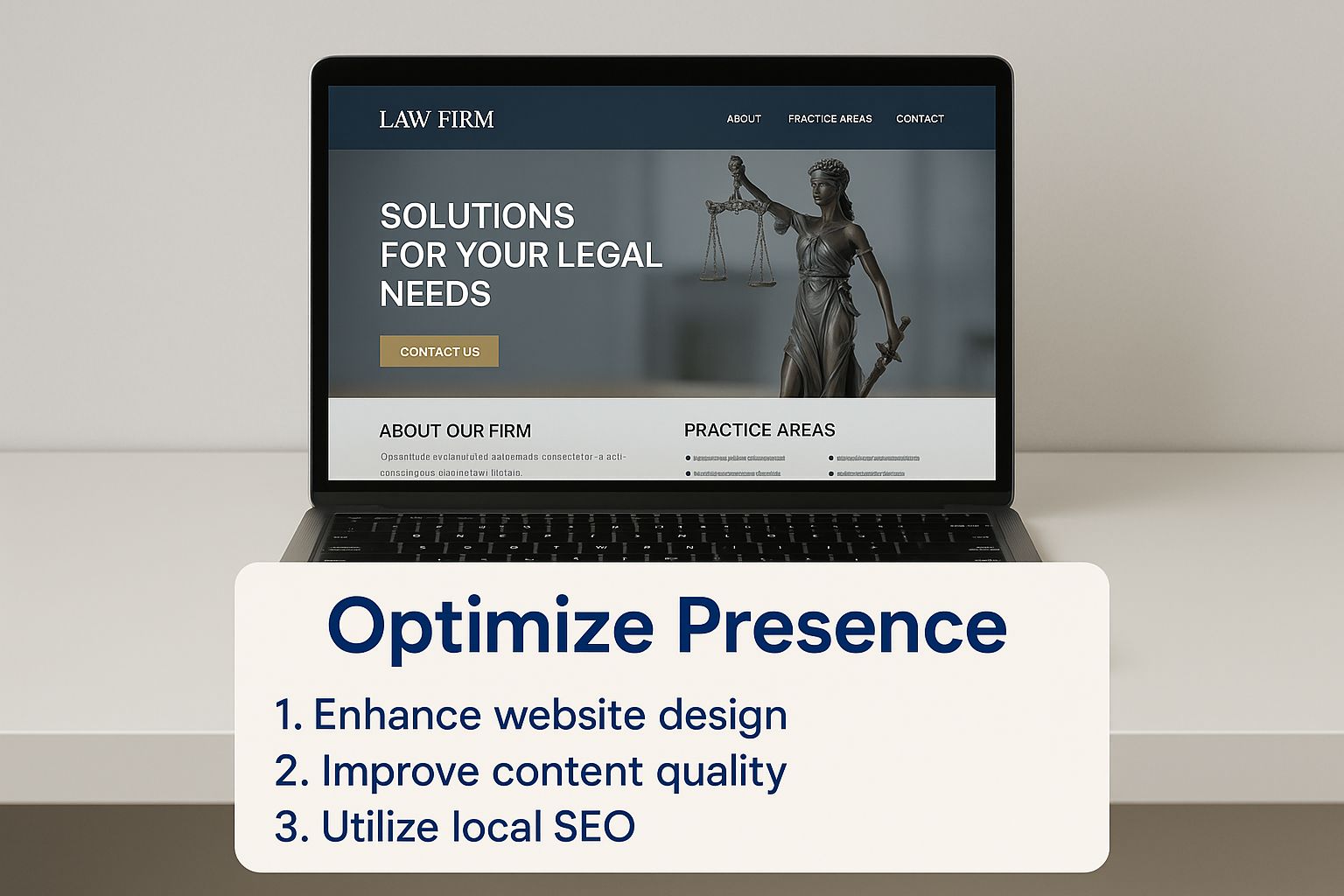
It all starts here. A strong online presence is the launchpad for any successful client acquisition strategy.
Build Trust Through Online Reviews and Consistency
Okay, so a potential client has found you online. What’s their very next move? They’re going to check your reviews. In the legal field, where trust is everything, online reviews are the new word-of-mouth.
A steady flow of recent, positive reviews on your Google Business Profile is one of the most powerful conversion tools you have. It directly impacts your search ranking and, more importantly, a person’s decision to pick up the phone and call you.
You need a system for this. Make it a core part of your process to actively ask satisfied clients for a review. Send them a direct link to make it painless. Just as important, respond professionally to all of them, good and bad. It shows you care.
Finally, a bit of housekeeping that makes a huge difference: make sure your firm’s name, address, and phone number (NAP) are 100% identical everywhere online—from Yelp to Avvo to your own website. Inconsistencies create doubt for both search engines and potential clients. This foundational work pays off by creating a cohesive, trustworthy digital footprint that turns searchers into signed cases.
Before you invest in advanced marketing, run through this checklist. Nailing these fundamentals ensures your marketing dollars will actually have a chance to work.
Digital Foundation Checklist for Law Firms
| Component | Key Action | Why It Matters for Client Acquisition |
|---|---|---|
| Website Performance | Ensure fast load times (<3 seconds) and a mobile-first, ADA-compliant design. | A slow or broken site makes potential clients leave immediately, killing conversion opportunities before they start. |
| Google Business Profile | Fully complete every section, add high-quality photos, and use the Q&A feature. | This is your ticket to appearing in the “map pack” for high-intent local searches like “lawyer near me.” |
| Online Reviews | Implement a consistent process for requesting and responding to client reviews on Google. | Reviews are social proof that builds immediate trust and heavily influences a potential client’s hiring decision. |
| NAP Consistency | Audit and correct your firm’s Name, Address, and Phone number across all online directories. | Inconsistent data confuses Google and erodes trust, hurting your local search rankings and credibility. |
Getting these four pillars right isn’t just a suggestion; it’s the price of entry for effectively competing for clients online today.
Dominate Search Results with Strategic Legal SEO

A beautiful, well-designed website is worthless if potential clients can’t find it. To actually bring in new cases, your firm needs to show up the exact moment someone is frantically typing their legal problem into Google. This is where strategic Search Engine Optimization (SEO) stops being a tech chore and becomes your single most powerful tool for client acquisition.
Effective legal SEO isn’t about trying to trick search engines. It’s about methodically proving to Google that your firm is the most authoritative, trustworthy, and relevant answer to a potential client’s urgent question. This requires a multi-layered approach that goes way beyond just a few obvious keywords.
And it’s an investment that pays for itself over and over. Digital is where your clients are. Research shows that roughly 73% of legal clients now find their lawyers online, and the majority of firms are pouring money into paid search and video to keep up. With about 60% of law firm website traffic coming from smartphones, a dominant mobile presence isn’t just nice to have—it’s essential.
Uncovering How Your Ideal Client Searches
Great SEO starts with understanding the exact language your potential clients are using. This is so much deeper than just targeting a phrase like “personal injury lawyer.” You have to capture them at every stage of their search.
- High-Intent Keywords: These are the money-makers. Think “car accident lawyer for hire in Phoenix” or “best DUI attorney near me.” These people are ready to pick up the phone and need to find you now.
- Informational Keywords: These are the questions people ask before they even know they need an attorney. Things like “what to do after a fender bender” or “how is alimony calculated in Texas” draw people in at the very beginning of their journey.
By creating content that answers both types of queries, you build a powerful funnel. You become a trusted resource by answering their early-stage questions, making your firm the only logical choice when it’s finally time to hire someone.
Think of your SEO strategy as a conversation. Informational content starts the dialogue, and high-intent pages close the deal. You need both to succeed.
For instance, a personal injury firm could publish a detailed guide on navigating insurance claims after an accident. This article will attract organic traffic from people who are just starting their research. When that same person realizes they’re in over their head and need legal help, your firm is already top of mind. For a much deeper dive, our guide on SEO for personal injury firms lays out these targeted strategies in detail.
Building Authority with High-Quality Backlinks
In Google’s world, not all law firms are created equal. One of the most powerful signals of your website’s authority is its backlink profile—that is, the collection of other reputable websites that link back to your site.
A single link from a respected legal publication is worth more than a hundred links from spammy, low-quality directories. The goal is to earn links that signal trust and relevance.
- Legal Directories: Get listed in the heavy hitters like Avvo, FindLaw, and Justia. Make sure your profiles are 100% complete and consistent across all of them.
- Local Media: Did your firm sponsor a local charity event? Did one of your attorneys provide a quote for a local news story? Those mentions often come with a powerful backlink.
- Guest Articles: Writing a valuable, insightful article for a local business journal or a legal association’s blog is a fantastic way to showcase your expertise and earn a link.
Building a solid backlink profile is a marathon, not a sprint. Every high-quality link you earn acts as a vote of confidence, telling search engines that your firm is a trusted authority in its field. That trust directly translates into higher search rankings and, ultimately, more clients.
Demystifying Technical SEO for Law Firms
Finally, you can have the best content and the most powerful backlinks in the world, but it all falls apart if your website is a technical mess. Technical SEO is the practice of ensuring search engines can crawl, understand, and index your website without running into any roadblocks.
Think of it as the plumbing and foundation of your house. When it works perfectly, you don’t even notice it. But when it’s broken, the whole system grinds to a halt.
Key Technical SEO Checkpoints:
| Area | Why It Matters for Client Acquisition |
|---|---|
| Site Speed | A slow website is a deal-breaker. If your page takes more than a few seconds to load, potential clients are gone. |
| Security (HTTPS) | An “HTTPS” connection is non-negotiable. It protects user data, builds trust, and is a confirmed Google ranking factor. |
| Mobile-Friendliness | With most of your market searching on their phones, a site that isn’t mobile-friendly might as well be invisible. |
| Clean URL Structure | Simple, clear URLs (like /personal-injury/car-accidents) help both users and search engines understand your site’s structure. |
Focusing on these three pillars—keywords, authority, and technical health—is how you win the search game. It’s a deliberate process that turns your website from a static online brochure into a dynamic, client-generating machine.
Here’s the rewritten section, crafted to sound like it was written by an experienced human expert, following all your specified requirements.
Create Content That Turns Prospects Into Clients
Let’s be honest: your content is the real engine of your client acquisition machine.
It’s how you build genuine trust, prove your expertise without coming off as a pushy salesperson, and gently guide someone from a place of fear and uncertainty to feeling confident enough to pick up the phone and call your firm. This isn’t about just cranking out blog posts. It’s about creating strategic assets that answer the most pressing questions your ideal clients have.
When you get this right, your firm becomes an indispensable resource long before a prospect is even thinking about hiring an attorney. A deep library of genuinely helpful content gives you a powerful arsenal to share on social media or in your email newsletters, creating multiple touchpoints that keep your firm top of mind.
One of the most reliable strategies we see working for firms today is building out a high-quality legal blog. Sure, blogging might not generate the same flood of direct calls it did a decade ago, but it remains a crucial piece of your marketing foundation. A well-executed blog establishes your authority, fuels your SEO, and educates potential clients while they’re in the critical decision-making phase. If you’re skeptical, it’s worth understanding why legal blogging is still a viable strategy and how its role has evolved.
Answer Their Questions Before They Even Ask
Your potential clients are on Google right now, typing in specific, often stressful, questions. The law firm that gives them the clearest, most helpful answer is the one that earns their trust. The entire heart of your content strategy should be to build a comprehensive resource center that directly addresses their pain points.
Just think about the questions you hear over and over again in those first consultation calls. Those are absolute content goldmines.
- “How long does a personal injury case really take?”
- “What are the very first steps in a divorce?”
- “Can I actually get a DUI charge reduced in California?”
Each of these is a perfect starting point for a detailed blog post, a dedicated FAQ page, or even a quick, two-minute video. By answering these questions out in the open, you immediately prove you know your stuff and build an instant connection with someone who desperately needs your help.
Every single piece of content you publish should have one simple goal: empower a potential client with the information they need to take the next step. It’s about service, not sales.
This approach is the very essence of effective law firm content marketing. It transforms your website from a static online brochure into a dynamic, client-generating tool that works for you 24/7.
Move Beyond the Standard Blog Post
A legal blog is essential, but it can’t be your only play. To build a truly robust content engine, you have to diversify your formats. Different people absorb information in different ways, and various types of content serve unique purposes along the path to becoming a client.
You should seriously consider expanding your content library to include these powerful formats:
- In-Depth Practice Area Pages: These aren’t just short service descriptions. I’m talking about comprehensive, multi-thousand-word guides that cover everything a potential client needs to know about a specific area of law—from the legal process to common pitfalls and potential outcomes.
- Compelling Client Case Studies: Anonymized success stories are incredibly persuasive. They offer concrete proof that your firm can solve real-world problems, moving beyond abstract claims of expertise to show tangible results.
- Downloadable “Lead Magnets”: Offer up a valuable resource—like a checklist for “What to Do After a Car Accident” or a simple guide to “Navigating Probate”—in exchange for an email address. This is how you build a pipeline of warm leads you can nurture over time.
Create Every Piece of Content with a Clear Purpose
Every article, guide, or case study you publish needs a job to do. Are you trying to attract broad awareness with an informational topic, or are you targeting someone ready to hire with a detailed service page? Knowing the goal from the very beginning shapes the entire piece.
For example, a blog post titled “Understanding California’s Statute of Limitations for Personal Injury” is designed for people in the early research phase. The call to action at the end might be to read another related article or download a free guide.
On the other hand, a page dedicated to “Los Angeles Truck Accident Lawyers” is for someone much further down the funnel. That content needs to be direct, highlight your firm’s specific experience with these complex cases, and feature a prominent “Request a Free Consultation” button. Building this kind of purposeful resource library is how you systematically turn anonymous website visitors into your firm’s next clients.
Amplify Your Reach with Video and Social Media

If you want more clients, you have to go where they are. And these days, that means mastering video and social media. These aren’t just trendy add-ons anymore; they’re core channels for putting a human face on your law firm, forging real connections in your community, and simply staying on people’s radar.
A smart social media strategy does way more than just announce your services. It’s your chance to show your firm’s personality, share genuinely helpful advice, and build a following of people who trust you long before they ever need to hire a lawyer. It’s about building a community, not just a client list.
This is a big deal because clients today expect more than a static website. They want to see the people behind the firm, and video is hands-down the best way to make that introduction.
Put a Human Face on Your Firm with Practical Video
Video is the ultimate shortcut to building trust and cutting through the digital noise. Let’s be honest, hearing an attorney explain a legal issue directly is infinitely more powerful than reading a dry block of text. The secret is to create content that helps, not just sells.
Short, simple Q&A videos are an absolute goldmine. Just think about the top five questions you get in every initial consultation. Turn each one into a quick, one- or two-minute video. This move instantly positions you as an accessible expert and gives potential clients real value upfront.
The point of video isn’t to go viral. It’s to build familiarity. When a potential client feels like they already know you from your videos, picking up the phone to call your firm feels like a much smaller, easier step.
These clips are perfect for sharing on YouTube and LinkedIn, and they’re fantastic additions to your website’s practice area pages. By consistently answering the questions people are already asking, you create a rich library of content that proves your expertise and builds that crucial personal connection at scale.
Pick Your Platforms Wisely
Don’t make the mistake of trying to be everywhere at once—it’s a fast track to burnout. The only way to win on social media is to focus your energy where your ideal clients actually spend their time. There’s no one-size-fits-all answer here.
For example, a firm that handles business litigation needs to live on LinkedIn. That’s the playground for professional networking, sharing deep-dive articles on corporate law, and getting in front of C-suite executives.
On the other hand, a family law or estate planning practice will see far better results on Facebook. It’s built for community engagement and allows you to connect with local residents through targeted posts and by participating in local groups. A winning approach requires a real understanding of social media and local video marketing to make sure your content lands with the right people.
Create Content That Connects and Builds Credibility
Once you know where you’re posting, the game is all about creating content that actually stops the scroll. People are on social media to connect and learn, not to get a sales pitch. Stick to the 80/20 rule: 80% of what you post should be valuable and informative, leaving just 20% for anything directly promotional.
Here are a few content ideas that consistently work for law firms:
- Quick Legal Tips: Share bite-sized, useful advice related to your practice. Think “3 things to do after a car accident.”
- Behind-the-Scenes Glimpses: Introduce a new paralegal or celebrate a firm milestone. It shows the human side of your practice.
- Client Testimonials: With permission, share a powerful quote or a short video from a happy client. This is the best social proof you can get.
- Community Involvement: Post about the local charity run or little league team your firm is sponsoring. It reinforces your local roots.
When you consistently deliver value, you build an audience that sees your firm as a go-to resource. That way, when a legal problem does pop up, you’re the first call they make. That’s how you turn followers into real, qualified cases.
Your Top Questions About Finding More Legal Clients, Answered
Even with a solid game plan, most attorneys I talk to still have a few nagging questions about how all this digital marketing stuff actually works in practice. It can seem overwhelming, but the core ideas are simpler than you think. Let’s tackle some of the most common concerns I hear from firms trying to grow.
Getting straight answers to these questions is the first step. It helps you build a marketing plan that feels achievable and, more importantly, effective. My goal here is to clear up the confusion so you can put your time and money where it will make the biggest difference.
How Long Does Legal SEO Really Take to Generate Clients?
This is always the first question, and I’ll give you the honest answer: SEO is a long-term play, not an instant fix. Think of it like planting an oak tree, not flipping on a light switch. You can realistically expect to see some initial traction in your search rankings within 3 to 6 months of consistent, high-quality work.
Now, if you’re in a highly competitive field like personal injury in a major city, a more practical timeline to see a meaningful, steady stream of leads is closer to 6 to 12 months. A lot depends on factors like your website’s history, how fierce the local competition is, and whether your content is genuinely top-notch.
Think of SEO as building a permanent asset for your firm. The effort you invest today keeps generating clients for years, creating a predictable pipeline of cases long after the initial work is paid for.
This is the complete opposite of paid ads, which vanish the second you stop paying. SEO builds lasting digital real estate that pays dividends for the long haul.
What Is the Most Cost-Effective Way to Get New Clients?
For a small or solo firm watching every dollar, the most powerful and budget-friendly strategy is a one-two punch: dominate local SEO and create genuinely helpful content. You can start making a real impact here without needing a huge upfront investment.
Your very first move should be to completely dial in your Google Business Profile. It’s a free tool that puts you directly in front of high-intent searchers in your neighborhood—the people most likely to hire you.
At the same time, start writing blog posts or building out FAQ pages that answer the exact questions your ideal clients are typing into Google. This builds incredible organic traffic over time without a hefty ad budget. To supercharge this, make a habit of asking for client reviews. This boosts both your local reputation and your search visibility, all without costing you a dime.
Should My Law Firm Be Using Paid Ads Like Google Ads?
Absolutely. Paid advertising can be an incredibly powerful tool for getting the phone to ring right now, especially while you’re waiting for your long-term SEO strategy to mature. The key is to be strategic and let the data guide you. Paid ads are the faucet you can turn on for immediate inquiries.
But don’t just throw money at generic ads. Focus your budget on high-intent keywords tied directly to your most profitable services. For instance, a search term like “hire a divorce attorney in Santa Monica” is infinitely more valuable than a broad, vague term like “family law.”
And this part is crucial: make sure your ads send people to dedicated landing pages built for one thing—conversion. Don’t just dump them on your homepage. While PPC requires a consistent budget, the return on investment can be huge when it’s managed correctly, making it a vital tool for firms that need leads coming in the door today.
How Important Are Online Reviews for Getting Clients?
In a word: essential.
In the legal field, trust is everything. Online reviews have become the modern-day word-of-mouth referral, and they’re often the single most decisive factor for a potential client.
A steady flow of recent, positive reviews on platforms like Google and Avvo accomplishes two critical things:
- It gives your local SEO a direct boost, helping you appear more often in the valuable “map pack.”
- It builds instant credibility, making a prospect far more likely to call you instead of the firm listed right below you.
Setting up a simple, consistent process to ask happy clients for a review is one of the highest-impact marketing tasks you can do. It directly fuels both your visibility and your conversion rate, making it a non-negotiable part of any serious client acquisition strategy.
At Case Quota, we specialize in transforming your firm’s online presence into a powerful client-generation engine. Let’s build a strategy that delivers the cases you want.