

AI visibility: How Law Firms Win Search in an AI-First World
AI visibility is now the gatekeeper for law firms in search. As AI-powered engines like ChatGPT and Gemini change how people find answers, firms face new discovery risks. Search is shifting from keywords to signals and citations. AI models run background web searches. Therefore, your content must not only rank. It must be referenced, grounded, and cited by LLMs. Law firms struggle because citations now scatter across engines. Also, retrieval augmented generation calls different queries than client searches. As a result, tracking and shaping those queries matters more than traditional ranking alone. Organizational silos make matters worse. When data patterns are inconsistent, AI reflects that confusion. Thus, governance and cross-team alignment become central to maintaining AI visibility.
This introduction explains why optimizing law-firm SEO for AI-driven search is crucial today. You will learn practical steps for monitoring LLM citations, translating queries, and closing the measurement gap. Moreover, we will show how to convert AI-driven signals into client leads. Because the stakes include brand trust, local visibility, and business development, firms cannot ignore this shift. Read on to discover tactical, governance-first strategies to improve your AI visibility across engines and use cases.
AI visibility challenges: tracking LLM citations and translating queries
AI visibility describes whether large language models reference and cite your firm’s content. Because LLMs synthesize answers, firms must be cited to gain discovery. However, citations now spread across multiple engines such as ChatGPT, Gemini, Claude, and Perplexity. As a result, a page that ranks well in Google might not appear in LLM responses.
LLMs often run background web searches inside Retrieval Augmented Generation contexts, not just rely on internal knowledge. Therefore, the queries an AI fires can differ from what clients type. As Mark Williams-Cook warns, “You can’t use an LLM to write an analysis of your SEO report. If you’re ✨ lucky✨, an LLM will correctly describe what has happened in the data, but this is not an analysis.” Read his note here: Mark Williams-Cook’s note.
Key AI visibility challenges
- Distributed citations across engines cause incomplete tracking and fractured signals. Because each engine surfaces different sources, measurement becomes noisy.
- Query translation mismatch means AI rewrites queries before searching. As a result, your target keywords are often not what the AI actually searched for.
- API and technical changes reduce transparency. For example, Google’s change to the num=100 parameter disrupted rank tools and LLM sourcing workflows. See details here: Google’s change details.
- The measurement gap lets dashboards flag missing citations but not resolve operational misalignment. Dashboards show symptoms, not fixes.
- Organizational silos amplify the problem because inconsistent data patterns produce inconsistent AI responses.
“Sam Garg is the founder and CEO of Writesonic, where his team has deployed AI agents into the marketing workflows many SEO teams are still managing manually,” and this trend matters for law firms too. See Writesonic for context.
In short, AI visibility is not a pure SEO problem. It is a cross-functional governance and data-consistency challenge. Therefore, legal marketing teams must track citations across engines, translate AI-fired queries back into content targets, and align stakeholders. In the next section we will map the measurement gap and propose tactical fixes for citation tracking, attribution, and query translation.
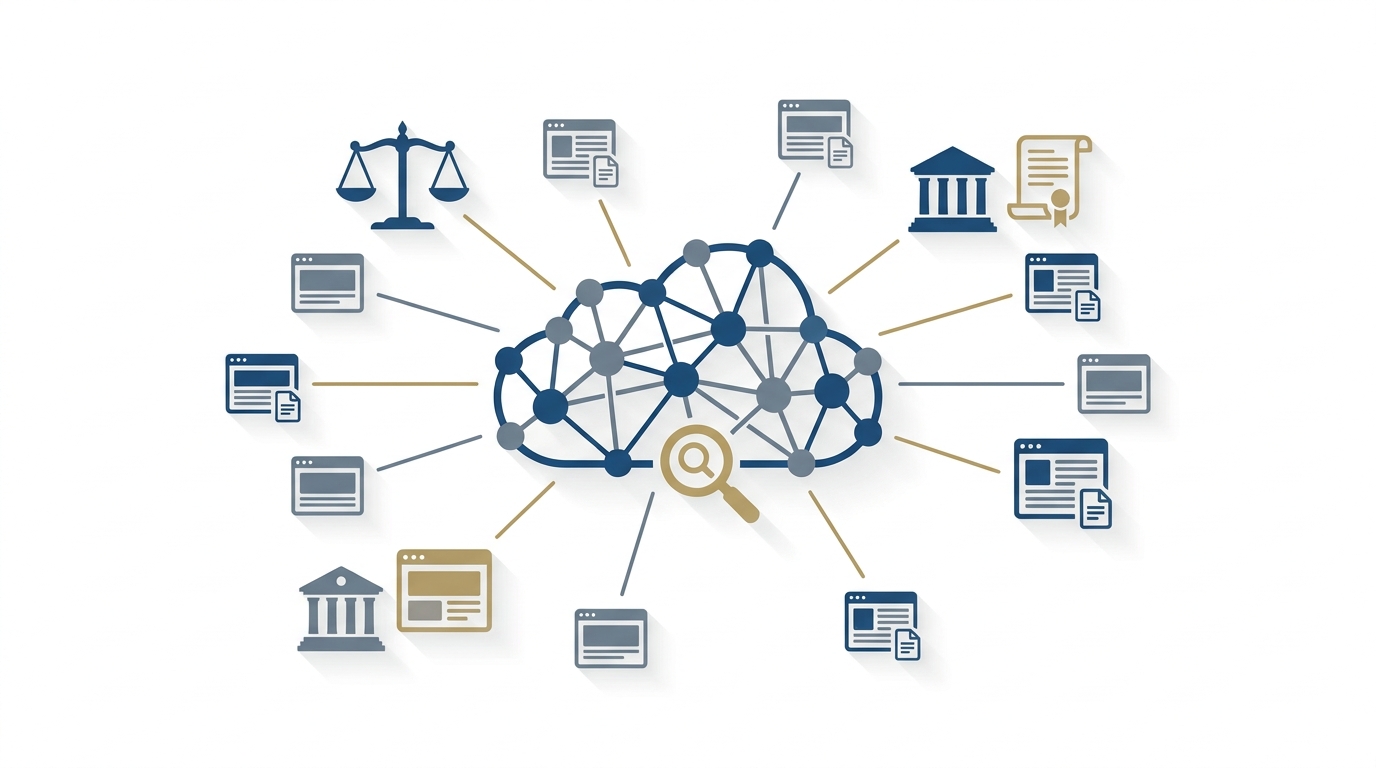
Traditional SEO versus AI driven SEO for law firms
| Strategy | Process | Tools | Visibility Impact | Outcomes |
|---|---|---|---|---|
| Traditional SEO | Traditional SEO focuses on ranking for keywords; it relies on backlinks and on page relevance | Google Search Console, Ahrefs, Screaming Frog, AlsoAsked | Improves organic rankings in Google and Bing; however, it yields limited LLM citations and citation share | Traffic growth and measurable rankings; however, AI visibility remains weak and presence in LLM responses is limited |
| AI driven SEO | Optimize for signals that LLMs cite; emphasize citations, grounding and RAG aware content | LLM APIs, QueryFan, RAG pipelines, cross engine citation trackers | Boosts AI visibility across ChatGPT, Gemini, Claude and Perplexity; therefore increases citation share | Higher grounding in AI answers; better lead relevance and improved conversion from AI referrals |
| Hybrid transition playbook | Blend classic ranking with citation engineering and governance; therefore align teams across marketing, legal and IT | CMS governance, analytics, internal taxonomies, QueryFan integration | Sustains organic presence while building LLM citation authority and cross engine signals | Resilient discovery, consistent brand voice and clearer attribution across engines |
Aligning teams and governance to close the AI visibility gap
AI visibility problems often stem from operational misalignment, not SEO issues. When your data patterns vary across teams, AI reflects that confusion back to users. Therefore, law firms need governance and consistent data to appear reliably in LLM citations and RAG contexts.
Begin with a governance charter. Define data owners for content, location pages, attorney bios, and practice pages. Assign responsibility for accuracy, canonicalization, and schema markup. As a result, you reduce conflicting signals that confuse LLMs.
Promote cross functional workflows. Create a weekly sync between marketing, intake, IT, and practice leads. Use short agendas to resolve content disputes, fix structured data, and prioritize updates. Over time, this prevents silos from producing inconsistent data.
Quote backed context
- Mark Williams Cook warns, “You can’t use an LLM to write an analysis of your SEO report.…this is not an analysis.” See his note here: Mark Williams Cook’s Note
- “Sam Garg is the founder and CEO of Writesonic, where his team has deployed AI agents into the marketing workflows many SEO teams are still managing manually.” For firm-level context, see Writesonic
Operational steps to improve AI visibility
- Map your data landscape: Inventory pages, knowledge base articles, author profiles, and citationable resources. Then, tag items with owners and update cadences.
- Standardize schema and metadata: Apply consistent JSON-LD across practice and attorney pages to help LLMs ground facts. Also mark publication dates and authorship clearly.
- Centralize canonical controls: Ensure one source of truth for identical content across state and local pages. Otherwise, AIs cite fragmented versions.
- Integrate QueryFan or similar tools: Capture persona prompts and the actual queries AIs fire. QueryFan helps translate AI searches into concrete content targets. QueryFan
- Create a citation playbook: Record which pages serve as authoritative citations for common legal questions. Then, optimize those pages for grounding and references.
- Monitor cross engine citations: Track citations in ChatGPT, Gemini, Claude, and Perplexity. Use weekly dashboards to spot missing or contradictory references.
- Run incident retrospectives: When an AI gives poor answers, treat it like a postmortem. Identify data gaps, fix sources, and update the citation playbook.
Governance metrics and KPIs
- Citation share across engines by topic and page
- Percentage of pages with correct schema and data owners
- Time to resolve data inconsistencies
- Conversion rate on AI referred leads
By creating clear ownership and repeatable workflows, firms reduce signal noise. Consequently, AI visibility improves because models find consistent, authoritative content. Therefore, governance becomes the technical SEO advantage in an AI driven search landscape.
Conclusion
AI visibility remains the decisive metric for law firms in an AI first search world. As models like ChatGPT and Gemini synthesize answers, firms must be cited and grounded. Therefore, optimizing for citations and cross engine signals matters beyond traditional ranking.
Organizational alignment reduces conflicting signals and improves data consistency. Because content owners, intake teams, and IT must share a single source of truth. Governance ensures schema, authorship, and canonical rules stay consistent across pages. As a result, LLMs find authoritative content and cite your firm more reliably.
Cross engine workflows translate AI fired queries into concrete content targets. Tools like QueryFan can capture persona prompts and background searches. However, dashboards alone only highlight gaps; teams must act on findings.
Track citation share, fix inconsistencies quickly, and measure conversions from AI referrals. Then, iterate governance, content, and technical fixes in short cycles. Proactive measurement closes the measurement gap and builds durable AI visibility.
For small and mid sized firms, the path mirrors Big Law strategies. Case Quota helps firms achieve market dominance by applying those playbooks. Explore their approach and start improving your AI visibility today: Case Quota.
With alignment, governance, and cross engine measurement, firms convert AI signals to clients. Ultimately, AI visibility becomes a strategic advantage, not a reporting problem. Move decisively now, because early leadership yields long term growth.
Frequently Asked Questions (FAQs)
What is AI visibility in law-firm SEO?
AI visibility refers to the extent to which a law firm’s content is accessible and cited by AI-driven search engines, such as ChatGPT and Gemini. This means that for your content to reach users through AI platforms, it must be recognized, referenced, and linked by these systems. AI visibility goes beyond traditional SEO as it involves ensuring that content is not only keyword optimized but also cited in AI-generated responses.
Why is tracking AI citations important?
Tracking AI citations is crucial because they determine whether major AI models reference your content. Unlike traditional search engines, AI platforms often derive their answers from multiple sources. Therefore, a high citation rate across AI platforms can greatly enhance a firm’s online visibility and authority. It helps in understanding which content pieces are considered authoritative by LLMs and optimizing these contents for more accurate AI referencing.
What challenges do law firms face in maintaining AI visibility?
Law firms face several challenges such as:
- Distributed Citations: AI engines distribute citations across platforms like Claude and Perplexity, making tracking complex.
- Query Translation Problems: AI systems may rewrite client queries before searching, misaligning target keywords with actual AI perceptions.
- Technical Changes: Updates to APIs and backend search functions can disrupt your current SEO strategies, leading to visibility issues.
How can law firms improve their presence in AI-driven searches?
Law firms can improve their AI search presence by:
- Enhancing Data Consistency: Use clear schema and canonical tags for all web content.
- Integrating Cross-Engine Tools: Utilize tools like QueryFan to capture and adapt to AI-generated search queries.
- Creating a Citation Playbook: Identify authoritative pages and optimize them for AI-horizon queries, ensuring they are top sources across engines.
What role does organizational alignment play in enhancing AI visibility?
Organizational alignment ensures all departments work towards a unified SEO strategy. By defining data ownership and consistent practices across teams, firms can eliminate conflicting signals that confuse AI systems. This alignment helps maintain data consistency and authority, which supports stronger visibility and more credible citations across AI platforms.