

AI-Driven SEO Prioritization and Measurement
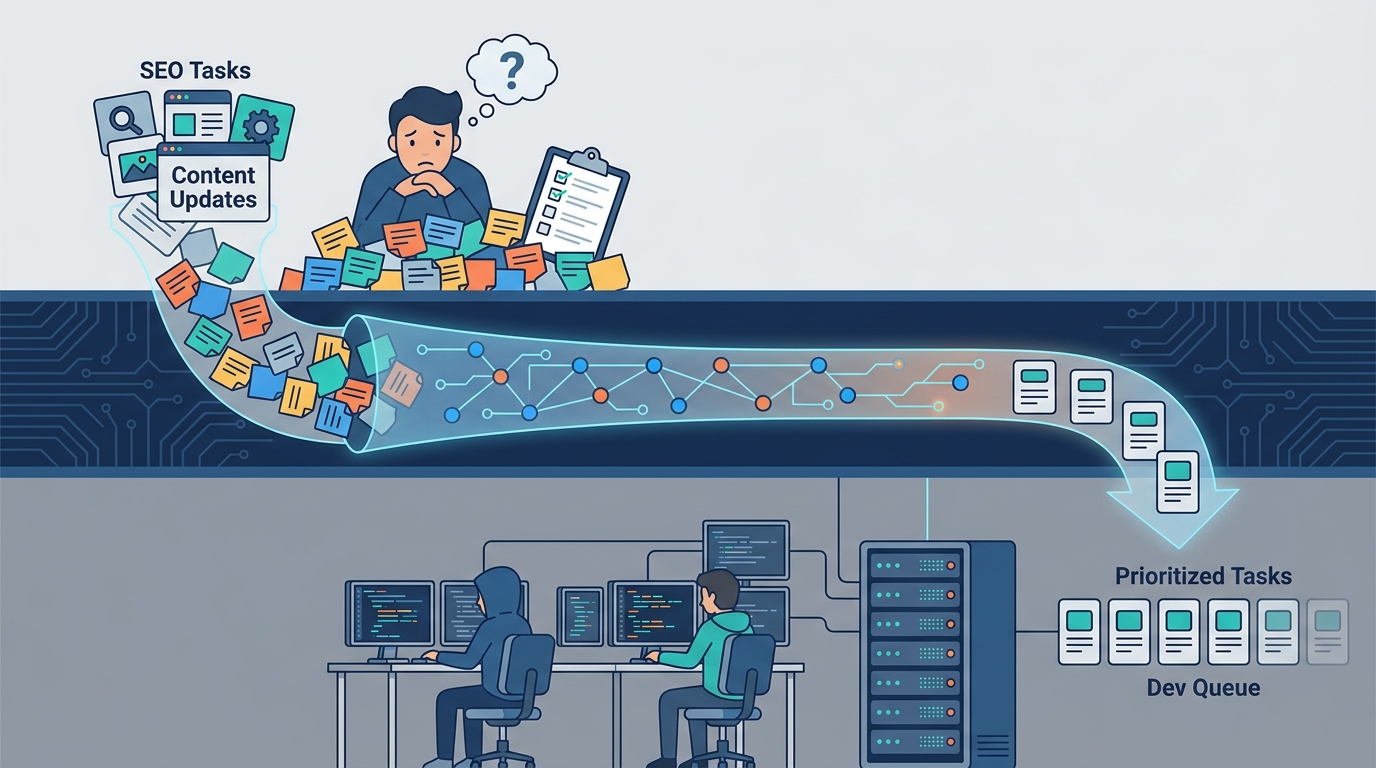
AI-driven SEO prioritization and measurement must replace manual triage if law firms want measurable wins. Law firms face three linked challenges: the IT line of death, weak measurement, and a shifting search landscape. Because engineering bandwidth is thin, many recommended fixes stall in long backlogs. Therefore audits and recommendations rarely translate into traffic or revenue.
Measuring SEO effectiveness requires a practical, data-driven framework. Incrementality testing and media mix modeling reduce attribution error and highlight real impact. However, many teams still default to last-click reports and vanity KPIs. As a result, stakeholders cannot distinguish between symptoms and causes. Tie SEO outputs to pipeline metrics and revenue to prove value.
Planning for a low-search future must start now. Plan for zero search while you optimize for today’s queries. This dual approach hedges organizational risk and forces better product thinking. Build brand authority, nurture direct audiences, and invest in niche topical depth. Meanwhile stabilize URLs, SKU pages, and site search to retain existing value because small slippages compound.
Operationally, align prioritization with IT by translating SEO asks into business cases. Prioritize work that unblocks engineering and shows near-term ROI. Use AI-driven signals to rank tasks and to estimate incremental traffic. Therefore run rapid, small experiments and measure lift before scaling. In short, treat the backlog as an inventory of intent, not progress, and act with measurable urgency.
Start by mapping backlog items to business impact and cost. Then score items by expected traffic lift and engineering effort. Finally, report results in weekly dashboards.
Overcoming the IT Line of Death with AI-driven SEO prioritization and measurement
The IT line of death describes the invisible barrier between SEO intent and engineering delivery. In many law firms, SEO audits produce long lists of fixes. Yet work stalls once requests hit the engineering queue. As one practitioner put it, “A backlog is not progress. It is an unimplemented intent.”
Backlogs are real and large. For example, teams have reported backlogs of 1,400 tickets over 18 months. Because engineering bandwidth is finite, recommended work competes with product and security requests. Therefore SEO items fall below the line and rarely get implemented.
This problem matters more now. Search referral trends show significant shifts. Small publishers lost roughly 60 percent of search referrals in two years, according to industry data; law firms should not assume stability in organic channels Search Engine Journal. Meanwhile media leaders plan for steep declines in search traffic in coming years Reuters Institute. As a result, law firms must squeeze more value from each engineering hour.
AI-driven SEO prioritization and measurement changes the dynamic. Instead of manual triage, AI ranks tasks by expected business impact. It uses historical clickstream, SERP feature signals, and internal revenue mappings. For instance, tools that analyze user behavior on results pages act like a memory of helpful pages. Therefore you can score fixes by estimated traffic lift and revenue impact before asking IT to commit.
Practical steps to cross the line
- Map each SEO ticket to a business metric, such as lead volume or net revenue. This clarifies value because stakeholders understand dollars and outcomes.
- Use AI to score impact and effort. Then rank work by a value to engineering cost ratio. As one source warns, “If you cannot explain why your recommendation is worth more than another team’s request, it will not get done.”
- Run small incrementality tests. First validate assumptions with A/B tests or holdouts. Then scale successful changes.
- Translate SEO asks into engineering stories. Include acceptance criteria, data needs, and rollout plans so tasks deploy quickly.
- Report weekly on lift and blockers. In short, treat the backlog as inventory, not progress.
Finally, align prioritization with executive narratives. Work is not prioritized because it is best practice. It is prioritized because it aligns with current business priorities. Therefore use AI-driven signals to prove impact, win IT time, and move SEO from intent to implemented value.
Measuring Search Impact and Preparing for a Low-Search Future with AI-driven SEO prioritization and measurement
Clicks and ranks no longer prove commercial impact. Law firms must move beyond those proxies to causation and revenue. Because search referral channels change quickly, teams need a broader measurement stack.
Start with the data problems. Industry reporting shows sharp declines in search referrals. Chartbeat data suggested small publishers lost roughly sixty percent of search referrals in two years. You can read that analysis here: Search Referral Traffic Decline Analysis. Meanwhile media leaders expect steep drops in search over the coming years. The Reuters Institute documents forecasts of more than forty percent declines and includes executive commentary on planning for zero search. Read the report here: Journalism, Media, and Technology Trends Report.
These trends force three measurement shifts:
- Monitor AI visibility signals because generative engines expose different features than classic SERPs. For example, knowledge panels and featured answers matter more now. Therefore track AI citation presence and exposure across queries.
- Prioritize incrementality testing to prove lift. Use holdouts, A B tests, and geo splits to measure true impact. As one practitioner warns, test before you scale.
- Move to multi-touch attribution and media mix modeling. MMM and multi-touch frameworks allocate credit across channels and time. This method reduces reliance on last-click metrics, which often misattribute value.
How to build the measurement stack:
- Capture AI visibility: instrument pages for signals that show up in AI responses and extractability. Monitor knowledge panel hits, snippet pickups, and image carousel inclusion.
- Run incrementality experiments: pick a small set of prioritized pages, apply changes, and use holdouts to measure net lift. If lift is positive, scale quickly.
- Use MMM and multi-touch models: combine funnel, pipeline, and revenue data with marketing inputs. This ties SEO outputs to actual business outcomes.
- Tie outputs to pipeline: link leads and case intake to landing pages. Then map revenue per lead and compute return on engineering effort.
Prepare for zero or low search:
- Plan as if search is zero. This forces product choices that reduce dependency on organic traffic. As a result, teams build direct channels and retain control.
- Build brand authority and niche depth. Brands with strong authority or clear niches fare better in low-search futures. Invest in topical depth, trust signals, and direct audience touchpoints.
- Stabilize technical fundamentals. URL stability, SKU page quality, and internal site search prevent erosion of existing value during platform changes.
Operational tactics to combine prioritization and measurement:
- Score tasks by estimated incremental revenue and engineering cost. Use AI models to predict lift and rank accordingly. Then present a clear business case to IT.
- Integrate weekly dashboards that show lift, tests, and blockers. This keeps leaders informed and reduces friction.
- Use fast experiments and rapid measurement. Learn quickly, then reallocate resources to winners.
In short, AI-driven SEO prioritization and measurement pairs new visibility signals with robust testing. This approach proves value, reduces risk, and prepares law firms for a future that may include much less organic search traffic.
| Characteristic | Traditional SEO measurement | AI-driven SEO measurement |
|---|---|---|
| Primary focus | Last-click conversions, keyword rankings, pageviews | AI visibility signals, incrementality testing, predicted revenue lift |
| Data sources | GA4, tag manager, server logs, rank trackers | Clickstream datasets, SERP feature scraping, AI citation signals, NavBoost and Glue–style signals |
| Attribution model | Last-click or simple channel rules; multi-touch rarely used | Incrementality experiments, multi-touch attribution, Media Mix Modeling (MMM) |
| Actionability | Manual prioritization; many backlog items stall at IT | AI ranks fixes by estimated lift and engineering cost; supports clear business cases |
| Speed to insight | Slow reporting cycles and manual analysis | Faster detection of high-impact opportunities; confidence scores guide experiments |
| Benefits | Easy to implement; good for baseline reporting | Better ROI forecasting; reduces the IT line of death; ties work to pipeline |
| Limitations | Misattributes value; ignores AI visibility; encourages vanity KPIs | Requires data integration, model validation, and experiment infrastructure |
| Recommendation | Use as a baseline and complement with experiments | Adopt AI-driven measurement, run incrementality tests, tie outcomes to revenue and pipeline |
CONCLUSION
AI-driven SEO prioritization and measurement is no longer optional for law firms. It solves the IT line of death and focuses scarce engineering time on high-value fixes. Therefore teams can convert audits into implemented wins and measurable pipeline. As a result, firms reduce wasted backlog and unlock revenue tied to search.
Measurement must move past clicks and rank reports. Use AI visibility signals, incrementality tests, and Media Mix Modeling to prove causation. For example, run small holdouts to establish lift before scaling. Remember that “A backlog is not progress. It is an unimplemented intent.” This quote underscores the cost of unexecuted work.
Strategic planning must assume lower search volumes. Plan for zero search while you optimize for current queries, because this dual approach hedges risk. Build brand authority, deepen topical niches, and strengthen direct audience channels. Meanwhile stabilize technical foundations to retain existing value.
Specialized partners can accelerate change. Case Quota empowers small and mid-sized law firms with legal marketing strategies used by Big Law. They focus on high-level tactics, measurement frameworks, and execution plans that align SEO with firm revenue goals. Therefore working with a specialized agency can speed implementation and reduce risk.
Act now and plan your measurement roadmap. Score backlog items by expected incremental revenue and engineering cost. Then run prioritized experiments, report weekly, and iterate rapidly. In this way law firms gain a measurable competitive advantage in a shifting search landscape.
Frequently Asked Questions (FAQs)
What is the IT line of death and how does it affect law firm SEO?
The IT line of death is the invisible barrier between SEO recommendations and engineering delivery. In many firms, audits produce long lists that stop at engineering queues. For example, teams have reported backlogs of 1,400 tickets over 18 months. As a result, planned SEO work becomes unimplemented intent rather than impact.
How can AI-driven SEO prioritization and measurement overcome IT bottlenecks?
AI-driven SEO prioritization and measurement ranks tasks by predicted business value and engineering cost. First, models use clickstream and SERP feature signals to estimate lift. Then teams score backlog items by revenue potential and effort. Therefore you present clear business cases, win IT time, and reduce friction.
Which measurement methods should law firms adopt beyond last-click metrics?
Move to AI visibility signals, incrementality testing, and multi-touch attribution. Use Media Mix Modeling to allocate credit across channels. Also tie landing pages to pipeline and revenue data. This reduces misattribution and shows causation rather than correlation.
How should a law firm plan for a low-search or zero-search future?
Plan as if search could fall significantly. Build brand authority, deepen niche topical coverage, and grow direct audience channels. Meanwhile stabilize technical fundamentals like URL stability and site search. In short, hedge risk while you optimize current organic opportunities.
What are the first practical steps to implement AI-driven SEO prioritization and measurement?
Start by mapping backlog items to business metrics and estimated revenue. Next, run small incrementality tests or holdouts to validate predictions. Translate prioritized fixes into engineering stories with acceptance criteria. Finally, track progress in weekly dashboards and iterate rapidly.