

Protection Paradox: When Law Firms Hide and Then Buy Attention
The Protection Paradox shows up fast when law firms lock down their content but later pay to be found. Imagine a firm building a fortress around its whitepapers. Meanwhile the world walks past billboard ads asking for directions to the gate. In practice, firms block AI crawlers and protect PDFs behind forms because they fear leaks and data scraping. However, that protection often forces them to buy visibility on platforms they mistrust.
This paradox matters because it reshapes advertising strategy. When content stays gated or nonindexable, search engines and AI surfaces cannot learn from it. As a result, organic trust signals weaken and paid placements must work harder to carry credibility. Therefore, firms end up spending on sponsored listings, display ads, and promoted placements to reach the same audience they once expected to capture through discoverability and inbound leads.
Consider the tradeoffs at a glance:
- Gated content like PDFs and forms preserves control but limits indexable content and AI discovery
- Paid placements buy exposure but may not build organic trust or high quality leads like MQLs
- Blocked crawlers protect assets yet fragment brand signals across aggregators and analysts
This article examines those tradeoffs with an analytical, cautionary tone. It will show how paid placements and organic trust signals interact. You will learn practical steps to craft an ad strategy that works with AI crawlers and search engines, rather than against them. Along the way, we will explore implications for lead generation, repackaging, and the long term visibility of legal services. By the end, you will see why protecting ideas can sometimes mean paying to access them again, and how to avoid that costly loop.
Protection Paradox: Why Blocking Crawlers Backfires
The Protection Paradox describes a simple, costly cycle. Firms block AI crawlers to protect content. However, they then pay to be visible on platforms that users trust. This contradiction traps brands between control and discoverability. For law firms, the result can be higher ad spend and weaker organic trust signals.
How the Protection Paradox works with AI crawlers
First, firms use robots.txt rules and access controls to stop crawlers. They do this because they fear scraping, data leaks, and misuse of proprietary research. However, when AI surfaces and search engines can not learn from that content, those systems omit the firm from answers and summaries. Consequently, brands lose native visibility in AI-driven discovery.
Consider the real world example of Mondelez and Oreo. Mondelez treated AI crawlers as suspicious bots and kept them away from brand assets, which reduced Oreo presence in AI brand discovery. For reporting on this dynamic, see Search Engine Journal and Digiday.
Gated content, PDFs, and discoverability
Gated content like whitepapers and PDFs often lives behind forms. As a result, search engines rarely index that content fully. Moreover, a PDF behind a form is hard for AI systems to extract meaning from. The mechanics are simple: if crawlers are blocked, indexable content declines and AI surfaces cannot cite or synthesize your ideas. Technical guides on blocking PDFs and robots rules highlight these issues; for a technical reference see Stack Overflow.
Because of these limits, firms appear less in algorithmic answers. Therefore, marketers launch paid placements and sponsored listings. They do so to buy back visibility that protection removed. Paid channels deliver impressions quickly, yet they rarely transfer the organic trust that earned coverage once provided.
Strategic implications for law firm advertising
- Prioritize indexable landing pages where possible. This creates content AI can read and cite. Consequently, organic signals strengthen.
- Use gated content selectively. For instance, offer summaries publicly while gating full reports behind forms.
- Blend paid placements with discoverable content. Paid ads can amplify trust when they point to indexable resources.
- Monitor AI surfaces and aggregator behavior. Also, track whether analysts and aggregators cite your public pages.
In short, the Protection Paradox forces a tradeoff. Firms can keep control, but they may then tax their own visibility by paying for attention. Therefore, strategy must balance protection with discoverability, using technical and editorial fixes to avoid paying twice for the same ideas.
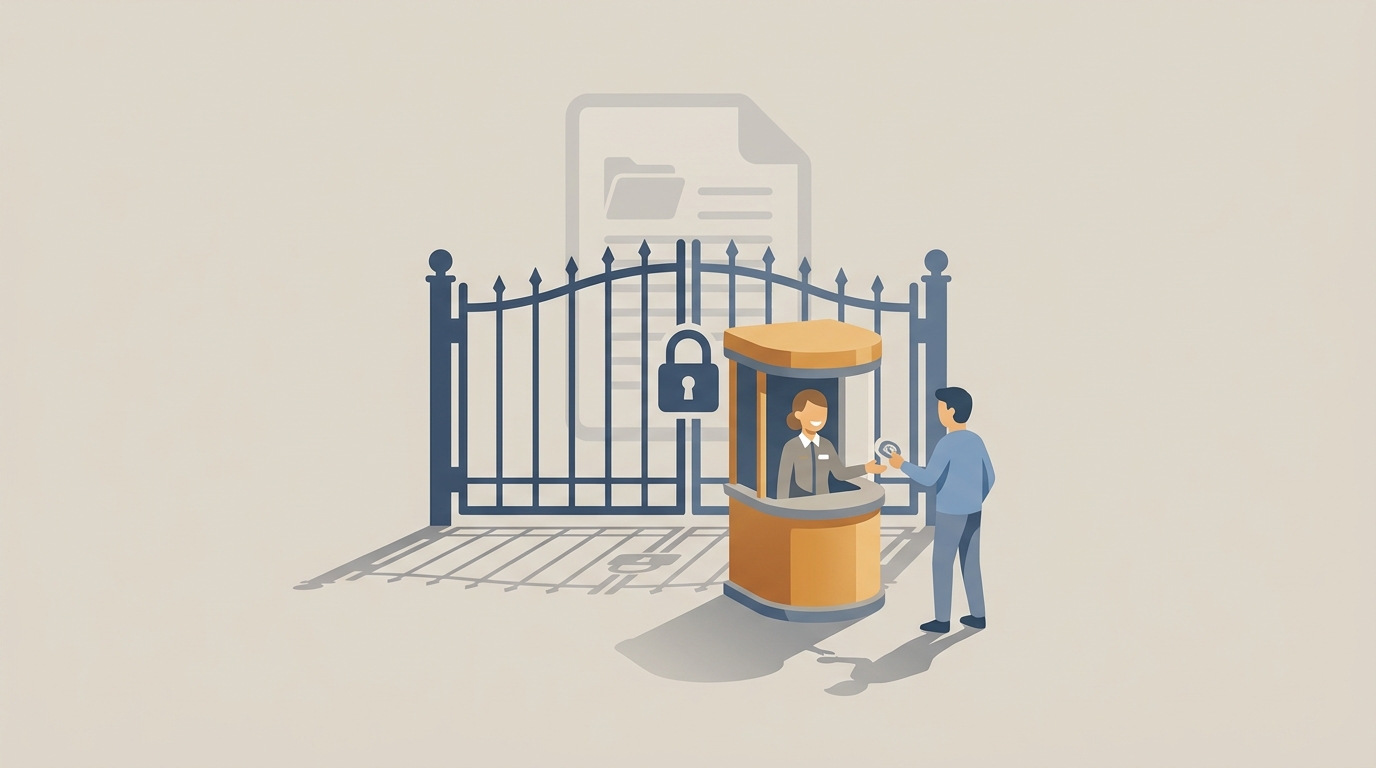
A simple vector-style illustration of a locked iron gate with a document silhouette behind it. In front of the gate sits a small toll booth. A person hands a coin to an attendant, symbolizing paying for access to protected content. The composition uses muted blues and grays with an amber accent and avoids any text or brand marks.
Protection Paradox: Paid Placements versus Organic Trust Signals
The Protection Paradox forces firms to choose between buying attention and earning it. Paid placements deliver immediate visibility. Organic trust signals build credibility over time. However, when firms block AI crawlers and gate content, organic channels weaken. As a result, marketing teams often increase paid spend to compensate.
Protection Paradox: How gated content undermines discoverability and indexable content
Gated content like PDFs and whitepapers often hides behind forms. Therefore search engines and AI surfaces cannot read or cite that material easily. For technical guidance on how robots rules affect indexing, see the Google developer guide. Moreover, a PDF behind a form is difficult for AI systems to extract and synthesize. Practical discussion about blocking PDFs appears at Stack Overflow. Consequently, firms that lock content reduce their presence in aggregated answers and AI summaries.
Consider the Mondelez example. Mondelez treated AI crawlers as suspicious bots and restricted access. As a result, Oreo appeared far less in AI brand discovery. Coverage of this dynamic appears at Search Engine Journal and at Digiday. Therefore the firm had to rely more on paid channels to restore visibility.
Protection Paradox: Why paid placements do not fully replace organic trust signals
Paid placements provide impressions and clicks. However, paid traffic rarely carries the same trust as organic referrals. Paid ads can seed awareness. Yet they do not create the cumulative authority that search engines reward. As a result, lead generation that depends only on paid tactics often yields lower quality MQLs. Paid strategies also risk higher cost per acquisition over time because they do not improve indexable content or AI citations.
Protection Paradox: Practical strategies to work with AI surfaces, not against them
Balance control and discoverability. Use these tactics:
- Publish indexable summaries for all gated reports. Consequently AI surfaces can cite your ideas while you protect depth.
- Use selective gating. For example, gate the full PDF but keep the key insights public. As a result, you preserve lead generation while improving discoverability.
- Structure pages for AI extraction. Use clear headings, plain HTML, and semantic markup so AI crawlers can parse content quickly.
- Combine paid amplification with discoverable pages. Paid ads should point to indexable landing pages, not locked PDFs.
- Measure signals that matter. Track organic visibility, AI surface mentions, and the quality of MQLs from each channel.
In short, the Protection Paradox is avoidable. Do not simply trade visibility for control. Instead, design content and ad strategies that let AI surfaces learn from your work while your firm keeps its competitive edge.
| Aspect | Paid Placements | Organic Trust Signals |
|---|---|---|
| SEO Implications | Offers no direct SEO benefits; requires ongoing investment | Enhances SEO with increased visibility and authority over time |
| Cost | Can be expensive, costs scale with reach | Initially free, but requires time and effort to generate |
| Trustworthiness | Lower trust as they appear as ads | High trust due to appearing in organic results |
| Effectiveness with AI | Limited effectiveness; AI may not prioritize ads | Highly effective when content is indexable; improves AI learning |
| Lead Generation (MQLs) | Immediate response potential | Typically attracts higher quality MQLs over time |
| Long-term Benefits | Short-lived; stops when buying stops | Long-lasting; builds brand authority and equity |
This table highlights how paid placements offer quick visibility but at a cost, often lacking the enduring benefits of organic signals. Effective law firm strategies should blend both to navigate the Protection Paradox while optimizing for discoverability and trust.
In conclusion, the Protection Paradox highlights a critical challenge for law firms navigating AI-driven marketing landscapes. While blocking AI crawlers can seem like a protective measure, it paradoxically demands heavier investment in paid advertising to compensate for the lost organic presence.
This strategy often results in a precarious balance. Firms then rely on shielding content but bear the burden of funding its rediscovery elsewhere. Paid placements deliver quick visibility but lack the depth of trust and authority that organic signals build over time. Therefore, crafting an advertising strategy that integrates both methods effectively unlocks lasting benefits.
Case Quota excels in equipping small and mid-sized law firms with strategies once reserved for Big Law firms. By fusing technical know-how and organic content techniques, Case Quota helps law firms achieve market dominance. They also ensure that their clients leverage both paid and organic paths to visibility. For more information, visit Case Quota.
As firms strive to overcome the Protection Paradox, aligning paid and organic efforts will prove crucial. By making strategic choices about discoverability, content accessibility, and AI interactions, law firms can sustain their visibility without over-spending. This continuous optimization will ensure prominence in competitive search environments.
Frequently Asked Questions (FAQs)
What is the Protection Paradox?
The Protection Paradox describes when firms block AI crawlers but then pay to be found. Firms protect content to prevent scraping and leaks. However, that protection reduces indexable content and discoverability. As a result, they often buy visibility on paid channels to replace lost organic reach.
Why do law firms block AI crawlers in the first place?
Firms block crawlers because they fear data scraping and unauthorized redistribution. They also worry about client confidentiality and competitive intelligence. However, blocking crawlers can fragment brand signals and reduce appearances in AI answers. Therefore, the initial protection can create expensive downstream costs.
How does gated content affect discoverability and AI surfaces?
A PDF behind a form is difficult for search engines to index. Consequently, AI surfaces and aggregators cannot extract or cite those insights. This reduces organic trust signals and weakens long-term SEO authority. As a result, lead generation and the quality of MQLs can suffer.
Can paid placements fully solve the Protection Paradox?
Paid placements restore visibility quickly, but they do not automatically build trust. Paid traffic can boost impressions and clicks, yet it rarely creates the authority organic results deliver. Therefore, a reliance on paid alone often yields higher acquisition costs and lower quality MQLs over time.
What practical steps should law firms take to balance protection and discoverability?
Start by publishing indexable summaries for gated reports so AI can cite your ideas. Second, use selective gating by keeping key insights public while protecting depth. Third, structure pages with clear headings and semantic HTML to help AI extraction. Finally, blend paid amplification with discoverable landing pages and then measure MQL quality across channels.