

In the rapidly evolving digital landscape, law firms must capitalize on AI-powered SEO and answer engine optimization (AEO/FSA) to enhance their online presence and drive business. A well-structured SEO audit tailored specifically for legal services is vital for uncovering hidden technical issues that could block indexing and hinder conversions. Such an audit can transform your website from a mere digital brochure into a powerful growth engine.
Technical SEO is often underestimated, yet crucial for any law firm seeking visibility. Common pitfalls include broken links, poor site speed, and inadequate mobile optimization. These issues not only impede search engine indexing but also drive away potential clients. With a robust SEO audit, these technical hitches can be identified and rectified.
Moreover, implementing schema and AEO best practices directly on your legal pages can significantly boost your site’s performance. Schema markup enhances your website’s visibility by making your legal services easily discoverable by search engines. Active engagement in AEO ensures that your content is not just found, but leveraged by search engines like Google’s AI-driven tools to provide accurate and authoritative answers.
With the advent of AI technologies in SEO, law firms can take advantage of tools such as HubSpot’s AEO Grader to improve overall site efficacy. It’s imperative for legal practices to adopt AI-powered strategies that not only focus on SEO but also emphasize answer engine optimization. As the digital frontier progresses, being proactive in these areas will set your firm apart from the competition.
AI-powered SEO and answer engine optimization (AEO/FSA) for law firm audits
An audit for a law firm must combine classic SEO checks with AI visibility tactics. Therefore, you need to measure crawlability, indexability, and answer engine readiness. Diagnosis before tactics, every single time. A well executed SEO audit turns your website into a growth engine.
Start with data. Most SEO audits take between two and eight weeks. Yet quick wins can show impact in days. For example, one case saw AI Share of Voice rise from roughly 27 percent to 72.7 percent within 96 hours. This shows that focused fixes can rapidly improve AI visibility and branded answers.
Running an SEO Audit: AI-powered SEO and answer engine optimization (AEO/FSA) steps
Use a structured process. Below are the steps tailored to legal pages. Each step maps to the FSA Framework of Freshness, Structure, and Authority.
Audit steps
- Crawl the site to surface broken pages, redirects, and orphan pages. Use Screaming Frog to export issues and status codes. Link: Screaming Frog
- Check index coverage and XML sitemaps in Google Search Console. Prioritize pages that serve high intent legal queries.
- Run a site speed and Core Web Vitals test. Slow pages reduce conversions and lower AI retrieval rank.
- Evaluate mobile usability because more than half of local legal searches come from mobile devices.
- Map content to user intent and answer triggers. Identify pages that should be optimized for answer engines.
- Audit schema markup and legal structured data. Ensure lawyer, organization, FAQ, and Service schema are correctly implemented.
- Analyze backlink quality and entity authority. Include brand signals and local citations.
- Use an AEO grader to measure answer readiness and the presence of direct answer signals.
Tools and how to use them
- Semrush provides keyword gap analysis, technical audits, and backlink tracking. It is useful for competitive benchmarks and keyword research. Pricing and plans: Semrush Pricing
- Screaming Frog helps you find indexability issues quickly. It exports bulk data for remediation workflows. Learn more: Screaming Frog
- HubSpot AEO Grader helps score answer engine readiness and on page AEO signals. It also ties SEO work to conversions inside HubSpot. Explore the tool: HubSpot AEO Grader
Quick wins for law firms
- Fix 404s and redirect chains within one week to restore link equity.
- Add FAQ schema to high intent pages to increase answer eligibility.
- Improve title tags and meta descriptions for top converting pages.
- Update attorney bios with credentials and schema to boost E E A T and entity authority.
Finally, prioritize fixes that unblock indexing and conversions first. As a result, you will see faster gains in AI Share of Voice and organic inquiries.
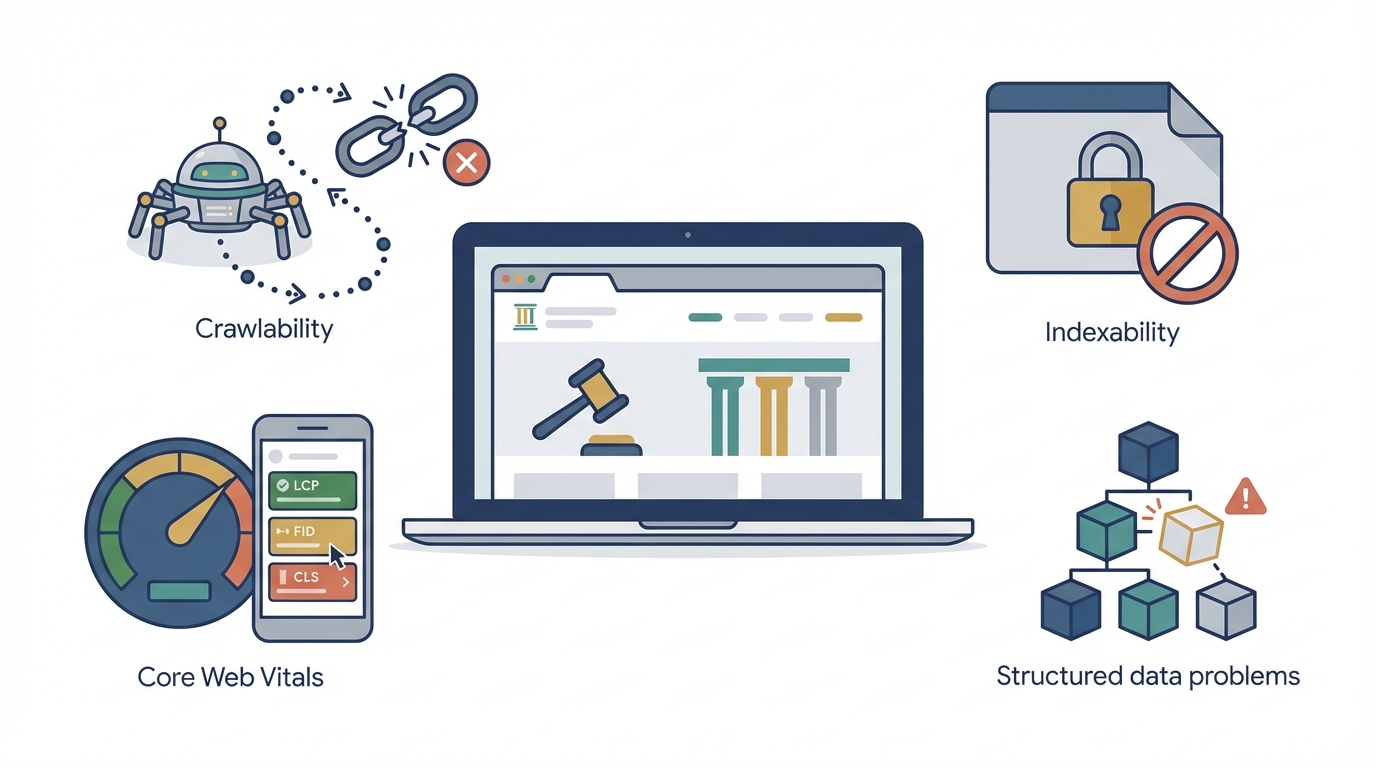
Fixing Technical SEO Issues That Block Indexing and Conversions
Technical issues can silently kill a law firm’s visibility and leads. Therefore, start with the principle: “Diagnosis before tactics, every single time.” Conduct a focused technical audit that targets crawlability, indexability, Core Web Vitals, and entity authority. Doing so reduces friction and improves the odds that AI systems surface your firm’s content.
Key areas to diagnose
- Crawlability. Check robots.txt, site architecture, and internal linking. If search engines cannot reach pages, they cannot index them.
- Indexability. Verify canonical tags, noindex directives, and XML sitemaps. Incorrect signals block pages from appearing in search results.
- Core Web Vitals. Measure LCP, FID or INP, and CLS. Slow or janky pages lower rankings and reduce conversions.
- Structured data and entity authority. Ensure lawyer, organization, FAQ, and Service schema are valid. Structured data helps AI systems extract answers.
How to diagnose these issues
- Use Google Search Console to find coverage and indexing errors. Review the sitemap and discovery reports at Google Search Console.
- Run a full crawl with Screaming Frog to export redirects, 4xx and 5xx errors, and orphan pages. Tool link: Screaming Frog SEO Spider.
- Test page speed and Core Web Vitals in PageSpeed Insights and Lighthouse. Fixing these metrics lifts UX and search performance.
- Validate schema with the Rich Results Test and Realtime schema validators. Correct JSON-LD errors to improve answer eligibility.
- Monitor backlinks and brand mentions to strengthen entity authority. Use Semrush for backlink audits and competitive context: Semrush.
Actionable fixes and expected impact
- Repair redirect chains and 404s within a week. This restores link equity and improves crawl budget use.
- Fix robots.txt blocks and accidental noindex tags. Doing so often returns pages to the index quickly.
- Optimize images, defer noncritical JS, and use a CDN. As a result, LCP improves and mobile conversions rise.
- Implement or correct FAQ schema on conversion pages. Consequently, pages become eligible for answer snippets and AI answers.
- Harden attorney bios with credentials and structured data. This raises E E A T signals and entity authority.
How these fixes affect AI Share of Voice and brand signals
Technical fixes boost retrieval rank and answer eligibility. For example, focused remediation has driven AI Share of Voice from about 27% to 72.7% in 96 hours in case studies. Therefore, solving crawlability and indexability issues helps AI systems cite your pages more often. Moreover, improving Core Web Vitals increases user engagement, which strengthens brand signals. In short, technical SEO is not optional. It is foundational to both organic rankings and AI-powered visibility.
For teams using HubSpot, integrate these fixes into your CMS and track conversion impact inside the platform. See HubSpot’s SEO tools for on page grading and AEO readiness at HubSpot SEO Tools.
Prioritize fixes that unblock indexing and conversions first. Then iterate on authority and content. This sequence produces faster, measurable gains.
| Tool | Pricing | Key features | Ease of use | Role in AI-powered SEO and answer engine optimization (AEO/FSA) | Best use case for law firms |
|---|---|---|---|---|---|
| Semrush | Starts at $165/month. Full pricing and plans: Semrush Pricing | Keyword research, site audit, backlink analysis, rank tracking, content gap, SERP features monitoring. | Moderate. Dashboard is rich, but learning curve exists. | Use for keyword gap analysis, tracking retrieval rank, and backlink audits. Supports AI visibility and entity authority work. | Competitive benchmarking and content strategy for practice areas. |
| Screaming Frog SEO Spider | Free tier; licensed version listed at $279/year. More at Screaming Frog | Deep site crawling, redirects, status codes, sitemap analysis, structured data extraction. | Technical. Requires SEO knowledge to interpret exports. | Diagnose crawlability and indexability issues. Surface redirect chains, orphan pages, and schema errors that block AI answers. | Technical remediation and crawl budget optimization. |
| HubSpot AEO Grader | Free tool inside HubSpot’s SEO suite. Explore: HubSpot AEO Grader | AEO scoring, on-page recommendations, FAQ optimization, answer readiness checks. | Easy. Designed for marketers and content teams. | Measures answer engine readiness and AEO signals. Ties content changes to conversion metrics and freshness signals. | Rapid AEO audits and content fixes for high-intent legal pages. |
| HubSpot Marketing Hub | Plans range from Free to Enterprise. See HubSpot SEO page: HubSpot Marketing Hub | CMS, CRM integration, Website Grader, AEO Grader, reporting, automation, content hub. | Very user-friendly. Centralized for marketers and lawyers. | Unifies SEO with CRM and conversion tracking. Helps maintain Freshness, Structure, and Authority at scale for legal pages. | End-to-end SEO, content ops, and conversion tracking for law firms. |
Use these tools together. For example, crawl with Screaming Frog, analyze gaps with Semrush, and measure AEO readiness with HubSpot. This sequence speeds diagnosis and remediation.
AI-powered SEO and answer engine optimization (AEO/FSA) for legal pages
Schema markup and AEO are critical for law firms. They help search engines and AI systems understand your services, lawyers, and local presence. Therefore, implementing structured data raises the chance that AI answers cite your pages. As a result, you will capture higher AI Share of Voice and more qualified leads.
Why schema and AEO matter for law firms
Legal queries demand precision, authority, and local relevance. The FSA Framework emphasizes Freshness, Structure, and Authority. Meanwhile, GEO focuses on generative engine optimization and local signals. Together, they guide how content and markup should behave for modern AI retrieval systems. For example, structured data lets AI extract attorney credentials, practice areas, and contact options directly. Consequently, users see concise answers with clear attribution to your firm.
Schema types every law firm should use
- LocalBusiness schema for office locations and hours. Use it to surface maps and local info. See LocalBusiness Schema
- Attorney or Person schema for lawyer bios, credentials, and bar admissions. See Attorney Schema
- FAQPage schema for common client questions and quick answers. See FAQPage Schema
- Service schema to describe practice areas and typical outcomes. See Service Schema
- Organization schema for firm-level branding and legal entity details
Implement these types using JSON-LD in the page head or just before the closing body tag. Use canonical URLs and align on-page content with markup to avoid mismatch errors.
Best practices for implementing schema and AEO
- Use JSON-LD format for reliability and easier validation.
- Match schema fields to visible page content for trust and consistency.
- Prioritize FAQ and HowTo markup on pages with strong conversion intent.
- Mark up attorney bios with awards, publications, and verified credentials to boost E E A T and entity authority.
- Timestamp content and use structured update logs to signal freshness to AI systems.
- Validate markup with Google Rich Results Test and fix errors before deployment.
- Avoid stuffing schema with irrelevant properties. Irrelevance reduces trust.
Workflow and tooling
Start in your CMS and then test in staging. HubSpot Content Hub centralizes content, templates, and AI-driven recommendations. Learn more at HubSpot Content Hub. After implementing markup, measure AEO readiness with HubSpot Marketing Hub and the AEO Grader at HubSpot Marketing Hub. Use these tools to connect schema work to conversions and CRM signals.
Example snippets and content patterns
- Attorney bio: include name, jobTitle, almaMater, barAdmission, awards, and sameAs links to profiles.
- Service page: include serviceType, areaServed, typicalOutcome, and relatedFAQ entries.
- FAQ block: pair question and short answer, then expand into longer content for authority.
Freshness, structure, authority. Your content is no longer a destination, but an input. Therefore, treat schema as part of content strategy. As a result, you will increase answer eligibility, retrieval rank, and brand signals. Start with high-intent pages and iterate quarterly to maintain performance.
Conclusion
In today’s competitive legal landscape, harnessing the power of AI-powered SEO and answer engine optimization (AEO/FSA) is no longer optional for law firms; it’s essential. This article has highlighted the fundamental importance of conducting thorough SEO audits tailored to the legal sector, identifying and rectifying technical SEO issues that block indexing and conversions, and implementing schema markup and AEO best practices specifically for legal pages.
Deep dive into SEO audits reveal crucial insights that allow law firms to rectify issues like crawlability, indexability, and Core Web Vitals, ensuring websites remain competitive and visible in AI-driven search environments. Effective implementation of schema markup further enhances online visibility by helping search engines understand the context of your legal services. These strategies ensure that firms not only appear in search results but also provide direct, structured answers that potential clients are increasingly seeking.
For small and mid-sized law firms looking to level the playing field against larger competitors, specialized assistance is invaluable. This is where Case Quota comes into play. As a specialized legal marketing agency, Case Quota empowers these firms to harness high-level strategies used by big law firms, thus achieving market dominance. Their expertise in leveraging SEO, AEO, and technical optimization can transform your digital presence, helping you to stand out and reach the clients who need your services most.
Don’t leave your firm’s success to chance. Partner with Case Quota today and step into a new era of digital proficiency and market leadership. Visit Case Quota to learn more and start your journey towards optimized online visibility and client engagement.