

Embracing AI Enablement: Transformative Marketing Strategies for Law Firms
In today’s rapidly evolving digital landscape, AI enablement has become a cornerstone for innovative marketing strategies, especially within the legal sector. Law firms are increasingly recognizing the profound impact that artificial intelligence can have on their marketing efforts. By leveraging AI technologies, these firms can streamline operations, enhance client engagement, and outperform competitors.
This article delves into the powerful role of AI enablement in modern marketing, spotlighting Loop Marketing, AI adoption, and forecasting strategies tailored for legal practitioners. With the ability to automate routine tasks and provide deep insights into client behavior, AI empowers law firms to make data-driven decisions that boost efficiency and effectiveness.
More than just a buzzword, AI adoption is reshaping how legal professionals approach their marketing campaigns. According to recent statistics, 61% of marketers consider AI as the most significant disruption in the past two decades, with 80% already integrating it into their workflows. This trend is not just about keeping pace with technological advancements, but also about setting a new precedent for innovation in the legal industry.
However, the journey toward AI enablement is not without its challenges. Many firms face hurdles related to people and process changes when implementing AI solutions. Yet, those who persevere through the initial learning curve stand to unlock substantial value. As Amy Rigby aptly notes, “The hardest part about weaving AI into workflows is also the hardest part of any attempt at efficiency gains: It’s going to be wildly inefficient at first.”
This article will explore practical strategies for law firms to harness AI’s potential through Loop Marketing and adept forecasting. We will uncover how these strategies can be integrated to create a seamless experience that empowers legal marketers to amplify their reach and optimize resource allocation. Join us as we uncover the future of law firm marketing in a world increasingly driven by AI innovations.
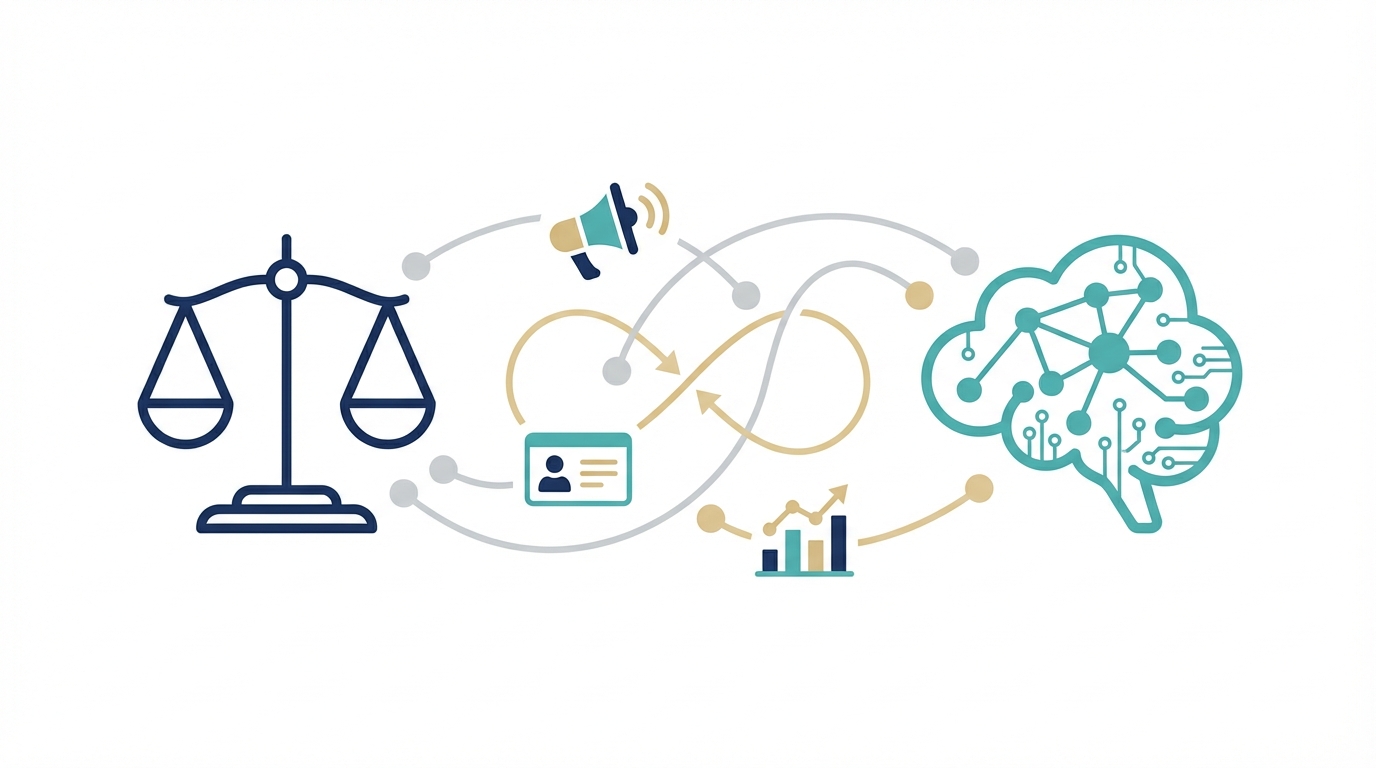
What Loop Marketing Means for Law Firms
Loop Marketing turns human insight into a repeatable growth system. It emphasizes a cycle of creating, testing, learning, and scaling. For law firms, that cycle aligns with client discovery, content creation, distribution, and measurement.
Loop Marketing reduces waste. It replaces one-off campaigns with a feedback loop that improves over time. As a result, teams spend less guessing and more optimizing.
AI enablement and Loop Integration
AI enablement amplifies every step of the loop. Because AI speeds content production and analysis, firms can test more variants in less time. This leads to faster learning and better outcomes.
- AI helps surface client intent from CRM data and search signals. Therefore firms can tailor messaging to real needs.
- AI automates repetitive tasks like draft writing, keyword research, and reporting. As a result, teams save time and focus on strategy.
- AI pilots allow firms to run rapid experiments across channels. Consequently you can scale winners with confidence.
For a practical primer on Loop Marketing, see HubSpot’s Loop Marketing playbook: HubSpot’s Loop Marketing playbook. To explore AI-powered campaign tools, review HubSpot Marketing Hub: HubSpot Marketing Hub. For broader adoption stats and trends, consult the Marketing AI Institute report: Marketing AI Institute Report.
Why law firms should prioritize adoption now
Many firms still treat AI as optional. However, early adopters gain compounding advantages. Those who persist through the learning curve will see measurable improvements in weeks.
- 67 percent of marketing teams report saving ten or more hours weekly with AI. This frees resources for high-value work.
- AI referral traffic often shows higher intent than traditional search. Therefore conversion rates can improve when AI drives discovery.
- Teams that adopt Loop Marketing commonly see gains within 30 to 90 days.
Voices from the field
“Awareness is passive, and adoption requires you to change how you actually work, not just add a new tab to your browser,” says Timothy Biondollo. He adds, “The gap is that most people are still moving through their day task by task, in order, doing the work themselves. Enabled people have made a completely different shift.”
Meg Prater echoes this practical view. She explains, “Someone who is AI-enabled is someone who is AI-curious. You should be experimenting with it, practicing with it, and trying out new tools/builds. It’s not enough to be running the same three prompts.” Her guidance highlights the need for continual practice as models evolve.
Actionable steps for AI adoption in a law practice
- Start small and publicize wins
- Run one experiment per month. Share the method and results across teams. As Timothy recommends, share the how not just the wow.
- Build prompt playbooks and templates
- Standardize prompts for common tasks such as intake emails, article drafts, and ad copy. Then iterate based on outputs.
- Link AI to CRM and content metrics
- Feed AI with anonymized CRM insights so it can suggest better segments and messaging. Track performance in dashboards.
- Train people before scaling tools
- Offer short, hands-on sessions. Encourage practice prompts and peer reviews. This reduces fear and shortens the learning curve.
- Measure cost to serve and lift
- Calculate hours saved and conversion lift. Use those metrics to justify further investment.
Final thought
Loop Marketing and AI enablement together create a practical, repeatable system. When law firms commit to small experiments, share the how, and measure results, they unlock sustainable growth and improved client relevance.
Quick Comparison: AI Tools and Marketing Forecasting Methods
| Tool or Strategy | Primary features | Benefits (how AI enablement helps) | Ideal use cases in legal marketing |
|---|---|---|---|
| Claude (Anthropic) | Safety-focused LLM; long-form synthesis; instruction following | Produces clear drafts and summaries quickly; therefore reduces manual writing hours; supports AI enablement by standardizing outputs | Blog posts; client Q&A drafts; summarizing case notes |
| ChatGPT (OpenAI) | Versatile LLM; plugin ecosystem; strong prompt flexibility | Accelerates content ideation and iteration; therefore teams test variants faster; enables rapid prototyping through AI enablement | Content drafts; ad copy; drafting SOPs and playbooks |
| Gemini (Google) | Multimodal reasoning; integrated with search and tools | Extracts insights from documents and search signals; therefore improves research speed; supports AI enablement for data-driven messaging | Research briefs; multimedia content; complex topic explainers |
| Perplexity | Answer-focused search with citations; concise sourcing | Improves discovery and factual accuracy; therefore raises content credibility; aids AI enablement for higher-intent traffic | Topic research; competitive intel; FAQ content |
| Breeze AI / Breeze Assistant | Workflow assistant tied to CRM and marketing tools | Automates CRM tasks and content publishing; therefore reduces handoffs; powers Loop Marketing through AI enablement | Nurture sequences; follow-up emails; campaign task automation |
| Time-series forecasting | Seasonal models like Prophet and ARIMA; trend decomposition | Predicts leads and traffic by season; therefore allocates resources smarter; AI enablement automates retraining | Planning seasonal campaigns; staffing and channel timing |
| Predictive machine learning | Regression and classification; feature engineering; ensembles | Scores leads and predicts conversions; therefore targets high-value prospects; AI enablement integrates signals across data | Lead scoring; propensity to convert; channel optimization |
| Marketing mix modeling | Aggregate causal models; channel contribution analysis | Measures channel ROI and trade-offs; therefore optimizes budget allocation; AI enablement speeds scenario runs | Budget allocation; cross-channel ROI analysis |
| Scenario-based forecasting | What-if simulations; Monte Carlo and sensitivity tests | Tests outcomes under uncertainty quickly; therefore informs risk-aware plans; AI enablement generates many scenarios fast | Contingency planning; bid simulations; pricing experiments |
| Pipeline-based CRM forecasting | Funnel metrics; velocity and conversion rules; deal staging | Produces granular revenue forecasts from live deals; therefore links marketing to revenue; AI enablement improves scoring and alerts | Forecasting revenue; weekly funnel reviews; forecasting by practice area |
Forecasting Strategies for AI-Enabled Marketing
Accurate marketing forecasting matters for law firms. With limited budgets and long sales cycles, firms need better foresight. AI in marketing improves prediction speed and precision. Therefore firms can allocate resources with more confidence.
Modern marketing forecasting blends classical models with machine learning. Time-series methods, predictive models, and scenario planning all play a role. Because legal demand often moves slowly, combining approaches reduces risk.
Key techniques and how AI enablement boosts them
- Time-series forecasting
- What it is: Models like Prophet and ARIMA predict seasonal patterns and trends.
- How AI helps: AI automates retraining and flags changing seasonality faster. As a result, teams update plans without manual recalculation.
- Use case: Planning content calendars and staffing for peaks in inquiry volume. See Prophet for a practical tool: Prophet.
- Predictive machine learning
- What it is: Models use features from CRM and web behavior to predict leads and conversions.
- How AI helps: Feature engineering scales across practice areas, and models retrain with new data automatically. Therefore lead scoring becomes more accurate over time.
- Use case: Prioritizing intake follow-ups and channel bids.
- Marketing mix modeling
- What it is: Aggregate causal models measure channel contribution to outcomes.
- How AI helps: AI speeds scenario runs and explores many budget mixes quickly. As a result, firms find efficient spend allocations under uncertainty.
- Use case: Allocating budgets across paid search, content, and referral channels.
- Scenario-based forecasting
- What it is: Monte Carlo and sensitivity tests simulate outcomes under different assumptions.
- How AI helps: AI generates thousands of what-if scenarios and summarizes the risk distribution. Therefore leaders choose plans that balance growth and risk.
- Use case: Preparing contingency plans for a major case win or loss.
- Pipeline-based CRM forecasting
- What it is: Uses funnel metrics, velocity, and stage conversion rules to estimate revenue.
- How AI helps: AI improves conversion probability estimates and surfaces stalled deals. Consequently revenue forecasts link tightly to marketing actions.
- Use case: Weekly revenue checks by practice area.
Practical steps to embed forecasting in legal marketing
- Centralize clean CRM data first. Without reliable inputs, models fail. Clean data improves AI model performance rapidly.
- Start with one pilot model. Measure lift in predictive accuracy and hours saved. Many teams report they save ten or more hours weekly after adopting AI workflows.
- Combine qualitative inputs. Partner insights and case timing matter. Use AI to tag notes and surface trends from qualitative data.
- Automate retraining cadence. Set weekly or monthly retrain intervals so forecasts reflect new signals quickly.
- Visualize uncertainty. Present ranges not single-point predictions to manage expectations.
Evidence and context
AI in marketing is now mainstream. For example, 61 percent of marketers call AI the biggest disruption in decades, and 80 percent use it in workflows. However, 74 percent of companies still struggle to show tangible business value, because people and process gaps slow adoption.
Don’t let that deter you. As Timothy Biondollo advises, change how you work rather than just adding a tool. Likewise Meg Prater urges teams to practice prompts and evolve with models. When forecasting and AI work together, law firms gain clearer plans and stronger returns.
Conclusion: Unlocking Potential with AI Enablement
As the digital marketing landscape continues to evolve, law firms must leverage Loop Marketing and AI adoption to stay competitive. Embracing AI enablement allows firms to enhance client engagement, streamline operations, and make data-driven decisions. The integration of AI tools with marketing strategies not only optimizes resource allocation but also accelerates growth in a rapidly changing market.
The insights into marketing forecasting underline the importance of strategic planning. By adopting time-series models, predictive machine learning, and scenario-based forecasting, law firms can achieve greater accuracy and flexibility in their marketing efforts. This enables a proactive approach, offering a competitive edge in client acquisition and retention.
In this era of digital marketing transformation, leveraging AI is not optional but essential. As Timothy Biondollo and Meg Prater have noted, shifting to an AI-enabled mindset is crucial for innovation and efficiency.
For law firms seeking to elevate their marketing initiatives, Case Quota stands out as an expert partner. Specializing in legal marketing, Case Quota empowers small and mid-sized firms with strategies akin to those used by ‘Big Law’ giants. By providing tailored solutions and leveraging the latest AI advancements, Case Quota helps firms achieve market dominance.
Explore how Case Quota can transform your firm’s marketing approach with AI-driven strategies. Discover more at Case Quota.
With intelligent tools and approaches in place, law firms can look forward to a future of optimized marketing performance and sustained growth.
Frequently Asked Questions (FAQs)
What is AI enablement in law firm marketing?
AI enablement means integrating AI into marketing workflows to boost speed and accuracy. It combines tools, data, and trained people. Loop Marketing uses these capabilities to create iterative tests and scale winners. As a result, firms move from one-off campaigns to repeatable growth systems.
How does Loop Marketing pair with AI adoption?
Loop Marketing follows a create, test, learn, and scale cycle. AI speeds content production and insight extraction. Therefore teams run more experiments and learn faster. Many teams see improvements in 30 to 90 days when they adopt Loop Marketing with AI.
Which forecasting techniques work best with AI in marketing?
Blend time-series models with predictive machine learning for the best results. Also use marketing mix modeling and scenario-based forecasting. AI automates retraining, explores many budget mixes quickly, and summarizes risk distributions. Consequently forecasts become more accurate and actionable for long sales cycles.
How should small and mid-sized law firms begin AI adoption?
Start with one pilot tied to a clear goal. Clean and centralize CRM data first. Then build prompt playbooks and templates for repeatable tasks. Train people with short, hands-on sessions. Measure hours saved and conversion lift, and scale what works.
What metrics prove AI and forecasting success?
Track hours saved, content throughput, and conversion lift. Also monitor lead quality and funnel velocity. For context, 67 percent of marketing teams report saving ten or more hours weekly with AI. Because AI referral traffic often shows higher intent, also measure intent and downstream revenue.