

Native ndMAX integration: Marketing Mid-Size Law Firms by Showcasing AI-Powered Workflow Integrations
Native ndMAX integration promises to untangle the messy web of disconnected AI tools in midsize firms. However, many mid-size law firms still juggle point solutions that fail to communicate with each other. This fragmentation wastes attorney time and creates duplicate work across systems. Because data sits in silos, firms cannot report on matter intelligence or automate repeatable tasks. As a result, marketing leaders struggle to position firms as efficient and tech forward.
The new solution combines Centerbase and NetDocuments with ndMAX to create connected workflows. Moreover, phase one links matter data to NetDocuments to trigger workspace setup and document packages. Soon, phase two will enable bidirectional flows so ndMAX can push extracted facts back into Centerbase. Therefore, firms gain governance, usage tracking, and billing visibility for AI adoption. This integration reduces double typing and speeds client onboarding while supporting alternative fee analytics.
Read on to learn how showcasing AI-powered workflow integrations becomes a marketing advantage for mid-size firms.
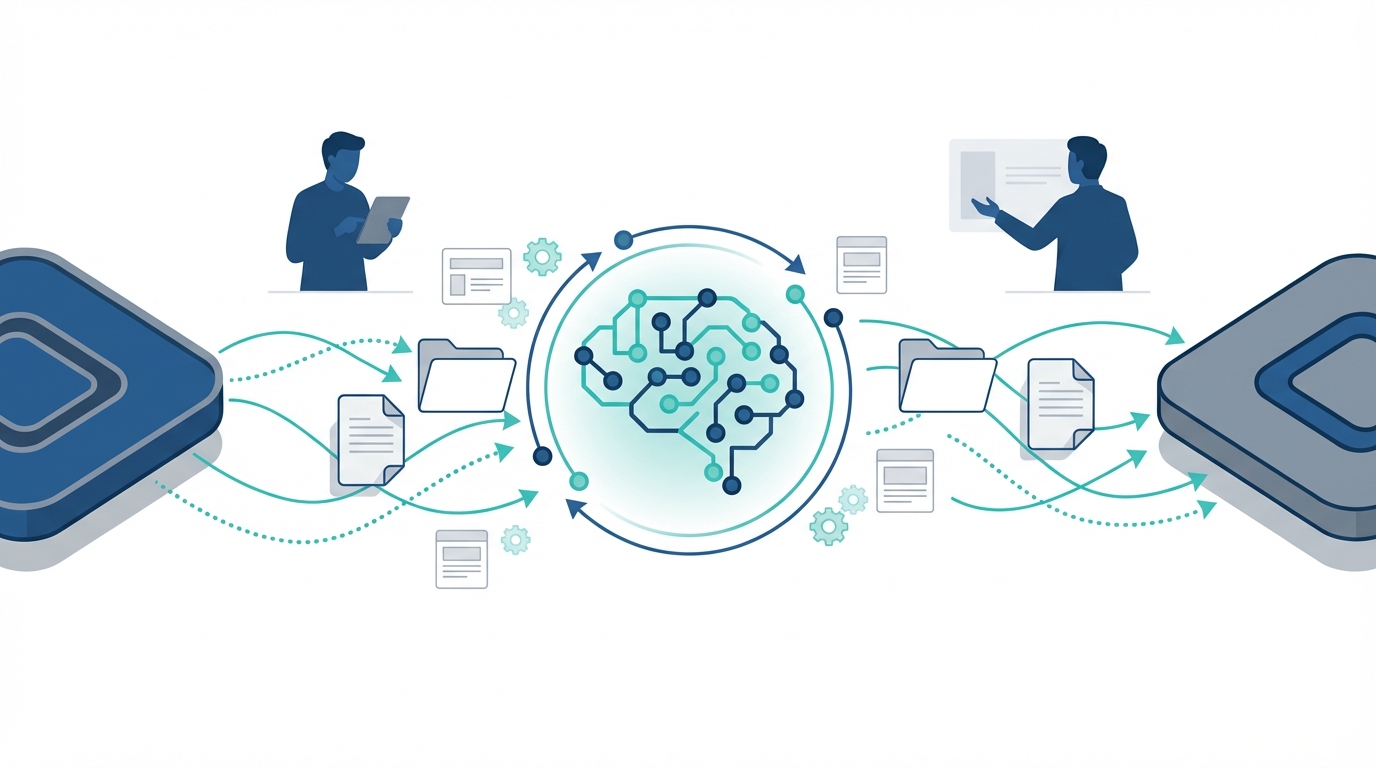
Native ndMAX integration capabilities and phase rollout
The Native ndMAX integration links Centerbase case data with NetDocuments document automation. Because the integration natively connects matter records and ndMAX, firms avoid toggling between systems. As a result, attorneys save time and reduce duplicate data entry. Moreover, the integration adds governance and usage tracking for AI adoption so firms can measure costs and benefits.
What the integration does
- It triggers document packages and workspace setup in NetDocuments when a matter record exists in Centerbase. For example, one click can create a closing folder with predefined templates. Because ndMAX handles document processing, the system extracts parties, dates, and obligations.
- It writes extracted metadata back into Centerbase. Therefore, matter fields stay current and ready for reporting or downstream workflows.
- It treats NetDocuments as a native action type inside the workflow engine. Administrators can configure data elements and templates across matters and practice areas.
Phase one details
Phase one releases core inbound flow from Centerbase to NetDocuments. In practice, matter data flows to NetDocuments to trigger workspace creation and package generation. This release lets firms automate onboarding and document assembly. Because templates and workspace rules sit in NetDocuments, setup time falls dramatically. Centerbase is the first practice management platform to natively connect matter data with ndMAX, and you can explore Centerbase at Centerbase.
Phase two roadmap
Phase two delivers bidirectional communication between ndMAX and Centerbase. After ndMAX processes a saved document, extracted metadata pushes back into Centerbase. For example, saving a client contract to NetDocuments will let ndMAX extract parties, key dates, and obligations and write them to matter fields. Therefore, firms gain true automation across systems.
Key benefits and governance
- Automation reduces manual double typing and prevents errors. Scott Cormier explained this clearly. “Normally one of the problem areas that our customers have highlighted is sometimes I have two distinct processes — I’m setting up the matter over here, but then I’m going over to NetDocs and I’m also doing some other additional updates,” Cormier said. “We completely eliminate that kind of double typing moment.”
- Usage tracking supports billing and AI governance. Rob Joyner emphasized governance as essential. “For these midsized law firms, governance can’t just be a feature for the firms,” Joyner said. “They need a system that can help them understand usage, that can actually track the usage from a billing standpoint and really work it into their workflows.”
- Reporting enables efficiency metrics and alternative fee modeling. As a result, firms can price more accurately and show measurable value to clients.
Demo and ecosystem
Centerbase and NetDocuments will demonstrate the integration at ABA TECHSHOW in Chicago. Visit ABA TECHSHOW for event details. Looking ahead, Centerbase plans a library of standardized workflow blocks that admins can activate in 2026. This roadmap promises faster rollouts and repeatable AI powered workflows for midsized law firms. For more on NetDocuments, see NetDocuments.
Together, the Native ndMAX integration moves firms from fragmented tools to a connected, auditable AI workflow platform.
Use this quick comparison to evaluate workflows. The table contrasts manual, disconnected workflows with AI powered ndMAX integration benefits. However, the right integration changes how firms operate and report.
| Feature | Traditional disconnected workflow | AI-powered ndMAX integration benefits |
|---|---|---|
| Double typing and re-entry | Users switch systems and re-enter matter data manually | Eliminates double typing because data flows automatically between Centerbase and ndMAX |
| Data governance and tracking | Limited visibility into AI usage and billing | Built-in usage tracking and billing visibility for governance and cost control |
| Document processing | Manual assembly and inconsistent templates | Automated workspace setup and consistent document packages |
| Metadata capture | Metadata often trapped in documents and not reported | ndMAX extracts parties, dates, and obligations and writes them to matter fields |
| Reporting and analytics | Reporting relies on manual summaries and guesses | Real-time reporting enables efficiency metrics and alternative fee modeling |
| Onboarding and setup time | Slow onboarding due to manual folder and template setup | Faster onboarding via triggered workspace creation and templates |
| Error rate and compliance | Higher risk of errors and missed obligations | Reduced errors and improved compliance, thereby lowering risk |
Native ndMAX integration governance and AI adoption
Governance sits at the center of successful AI adoption in midsized law firms. Because AI tools can scale unpredictably, firms need visibility into who uses AI and how. The Native ndMAX integration provides that visibility by tracking usage, associating costs, and logging actions across matter workflows. As a result, firms move from guesswork to measurable control.
Usage tracking and billing visibility
The integration captures ndMAX activity and ties it to Centerbase matter records. Therefore, firms see which matters generate AI processing costs and who triggered them. This enables accurate billing and internal chargebacks. Rob Joyner stressed the need for controls. “For these midsized law firms, governance can’t just be a feature for the firms,” Joyner said. “They need a system that can help them understand usage, that can actually track the usage from a billing standpoint and really work it into their workflows.”
Key usage features
- Matter level usage logs that feed billing systems
- Admin dashboards for consumption and cost trends
- Role based controls to limit or approve AI actions
For firms that want vendor details, see Centerbase and NetDocuments to compare platform capabilities.
Reporting, efficiency gains, and measurable outcomes
The integration writes ndMAX extracted metadata back to Centerbase. Therefore, firms gain structured data for reporting and automation. Consequently, managers can measure cycle times, document throughput, and bottlenecks. Scott Cormier highlighted the practical impact. “Normally one of the problem areas that our customers have highlighted is sometimes I have two distinct processes — I’m setting up the matter over here, but then I’m going over to NetDocs and I’m also doing some other additional updates,” Cormier said. “We completely eliminate that kind of double typing moment.”
What reporting unlocks
- Real time efficiency metrics for matters and teams
- Data to support alternative fee arrangements and pricing
- Audit trails that show what the AI extracted and when
Practical steps to realize gains
Adopt clear policies before enabling ndMAX workflows. Train staff on the new task triggers and templates. Also, start with high volume matter types to maximize early wins. Because the integration standardizes workspace templates, firms can roll out consistent processes quickly.
Bottom line for midsized law firms
Native ndMAX integration turns AI usage into tracked, billable, auditable activity. As a result, firms reduce errors, shorten onboarding, and justify modern pricing models with data. Moreover, governance and reporting create a defensible path to scale AI without losing control.
CONCLUSION
The Native ndMAX integration delivers clear business value for midsized law firms. It connects Centerbase matter data with NetDocuments ndMAX to automate document workflows, extract metadata, and update records. As a result, firms reduce double typing and speed client onboarding. Moreover, built in usage tracking provides governance and billing transparency. Firms can then measure AI costs and assign charges more accurately.
These efficiency gains enable smarter pricing. With structured data flowing back into Centerbase, leaders can build alternative fee arrangements based on real metrics. Reporting shows cycle times, volume, and bottlenecks, so teams improve processes continuously. Because audit trails record AI actions, compliance risks fall while confidence rises.
Looking ahead, the integration seeds a broader ecosystem of workflow blocks. Centerbase plans standardized blocks that admins can activate in 2026, which will accelerate rollouts. Therefore, firms can scale repeatable, auditable AI workflows across practices.
Case Quota helps firms translate these technology benefits into market advantage. As a specialized legal marketing agency, Case Quota adapts high level Big Law strategies for midsized firms to gain market dominance. Learn more and start a transformation at Case Quota.
Frequently Asked Questions (FAQs)
What are the main benefits of the native ndMAX integration?
The native ndMAX integration offers several benefits, including the elimination of double typing, improved data governance, streamlined document processing, and enhanced real-time reporting. By enabling seamless data flow between Centerbase and NetDocuments, firms can automate tasks and significantly reduce manual efforts.
How does the integration improve workflow automation?
The integration automates the creation of document packages and workspaces in NetDocuments based on matter data in Centerbase. This not only reduces manual setup time but also ensures consistency in document handling. Additionally, ndMAX processes documents, extracting important metadata and updating records, which further enhances automation.
What governance features does the integration provide for AI adoption?
Governance features include usage tracking and billing visibility, which help firms understand AI usage costs. This enables accurate billing and cost management while providing administrative dashboards for monitoring trends and setting role-based controls for AI actions.
What are the implementation phases of the native ndMAX integration?
The implementation is divided into two phases: Phase one focuses on inbound data flow from Centerbase to NetDocuments, triggering document handling upon matter record creation. Phase two, scheduled for release in May or June, will enable bidirectional data flow, allowing document processed data to update Centerbase records.
What future updates are planned for the integration?
Future updates include expanding standardized workflow blocks across practice areas by 2026, enabling faster rollout of repeatable workflows. Firms can look forward to increased capabilities that further enhance efficiency and governance. For additional information, visit Centerbase or NetDocuments.