

AI in SEO and Search: Misinformation Risks and Their Impact on Legal Practices
AI in SEO and Search: misinformation risks, CTR impact, and platform readiness are reshaping how legal practices attract clients. As AI-driven summaries and overviews appear in search results, they change user behavior quickly. In some markets, these overviews reduce clicks to the top organic result. Therefore, law firms must pay attention and act now.
Recent studies show AI Overviews appear on roughly one fifth of queries in some regions. When they appear, the click-through rate for position one can fall sharply. For example, top organic CTRs can drop from about twenty-seven percent to eleven percent. Because these losses scale across millions of queries, the impact becomes large.
Misinformation amplifies that risk. Experiments have placed fabricated updates into AI summaries and seen them rank on page one. As a result, false statements can gain visibility fast. Consequently, brands that rely on accurate representation can suffer reputational harm.
Platform readiness matters for response. Some search engines now monetize AI modes and place overview panels above organic listings. Others test ads inside conversational assistants. Therefore firms must test how their content appears across modes, like AI Overviews, traditional SERPs, and assistant responses.
This article guides law firms with data, practical checks, and tactical steps. It covers detection methods, schema and structured data tactics, and content governance. Furthermore, it explains monitoring workflows and crisis response for misinformation. By the end, teams will know how to protect CTR and client trust.
We also discuss measurement and KPIs so legal marketers can quantify AI-driven risks. For example, track changes in organic impressions, query coverage, and CTR by intent. Additionally, establish alerting for sudden drops in brand query clicks. Finally, adopt content verification steps to reduce the chance of AI spreading inaccurate facts.
Taken together, these steps help firms adapt quickly. They preserve visibility, credibility, and client acquisition pipelines.
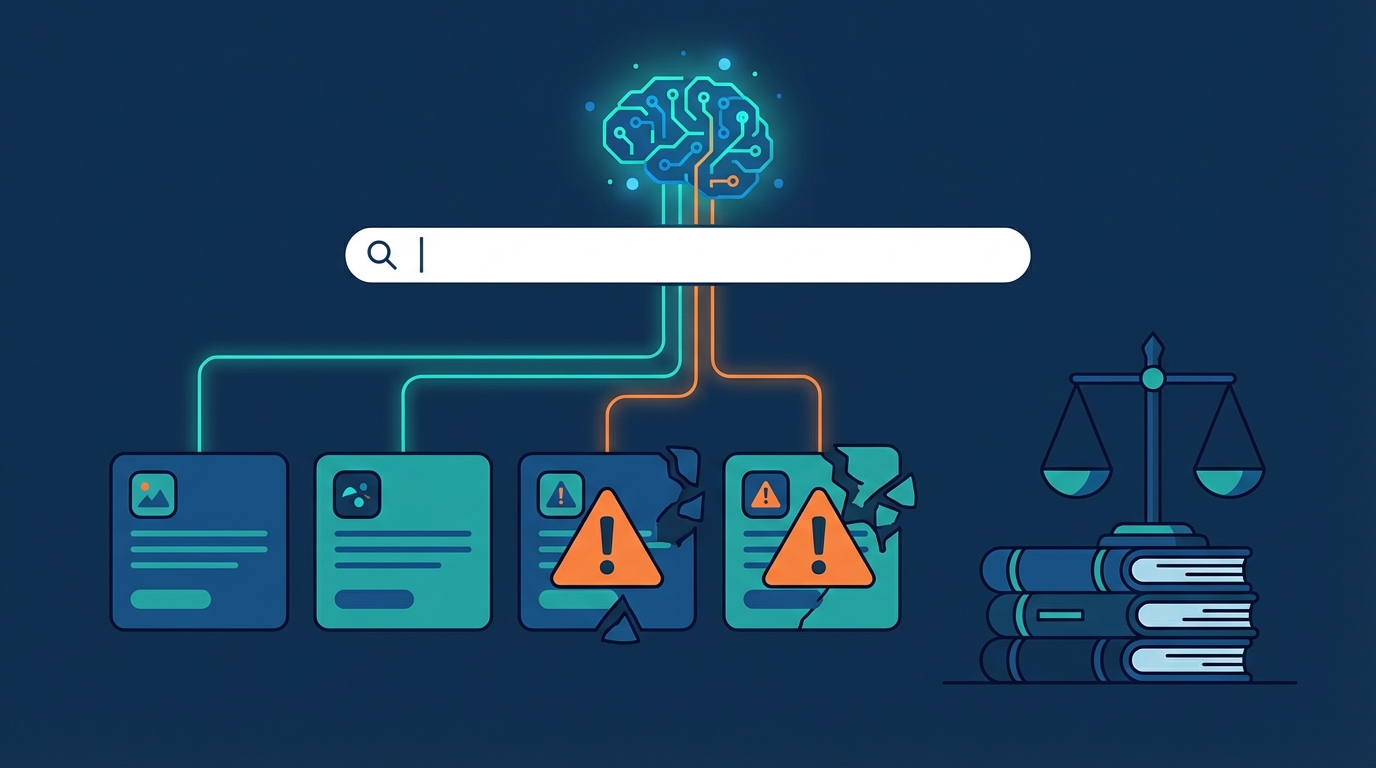
Image source: AI impact on search and law firm SEO.
AI in SEO and Search: misinformation risks, CTR impact, and platform readiness
AI Overviews and similar generative features can reshape legal search results quickly. Because these overviews often sit above organic listings, they change which pages users click. As a result, law firm pages face both lost traffic and amplified reputational risk.
How AI Overviews distort legal queries
AI Overviews can compress search journeys into a single summary. Consequently, users may never see organic listings below the panel. In Germany, SISTRIX found that roughly 20 percent of keywords trigger AI Overviews. Furthermore, about 79 percent of those overviews appear above organic results, increasing their shielding effect. For details, see the SISTRIX analysis.
Key observable effects include:
- Sharp drops in top organic click-through rates because AI Overviews satisfy queries.
- A higher likelihood of branded queries being answered directly by the overview, which can shift clicks away from law firm sites.
- Greater exposure to errors, since the overview aggregates multiple sources quickly.
Quantifying CTR impact and financial loss
SISTRIX reports show a dramatic change when AI Overviews appear. Specifically, the CTR at position one falls from about 27 percent to 11 percent. Therefore, the organic leader loses a majority of expected clicks. Because these shifts occur across many queries, SISTRIX estimates a monthly loss of around 265 million organic clicks in the German market. A news summary of that study is here: PPC Land article.
Other studies echo these declines. For instance, Search Engine Journal reviewed CTR changes after rollout and noted sizable reductions for top organic positions. See their analysis here: Search Engine Journal analysis.
Why misinformation spreads faster in AI-driven overviews
AI systems synthesize content from many sources. As a result, they can repeat inaccuracies as fact. In one experiment, fabricated information appeared inside an AI Overview and ranked on page one. Google’s own AI Overview even picked up the fabricated claim and presented it as fact. Therefore, misinformation can gain credibility quickly because it appears at the top of search.
Contributing factors include:
- Rapid aggregation across low and high quality sources.
- Lack of reliable, consistent fact checking at scale.
- The prominence of the overview panel above organic links.
Practical risks for law firms
- Traffic loss: reduced CTR for high-value queries reduces leads.
- Reputational risk: false statements in overviews can misrepresent cases or services.
- Competitive distortion: branded queries might route users to AI summaries instead of firm pages.
Because the problem varies by market, firms must measure impact directly. Start with query-level CTR monitoring, and then layer in branded query checks and intent analysis. Additionally, monitor sudden shifts that could indicate misinformation pulling visibility away from accurate sources.
Taken together, these data points show why law firms need to treat AI Overviews as a core SEO risk. Therefore they must update monitoring, verification, and content strategies to protect traffic and trust.
AI in SEO and Search: misinformation risks, CTR impact, and platform readiness — CTR by sector
Below is a comparative table showing AI Overviews prevalence and CTR impact across sectors. Use it to compare how legal keywords perform versus other categories. The table integrates CTR impact, AI Overviews prevalence in Germany and the United States, and category-level variation.
| Sector | AI Overviews Prevalence (Germany) | AI Overviews Prevalence (US) | Top Organic CTR without Overview | Top Organic CTR with Overview | Typical CTR Change | Category Variation and Notes |
|---|---|---|---|---|---|---|
| Parenting | Often at or above market average; higher prevalence for information queries | Often above average for informational queries | ~27% (typical top organic CTR benchmark) | Often drops substantially; far below 27% when overview present | Very high relative drop; category among hardest hit | SISTRIX notes parenting among heavily affected categories. Expect fewer organic clicks and more summary answers |
| Legal and law firm queries | Generally near market average; varies by intent and query specificity | Near market average; prevalence rises for broad informational queries | ~27% for strong organic result | Often approaches the lower end (~11%) when AI Overview appears | Drop of about 16 percentage points (27% to 11%), ~59% relative loss when overview present | Reputational risk matters. Even moderate CTR loss reduces leads. Monitor branded and high-intent defense/offense queries closely |
| Health and medical | Variable; informational health queries trigger overviews often | Variable; similar prevalence to Germany for health topics | ~27% benchmark for head keywords | Drops can be significant, but some branded health queries gain visibility | Medium to high CTR impact; depends on query and sources | AI health features and huge viewership increase signal strong overview coverage. Verify sources and authoritative content |
| E commerce and product queries | Often lower prevalence for transactional queries; knowledge base Q A can increase overview generation | Mixed; apps like Shopify Knowledge Base feed Q A content to models | Higher organic CTR on product pages for transactional intent | Overview may reduce exploratory clicks but not always transactional clicks | Medium impact overall; greater effect on informational product queries | Use structured data and product schema to protect transactional visibility |
| Branded queries | Prevalence varies; some branded queries trigger overviews | Prevalence similar to overall but context dependent | Branded results often enjoy higher CTR | Can increase CTR for brand in some cases | Branded queries with AI Overviews see an 18% increase in CTR | When an AI Overview cites the brand, click share can shift to brand assets. Still monitor for inaccuracies |
| Market average / Overall | ≈20% of keywords in German results trigger AI Overviews (SISTRIX) | ≈21% prevalence in US sample (SE Ranking) | ~27% baseline for top organic result | ~11% observed when overview present (SISTRIX) | Absolute drop roughly 16 percentage points; large aggregate loss | SISTRIX estimates ~265 million lost organic clicks per month in Germany when overviews are present at scale |
Related keywords included: AI Overviews, CTR impact, AI in SEO and Search: misinformation risks, CTR impact, and platform readiness, AI Mode, structured data, branded queries.
Platform readiness: AI in SEO and Search: misinformation risks, CTR impact, and platform readiness
Law firms must treat platform readiness as a strategic priority. As Google and others add AI modes, the search landscape changes fast. Therefore teams need platforms, processes, and content that resist misinformation and recover lost CTR.
Adopt AI-ready platforms and architecture
- Evaluate your CMS and hosting for fast indexing and recrawl support. For example, migrations to HTTPS require careful recrawling to avoid ranking losses. Because Google must reprocess each URL, allow sufficient time after any move.
- Choose a CMS that supports structured data out of the box and allows programmatic schema updates. Consequently, your pages can surface as reliable sources for AI agents.
- Build a centralized knowledge base that stores verified answers to common legal questions. While Shopify’s Knowledge Base App targets merchants, firms can mirror the approach by keeping canonical Q A content in a single, crawlable location. See the Shopify discussion here.
Strengthen signals with structured data and schema markup
- Add schema types such as LegalService, FAQPage, and CaseStudy to clarify intent to AI systems. Structured data increases the chance that authoritative content feeds AI summaries correctly.
- Use claimReview and sameAs where applicable to link primary sources and citations. As a result, AI models have clearer provenance for factual claims.
- Implement consistent metadata and JSON-LD across templates so AI crawlers find canonical facts quickly.
Prepare for monetization shifts and AI ad formats
- Monitor Google’s AI Mode developments and Direct Offers, which change user attention and ad placement. Read reporting on Direct Offers to anticipate commercial shifts: here.
- Track OpenAI’s ChatGPT ad tests and requirements. Because ChatGPT began testing ads with high minimums, platforms and budgets could shift for firms exploring conversational advertising. See this report: here.
- Map paid and organic touchpoints to avoid double-spend and to protect high-intent landing pages.
Maintain rigorous human verification and editorial controls
- Prioritize human-written, expert content. As Shelley Walsh and other editors note, human-authored resources remain a key trust signal in the AI era. For context, review strategies for smarter, human-led content: here.
- Create a verification workflow. First draft content with researchers, then fact-check with a legal reviewer, and finally publish with a timestamp and citation list.
- Use versioning and public corrections so AI crawlers can detect updates quickly.
Operational tactics and monitoring
- Set query-level CTR alerts, especially for branded and high-intent queries. When CTR drops suddenly, investigate for an erroneous AI Overview.
- Run periodic experiments to see how content appears in AI Overviews and assistant responses.
- Maintain a crisis response plan that includes outreach to platforms and rapid corrective content.
Taken together, these actions help law firms stay resilient. They improve platform readiness and reduce the chance that AI-driven misinformation erodes client trust and organic leads.
AI in SEO and Search: Misinformation Risks, CTR Impact, and Platform Readiness Demand Immediate Action from Law Firms
Data show AI Overviews appear on a meaningful share of queries. In Germany, SISTRIX reports about 20 percent prevalence. When overviews appear, top organic CTR falls from 27% to 11%. Therefore firms face substantial traffic loss. SISTRIX also estimates about 265 million lost organic clicks per month in Germany. Because misinformation can surface in overviews, reputational harm may follow.
To respond, firms must prioritize platform readiness and rigorous content governance. First, adopt structured data, FAQ and LegalService schema. Second, enforce human verification and expert review. Shelley Walsh highlights the ongoing value of human-written content. Third, monitor query-level CTR and set alerts for sudden drops. In addition, map paid and organic touchpoints to adapt to monetization shifts like Google’s AI Mode and ChatGPT ads.
Small and mid-sized law firms can compete with the right methods. Case studies show that targeted monitoring, canonical Q&A pages, and fast corrections restore visibility. Consequently, firms that act quickly preserve leads and trust.
Case Quota is a specialized legal marketing agency that brings ‘Big Law’ level strategies to smaller firms. They help implement AI ready platforms, structured data, and verification workflows. To begin adapting and to pursue market dominance, contact Case Quota.
Act now. Test appearances in AI Overviews. Update governance. Protect your organic pipeline.
Frequently Asked Questions (FAQs): AI in SEO and Search: misinformation risks, CTR impact, and platform readiness
How do AI Overviews affect law firm SEO and click-through rates?
AI Overviews often appear above organic listings. As a result, they reduce clicks to top organic pages. For example, when an overview appears, position one CTR can fall from 27% to 11%. Therefore, law firms may see fewer leads from organic search. Monitor query level CTR and prioritize high-intent pages.
What immediate steps reduce misinformation risks in AI Overviews?
First, publish human-reviewed, expert content. Second, add clear citations and timestamps for key claims. Third, centralize canonical Q A pages so crawlers find the correct source. Finally, correct errors publicly and quickly so AI agents index the update.
How should firms measure the CTR impact and detect problems?
Track impressions, clicks, and CTR by query daily. Also set alerts for sudden CTR drops on branded or high-intent queries. Run periodic checks to see if content appears inside AI Overviews. Use these signals to prioritize fixes and content updates.
What platform readiness steps help protect SEO performance?
Use a CMS that supports JSON-LD and programmatic schema. Next, implement LegalService, FAQPage, and claimReview schema. In addition, ensure fast indexing, canonical URLs, and clear metadata. Finally, keep a verified knowledge base for repeated legal questions.
Will AI-driven monetization like ChatGPT ads or Google’s AI Mode change strategy?
Yes. Monetization shifts change user attention and click paths. Therefore map paid and organic touchpoints to avoid overlap. Also test conversational ad placements and protect high-value landing pages with clear intent signals.
If you need help implementing these steps, consider expert legal marketing support. Small and mid-sized firms can use targeted monitoring, schema, and verification to limit risk and maintain leads.